Showing posts with label Highgate Cemetery. Show all posts

Thursday, December 4, 2025

Omar Khayyam

This post is in honor of mathematician Omar Khayyam who died on this date, December 4, in the year 1131AD. As well as having been a mathematician, Khayyam was a poet, astronomer and philosopher. His astronomial work lives on through his development of the Jalali calendar, which forms the basis for the Persian calendar still in use today. In mathematics, he is most remembered for his work on solving cubic equations, involving a geometrical approach including conic sections. But he is probably best known generally for the poetry attributed to him, which was translated into English in the mid-19th century by British poet Edward FitzGerald.

This is a mathematical travel blog, and, sadly, I have not had opportunity to travel to Khayyam's hometown of Neyshabur (Nishapur), Iran where his magnificent mausoleum stands, made of marble and calligraphied with his poems. But I was reminded of him in some of my other travels, including a visit to London's Highgate Cemetery where I saw a tombstone with one of his famous "rubaiyat" (quatrains) on it.
The poem jumped out at me immediately, as it was one of my grandmother's favorites - and subsequently one of my favorites. You can also see the attribution to Omar Khayyam below the lines and to the right. I find it to be a good reminder of how to live.

“The Moving Finger writes; and, having writ,
Moves on: nor all thy Piety nor Wit
Shall lure it back to cancel half a Line,
Nor all thy Tears wash out a Word of it.”

I cannot tell whose tombstone this is, as the letters identifying the person and their dates have become dislodged from the stone, as have the last three words of the first line of the poem.

Another of my favorites among his writing is the following, for which I created a photographic illustration many years ago using my chess pieces and a wooden chessboard and jewelry box my grandfather made for me:

“Tis all a Chequer-board of nights and days
Where Destiny with men for Pieces plays:
Hither and thither moves, and mates, and slays,
And one by one back in the closet lays.”

I have a special place in my heart for mathematicians who are also poets. And, as the great 19th-century mathematician Karl Weierstrass once said, “A mathematician who is not also something of a poet will never be a complete mathematician.” This is echoed by his student, Sophia Kovalevskaya, who said, “It is impossible to be a mathematician without being a poet in soul.”
The amazing 'lines' of Khayyam's life have all been written; he has left the 'chequer-board.' I can only hope that the finger writing my life and that my checkerboard of nights and days can leave behind even the tiniest fraction of what the great Omar Khayyam accomplished - and if not that, then my hope would be that when I come to my final square on the board I don't feel a need to weep in an attempt to wash out any of the lines I'll leave behind.

Thursday, May 5, 2016

Sonya Kovalevsky

Philosophenweg ("Philosopher's Way")
A significant part of my sabbatical is to walk - quite literally - where the famous mathematicians of the past walked, and I am certain that Sonya Kovalevsky (1850-1891) walked in the woods above.  This is on a path just off of Philosopher's Way.  It's an area in Heidelberg, just across the river from what's now called "Old Town," that began to be cultivated with vineyards in Roman times.  In the early 19th century  poets would walk through the vineyards, and between 1837 and 1841 the paths that are here today began to be laid out.  Sonya came to the university here in 1869.
Above is the Alte Brucke, or old bridge, which was built in 1788.  She would have been familiar with it and with its gate, a very recognizable landmark in Heidelberg that has been there since the middle ages.
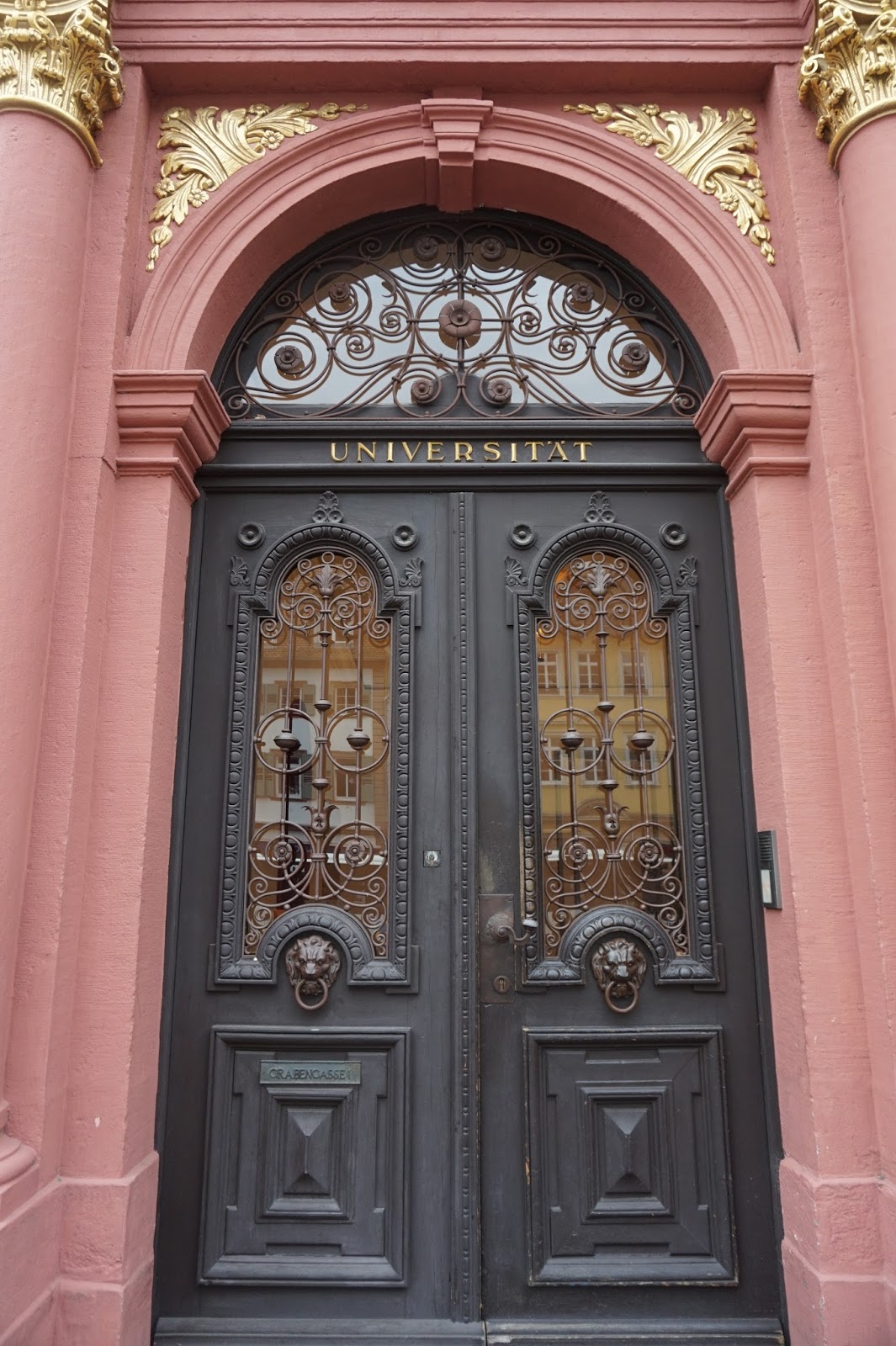
Above is the oldest building in the university - built in 1712.  The university itself was founded in 1386, but Heidelberg has been hit hard by war over the centuries, particularly the Thirty Years' War, so not many of the current buildings date much before that even though "modern Heidelberg" dates back to the fifth century AD.
As was the case for Mary Somerville and Sophie Germain, both of whom I've already posted about, it was nearly impossible for Sonya to become a mathematician because she was a woman.  She was born in Russia where it was certainly impossible for her to study mathematics.  Heidelberg University in Germany also would not allow a woman to take classes, but it would allow a woman to audit classes if the professor gave his permission.

Over her parents' objections Sonya (also known as Sofia Kovalevskaya) entered a marriage of convenience - nominal and platonic (initially) - for the sole purpose of gaining the ability to travel, something single women could not do.  Her husband Vladimir was a student of paleontology and was quite amenable to the plans.  At least three Heidelberg professors were open to having her audit their courses: Hermann von Helmholtz, Gustav Kirchhof, and Robert Bunsen.
The motto of Heidelberg University is "Semper Apertus," or "Always Open" - meaning that the book of learning is always open and that our minds should be always open - open through curiosity, open to new ideas both inside and outside the classroom.  This must have suited Sonya well.  In saying that I'm thinking of a story from her childhood.  it was her uncle Petr that first shared mathematical concepts beyond elementary arithmetic and geometry with her.  Though Uncle Petr was not a trained mathematician, he had a great deal of respect for that branch of learning, and he shared enthusiastically with her.  Of this experience she writes:

"It was from him, for example, that I heard for the first time about squaring the circle, about the asymptote, toward which a curve approaches constantly without ever reaching it  .  .  .  .  The meaning of these concepts I naturally could not yet grasp, but they acted on my imagination, instilling in me a reverence for mathematics as an exalted and mysterious science which opens up to its initiates a new world of wonders  .  .  ."
From the Collection of Mathematical Models and Instruments, Gottingen University
Another experience of mathematics in childhood happened when her family moved to Palibino when she was 11 years old.  Her parents were intent on redecorating the house from top to bottom, but they had not ordered quite enough wallpaper, so her bedroom was papered with lithographed notes on differential and integral calculus from her father's days as a student.  Here too she was "apertus."  She writes:

"I remember how I spent whole hours of my childhood in front of that mysterious wall, trying to make out a single sentence and find the order in which the pages ought to have followed one another.  From long daily contemplation of them, the appearance of many of the formulas burned itself into my memory, and the text itself left a deep imprint in my brain, although at the time I was studying it I could not understand it at all."

Her biographer, Ann Koblitz adds:

"[Sofia] desperately wanted to understand what was written on the wall and consquently was disappointed in her first arithmetic lessons, which did not help her to understand [the] symbols  .  .  .  .  [Sofia] soon convinced herself that in order to get to the point where she could read her wall, she would first have to learn boring things like division and multiplication"
From the Collection of Mathematical Models and Instruments, Gottingen University
Sonya did have some instruction in mathematics from a tutor at home in her younger days, more than a young girl would normally have been exposed to. Her attraction to mathematics became so intense that she started to neglect her other studies.  That's when her father decided to put an end to her mathematical education.  But, as with Mary and Sophie before her, she secretly read about mathematics in her bedroom at night.

Eventually her path did take her to university, and though she could audit courses, she could not earn a degree.  After two years in Heidelberg, she moved to Berlin to study under Karl Weierstrass, but in Berlin she was not even allowed to audit courses!  This ended up working to her advantage, though, as Weierstrass took her under his wing and tutored her privately.  By 1874 she had completed three papers, each one of which Weierstrass considered worthy of a doctorate - yet she could not earn such a thing at the University of Berlin, no matter how worthy her work was, simply because she was a woman.
Heidelberg University Library
Amazingly, though she had never take a course or any exams there, it was arranged that she could earn her doctorate through Gottingen University in 1874.  Her degree was granted summa cum laude.  Yet despite this and despite letters of strong recommendation from Weierstrass (a very well-respected mathematician) she could not obtain an academic position.  Eventually her friend Gosta Mittag-Leffler was able to get permission granted for her to lecture in Stockholm (1884); he had to raise personal funds in order to support her, as she was not paid by the university or government.  Five years after she began lecturing he was able to secure a tenured position for her.

Throughout her life Sonya had connections with circles of learned people.  Both she and her sister Anna were gifted with literary talents, and her sister had a short story published in a magazine edited by Dostoevski when she was still a teen.  This began for them a close friendship with an elite group of European intellectuals in Moscow.

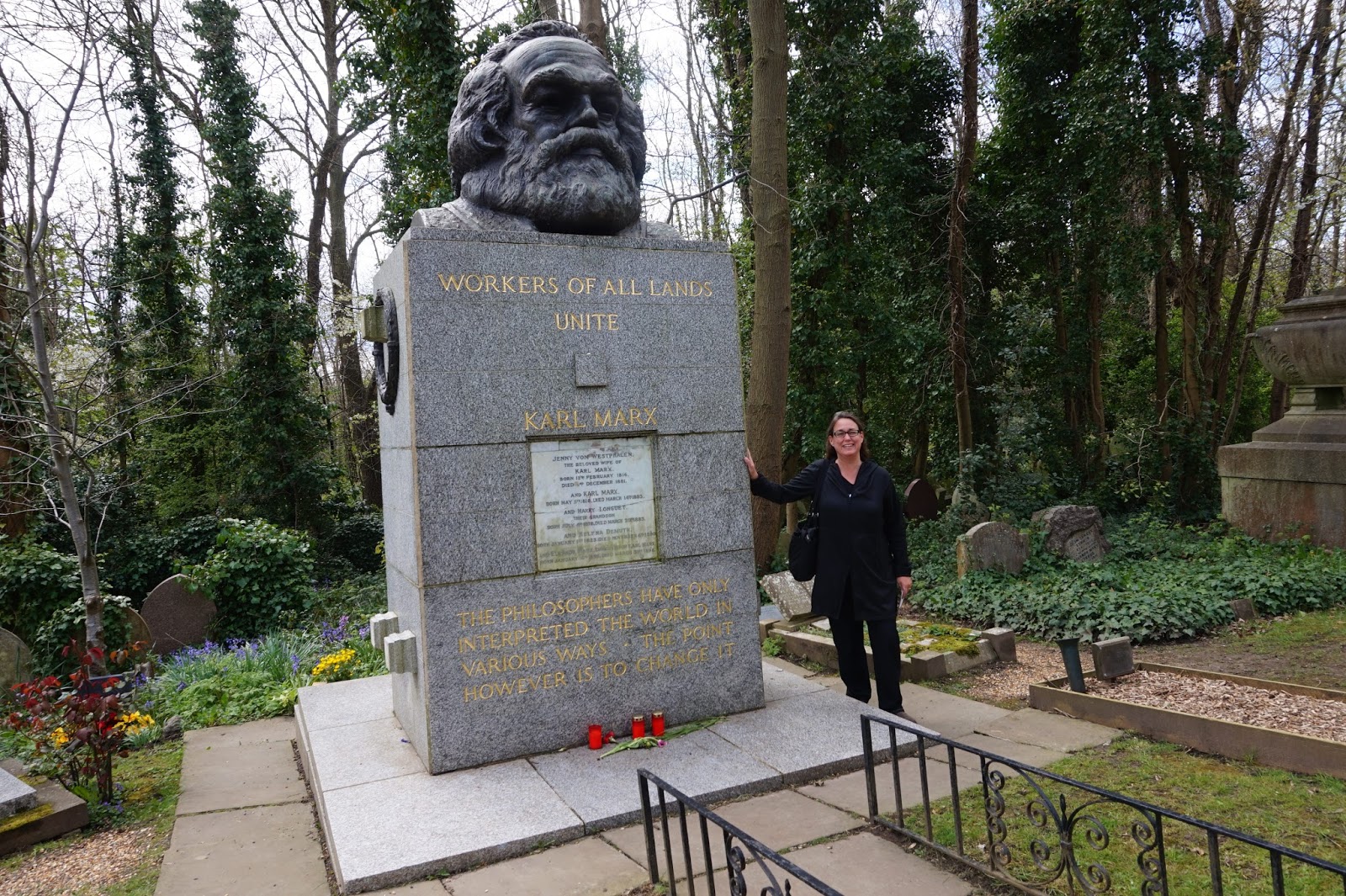
There is so much more I could write about Sonya - more on her family life - details of her mathematical work - her tragic, early death, but at this point I should probably just recommend the biography by Ann Koblitz: A Convergence of Lives: Sofia Kovalevskaia - Scientist, Writer, Revolutionary (Lives of Women in Science).  Below are pictures of the graves of some of her personal connections in London - the writer George Eliot (Mary Ann Evans) and also Karl Marx, both buried in Highgate Cemetery, London.


This picture is included in order to show my students I was really here checking out all of this history!

Saturday, April 23, 2016

Charles Lutwidge Dodgson


This display in the Museum of Natural History in Oxford is about the real Alice - the character in the books having been based on a real person.  Well, this post is about THE REAL LEWIS CARROLL.  His name was actually Charles Lutwidge Dodgson (1832-1898), and mathematics was his "day job."  He earned the Christ Church, Oxford, Mathematical Lectureship in 1855 and held it for the next 26 years.  His Fellowship at Christ Church, Oxford, gave him the privilege of living at Christ Church for the rest of his life provided he did not marry and that he prepared for holy orders, which is simply what was expected of Fellows living at the college at that time.

Museum of Natural History, Oxford
In 1856, Henry Liddell became dean at Christ Church.  Dodgson (Carroll) became very close to the Liddell family, especially Henry's wife Lorina and three of their children - the daughters Lorina, Edith and Alice.  He would sometimes take them to the Museum of Natural History (pictured above and below), and some of the characters in the Wonderland books came from creatures they saw here.  In particular it is likely that Dodgson represented himself as a Dodo because he had a stammer, so his name sometimes came out "Do-do-dodgson."

Museum of Natural History, Oxford
Dodo skeleton and taxidermy at Museum of Natural History, Oxford

Lewis Carroll enjoyed entertaining others.  This began early in life when he entertained his siblings.  He even used puzzles and riddles in his mathematics lectures at Oxford in order to engage his students.  He especially loved entertaining children.  I noticed in reading a biography of him that he used many of the same magic tricks that Mathemagician Arthur Benjamin, professor at Harvey Mudd College, uses today.

His friendship with the Liddell family involved excursions by boat, first with the son, Henry, and later with the daughters.  On July 4, 1862 Carroll invented the outline of the story we now know as Alice in Wonderland while out rowing with a friend and the girls.  Alice pressed him to write it down, and, after a long time, he finally presented her with a manuscript of the story, originally titled Alice's Adventures Under Ground.  

Writer George MacDonald, a pioneer of fantasy writing, was a friend and mentor of Lewis Carroll (and also influenced C. S. Lewis, J. R. R. Tolkien, Madaleine L'Engle and others).  It was after the family of George MacDonald had read the manuscript and after the MacDonald children had received it especially enthusiastically that Carroll took the manuscript to a publisher.  The rest, as they say, is history!

From the Alice display in the Museum of Natural History, Oxford
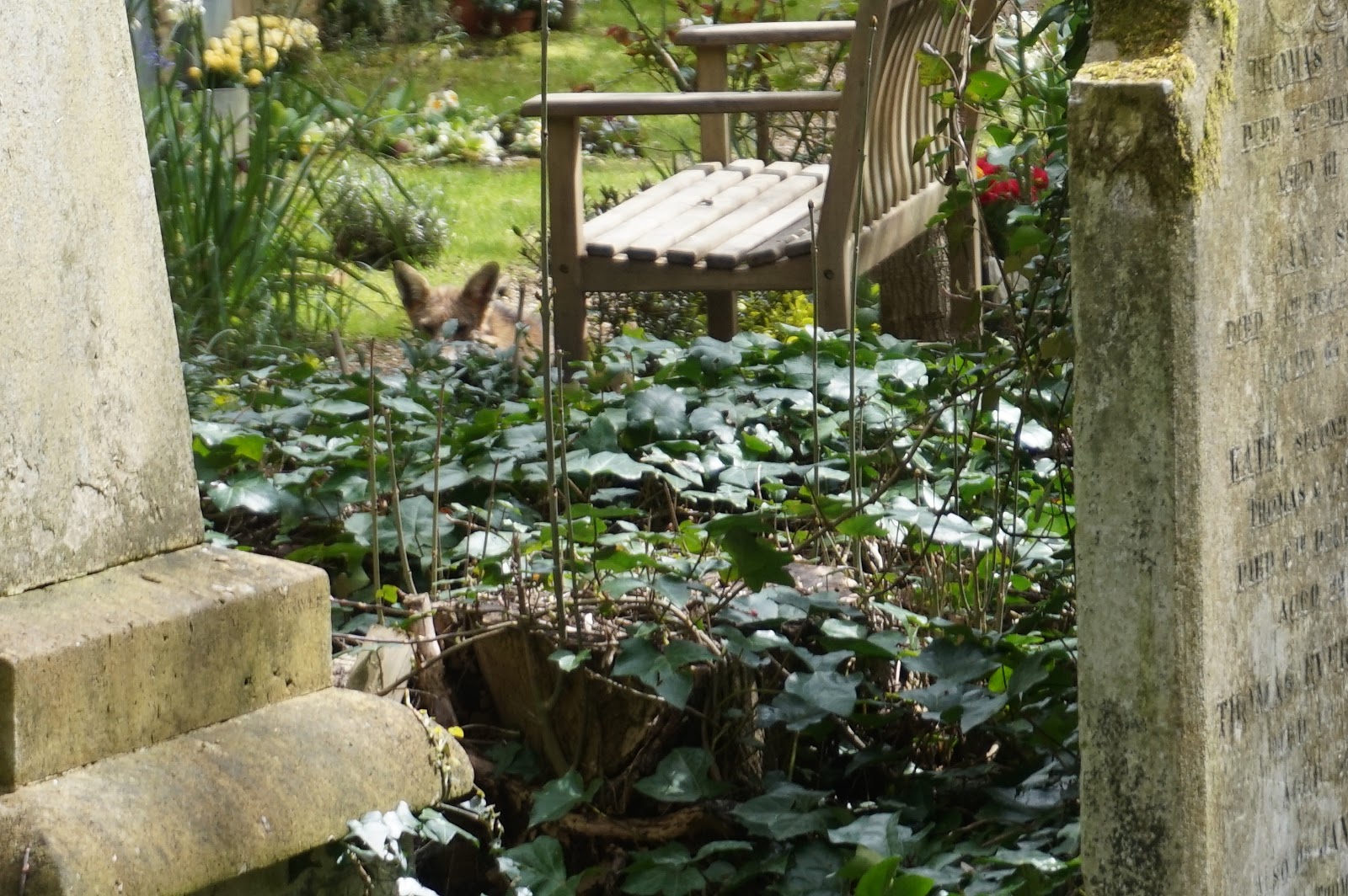
Another influence on Carroll was the pre-Raphaelite circle, including the Rossetti family - Dante Gabriel and Christina.  Below is an imagine of the Rossetti family plot in Highgate Cemetery, London.  Christina is buried here, and her name is on the flat stone on the ground.  The picture below is of a fox in the cemetery, which is a haven for wildlife.

Rossetti Family Plot - Highgate Cemetery, London
Fox in Highgate Cemetery, London (west)
Had Carroll not been remembered for his writing, he would have been remembered as the second-greatest photographer of the Victorian Era and the greatest photographer of children.  He was a very gifted artist, but, sadly, his reputation (as a person) has waxed and waned over the last century.  Many photographs he took of children were nude photographs, but he always took such photographs with the permission of the parents.  Also, it was the fashion of the time to take such photographs.  His writing too has gone through the scrutiny of Freudian psychology long after the fact, and people have come up with some pretty "interesting" and not so complimentary interpretations.  I side with Carroll biographer Robin Wilson who writes, "Sadly much nonsense has been written about Dodgson's friendships with children  .  .  .  .  Subjecting him to modern 'analysis' rather than judging him in the context of his time is bad history and bad psychology and says more about the writer than it does about Carroll."  

To that I say, "Amen!"

Here are some pictures of Christ Church College, Oxford.

Christ Church Cathedral as seen from the cloisters

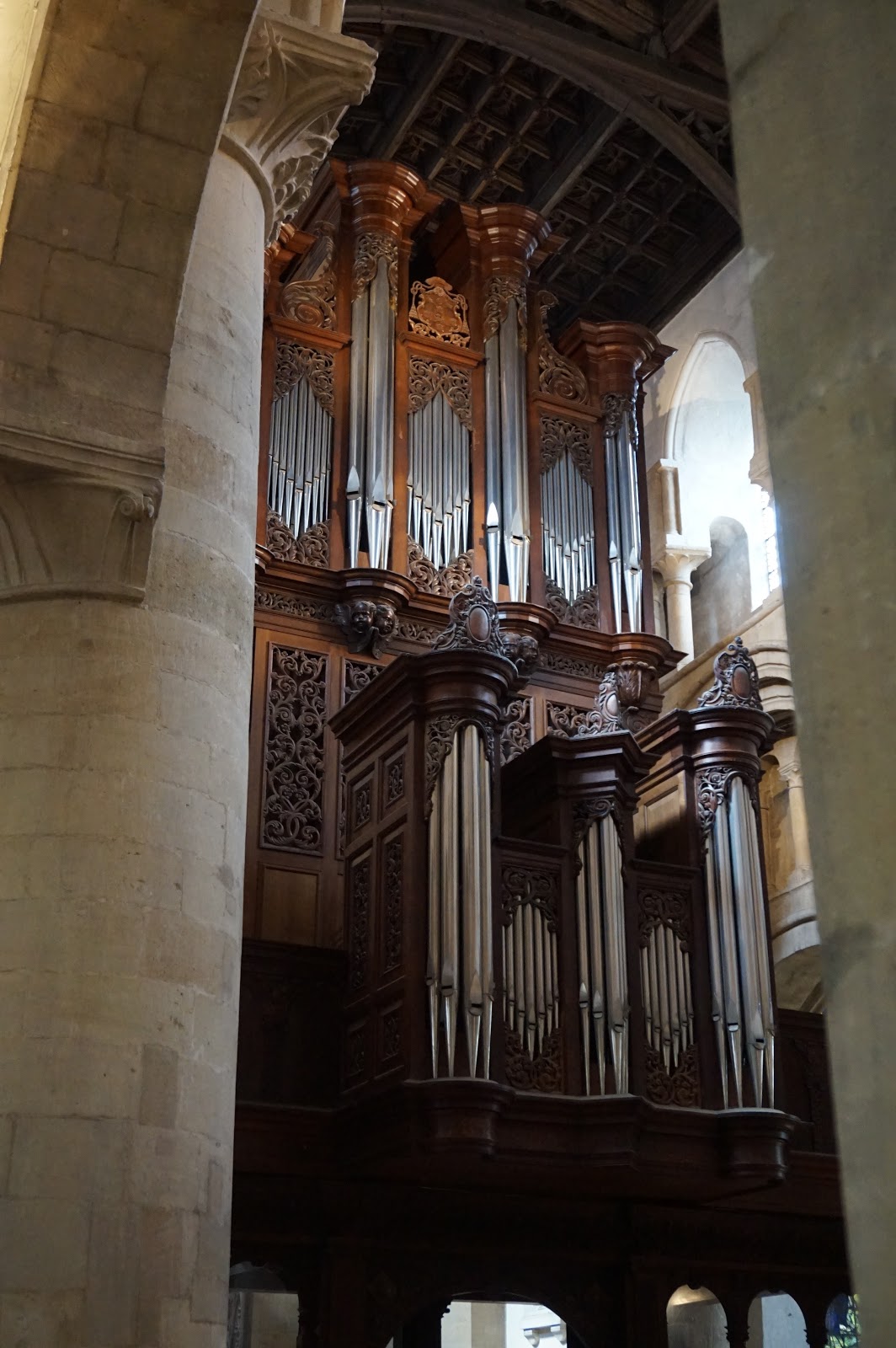
Organ of Christ Church Cathedral

Court of Christ Church College, Oxford

Entrance to Christ Church, Oxford as seen from the road

A view of the entrance of Christ Church College from the court
In terms of mathematics, he worked particularly in geometry, logic, linear algebra and recreational mathematics.  Dodgson discovered a method for finding determinant of matrices that significantly shortened the process, especially for matrices of order 4 or larger; it is called his method of condensation.  He did excellent mathematical work with ideas relating to electoral reform.  In general, however, he was a very conservative mathematician who did not really break new ground, so none of his books have proven to be of enduring importance.

I am going to touch on two of his books, however.  I have enjoyed looking into The Game of Logic, which seems to me to include a method that would be an improvement on Venn Diagrams in working with syllogisms.  Another book that has endured has done so for historical purposes, and that is his work Euclid and His Modern Rivals.  Then, as now, there were arguments about how mathematics (and other subjects) should be taught.  For centuries Euclid's Elements was taught as if it were the Bible - with students actually memorizing its books and propositions by number as if they were chapters and verses in the Bible.  Others in his day wanted to use different geometry texts in which exploration and discovery were emphasized more than memorization, which sounds quite familiar to me in what is going on today with our pendulum swing between "back-to-basics" movements and "discovery-based" learning, as we are seeing right now with the Common Core fights raging around us.  Clearly this is nothing new.

I recommend Robin Wilson's 2009 biography Lewis Carroll in Numberland: His Fantastical, Mathematical, Logical Life.  I especially enjoyed excerpts from Carroll's (or should I say "Dodgson's") diary in which he expresses his thoughts about his teaching - his feelings when things went well and his self-doubt when things went poorly.  I found it impacting, eye-opening and touching to read about Lewis Carroll in Lewis Carroll's own words.