Showing posts with label Napier. Show all posts

Tuesday, July 21, 2026

Treasure Hunt Contract


Fast Castle, Berwickshire, Scotland
So intrigued am I by the story of John Napier's treasure hunt that I've visited the site, the ruins of Scotland's Fast Castle, three times. I have been there twice by land and once by sea

Fast Castle, Berwickshire, Scotland
In July of 1594, mathematician John Napier entered into a contract with Sir Robert Logan to search for treasure at Logan's fortress of Fast Castle. There were longstanding rumors of treasure there, what it was (or is), we do not know. Perhaps they didn't either. Some possibilities are Templar treasure, a king's ransom*, plunder of wreckers**, and smugglers' hoards.
Fast Castle, Berwickshire, Scotland

Fast Castle, Berwickshire, Scotland
The castle is very nearly a complete ruin now, with only one significant portion of wall left standing, although if you look closely, and especially so on the north side, you can see more elements of the structure. As you approach the site, a long walk over farmland and hills, you initially see a promontory that looks to small to have held a castle. But as you move onto the promontory and continue walking, you see that it stretches on, tier after tier, and it becomes clear what a well-protected fortress this would have been.
Fast Castle, Berwickshire, Scotland
But my reason for writing today isn't to share about the site, it is to share about the contract itself. I spend a lot of time in archives, and this document, written in John Napier's own hand, is a manuscript I've wanted to access. Over the course of my studies and travels, John Napier has become the mathematician I am most interested in, and I seek to find every artifact related to him that I can.

I know from my readings that the contract was still in existence, despite the fact that its conditions specified that it was to have been destroyed. For years I've researched the whereabouts of this, reportedly, still-existing document. In one search, I read that it had been sold to a Napier collector and had later ended up in the collection of Trinity College, Cambridge, but this proved to be false. I imagined that it might be held in the National Library of Scotland or in the National Records of Scotland, but it is in neither of those collections. Searching for this manuscript has become a treasure hunt of its own for me.

So . . . I'd read in Napier biographies that the Napier-Logan Treasure Contract had not been destroyed, despite the terms of the contract, but I wasn't sure how that claim was being made. 

One biography ('memoir') was written by his descendant Mark Napier in the 1830s, and correspondence between Mark and the 9th Lord Napier about this project is held in the special collections of the National Library of Scotland. While reading that, I found a list that Mark had made of the items he was using from the family charter chest. Item 8.1 was "Contract betwixt Napier, the inventor of Logs and Logan of Restalrig." AHA! Now I had proof that the contract was still extant in 1832.
1830s Napier Correspondence, National Library of Scotland (shelf mark: MS 1663)
1830s Napier Correspondence, National Library of Scotland (shelf mark: MS. 1663, folio 22v)
I was so surprised and exited by reading this completely unexpected line that I just about fell out of my chair in the reading room. It was all I could do to remain quiet and not leap up and shout for joy!
Special Collections Reading Room, National Library of Scotland
I still didn't know where the actual manuscript was, but I did know for sure that it truly did continue to exist well beyond the 1594 date of its writing. Mark Napier accessed it in the family charter chest. But what happened after that? Did it get returned? Was it sold at some point, as one website would have me believe?

While reading another Napier biography, The Life and Works of John Napier by Rice, González-Velasco, and Corrigan, I noticed in their "Further Reading" section a book titled Gold at Wolf's Crag? An Inquiry into treasure at Fast Castle by Fred Douglas. This book, published in 1971, is no longer in print, but I was able to find it through a used bookseller.
Gold at Wolf's Crag? by Fred Douglas
By complete happenstance, I read through the acknowledgements one night, and there I saw, "Edinburgh Public Libraries for 'The Contract of Magic,' 1594." JACKPOT!
Acknowledgements, Gold at Wolf's Crag? by Fred Douglas
My next trip to Scotland saw me visiting Edinburgh's Central Library.
Central Library, Edinburgh

Central Library, Edinburgh
I contacted the library in advance asking if the document was still there and if I could access it. What I learned was that the item they held was a facsimile, a photozincograph, contained in Facsimiles of National Manuscripts of Scotland, Part III, published in 1871, a volume created at the command of Queen Victoria, who had a particular fondness for Scotland and wanted its historical documents preserved and promoted.
National Manuscripts of Scotland, Part III, Edinburgh's Central Library (shelf mark: F X DA 755)

Frontispiece, National Manuscripts of Scotland, Part III, CLE (shelf mark: F X DA 755) 

"Photozincographed by Command of Her Majesty Queen Victoria"

Napier-Logan Contract (LXXV) and Gowrie Conspiracy Document (LXXVI)
Napier-Logan Treasure Contact, Edinburgh Central Library (shelf mark: F X DA 755)

Contract Signatures of Robert Logan of Restalrig and John Napier, Fear of Merchiston
So this is as close as I've gotten to the original manuscript. This contract is written in John Napier's own hand. I write all this to share my excitement of being on "treasure hunts" of my own and also what it sometimes takes to move inch-by-inch toward what one is looking for in these researches. And, I have to say, that reading in Edinburgh's Central Library (and the National Library of Scotland as well) was an absolute joy!

Near the beginning of the volume is a list of "Places of Deposit of the Manuscripts." In it, I see that the treasure hunt contract (item 75) is, or at least was in 1871, in the Charter Room of Lord Napier at Thirlstane Castle. I have no reason to believe it is anywhere but still in the Napier Family Charter Chest. Though I would love to consult the original document, I don't think my want rises to the level of "need," especially given what I've been able to access already, so I'm not planning to contact Lord Napier. But who knows what may come about someday. Stranger things have happened over the course of my travels and researches.
National Manuscripts of Scotland, Part III, Edinburgh Central Library (shelf mark: F X DA 755)
National Manuscripts of Scotland, Part III, Edinburgh Central Library (shelf mark F X DA 755)


NOTES:

*In 1429, Fast Castle was the site of the robbery of 2000 merks, a part of a royal ransom payment on the way to the English king, Henry VI, for the ransom of James I of Scotland.

**The name Fast Castle derived from the earlier name Fause Castle (False Castle), so named because the inhabitants hung lights to make it look like there was a safe harbor there and then plundered the ships that broke up on the rocks below the castle.

Wednesday, July 9, 2025

John Napier Promptuary


John Napier's Promptuary - National Archaeological Museum of Spain (Madrid)
This spring was the first time my mathematical travels took me to Spain. The National Archaeological Museum of Spain, in Madrid, is home to the only known period example of John Napier's Promptuary. I've been focused on John Napier and his calculating devices for quite a few years, but I feared I would never have opportunity to see this one. I'm so glad this visit worked out. 

Drawers in the John Napier Promptuary

The drawers of the chest contain two types of strips for carrying out multiplication through horizontal and vertical placement. The thicker strips (central open drawer above) are covered in digits and form a vertical base when multiplying. The thinner strips (open drawer to the left) are laid horizontally atop the others. These thinner strips contain perforations that reveal digits on the thicker strips below them. I've included a picture of the set up below, but it's blurry due to how far away from me these strips were in the glass case and due to the darkness of the room, but hopefully you can get the idea.

Napier's Promptuary - multiplication using the strips
Results of the multiplication process are read diagonally down from right to left, any necessary carries being made diagonal to diagonal. This device is derived from Napier's earlier calculating device known as "Napier's Bones" or "Napier's Rod." Calculating can be carried out more quickly with this device than with the bones or rods. A couple of drawbacks to this device in comparison to the rods (bones) is that it is more difficult to create, and it cannot be used for operations other than multiplication.
Napier Promptuary - full display - National Archaeological Museum of Spain (Madrid)

Thankfully, this chest includes not only the strips described above but also a set of Napier's Bones (bottom left in the photo above). The bones were a widely used calculating device for hundreds of years and can be used in carrying out multiplication, division, and the taking of square and cube roots.
Napier's Bones - National Archaeological Museum of Spain (Madrid)


Napier's Bones - National Archaeological Museum of Spain (Madrid)

Napier's Bones - National Archaeological Museum of Spain (Madrid)
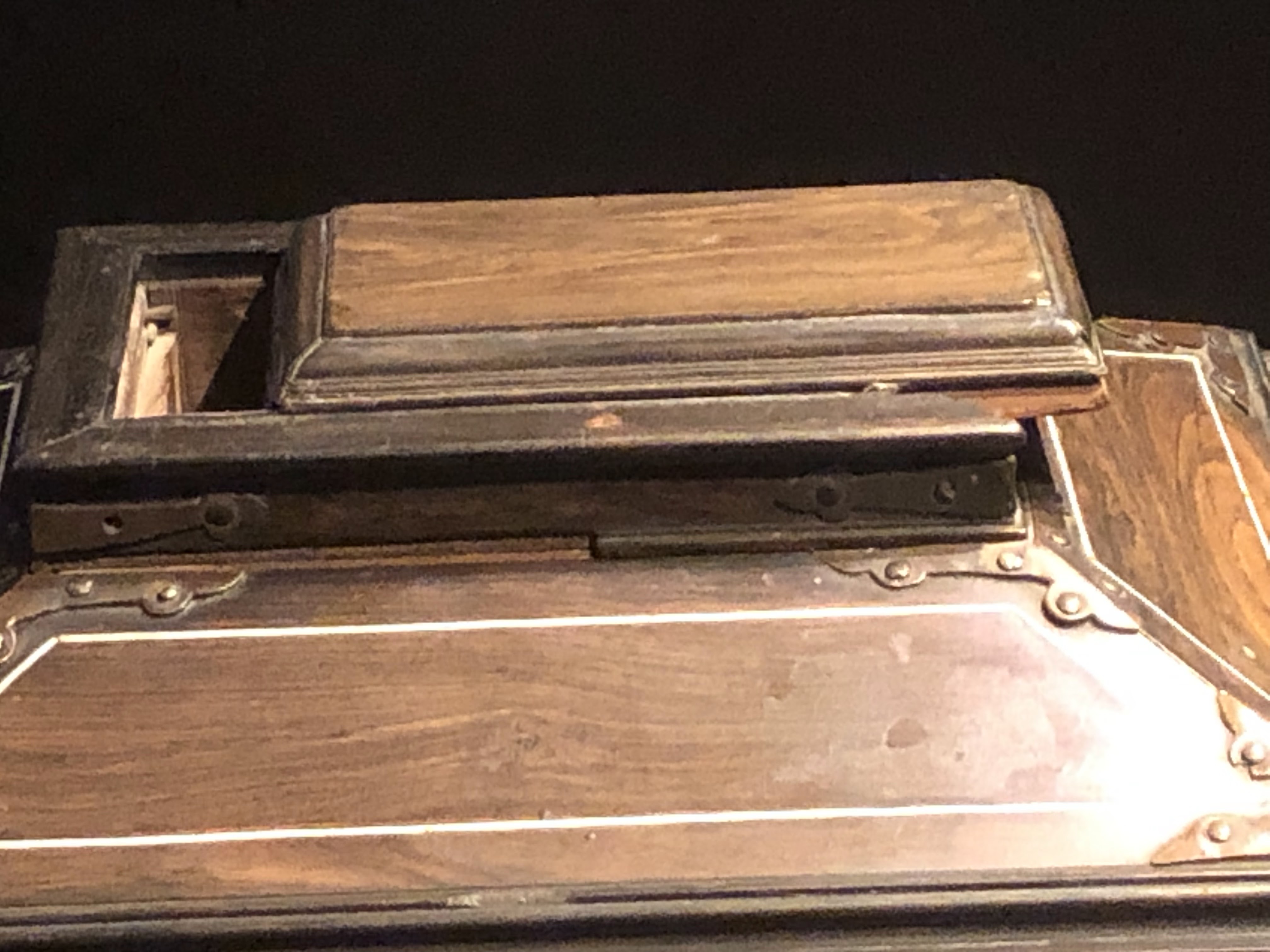
When I think of this Napier display in Madrid's Archaeological Museum, the phrase that comes to mind for me is "mathematician's toybox." There is so much more to this chest than meets the eye at first glance. 
Napier's Promptuary - National Archaeological Museum of Spain (Madrid)
At the very top of the chest is a lid that's been left askew for easier viewing. This is the spot in which to tuck away Napier's Bones when you are done with your calculations.
Napier's Promptuary - National Archaeological Museum of Spain (Madrid)
At the base of the chest is a large drawer on which calculations can be carried out. To the right we see the multiplication strips of the Promptuary. On the left we see a plate listing powers of the digits starting with squares and going up to the seventh power. Below that reference plate is the square root plate for Napier's Bones. (If you flip that plate over, you'll find what you need for cube roots.)
Exponent Reference Plate and Napier's Bones Root Plate

Even the space on the interiors of the chest doors is not wasted. There are reference charts here too. On the left-hand door there is another reference chart for exponentiation of digits. Sadly, the right-hand door (third picture below) is damaged, and it was too hard for me to decipher. I think the chart on this side has to do with numbers relating to geometric figures.
Detail of left-hand door of Napier's Promptuary

Detail of left-hand door of Napier's Promptuary


Detail of right-hand door of Napier's Promptuary
Below are some different views for context.
Napier's Promptuary - National Archaeological Museum of Spain (Madrid)

Napier's Promptuary - National Archaeological Museum of Spain (Madrid)


Door of Napier's Promptuary - National Archaeological Museum of Spain (Madrid)
As I create this post I have the sense of joy again that I did when I visited Madrid's NAM this spring. Napier's Promptuary really does feel like a toy box for a mathematician. And it's so cool how you can pack it all back up - putting the bones in the top slot, pushing in the drawers, closing the doors, and locking it all up with a key. If you're ever in Madrid, I recommend a trip to the National Archaeological Museum to see this device. One hint I have for you, in case you get there but can't find the Promptuary, is to ask where the "abacus" is. Napier's Promptuary is one of the treasures of this museum and very well known, but it is known there as an "abacus." It is currently on the second floor and to the right, but museum displays can tend to move. :-)
National Archaeological Museum of Spain (Madrid)


Sunday, June 19, 2022

Napier's Treasure Hunt Location (Part 2)


My "ride" with my tower home in the background
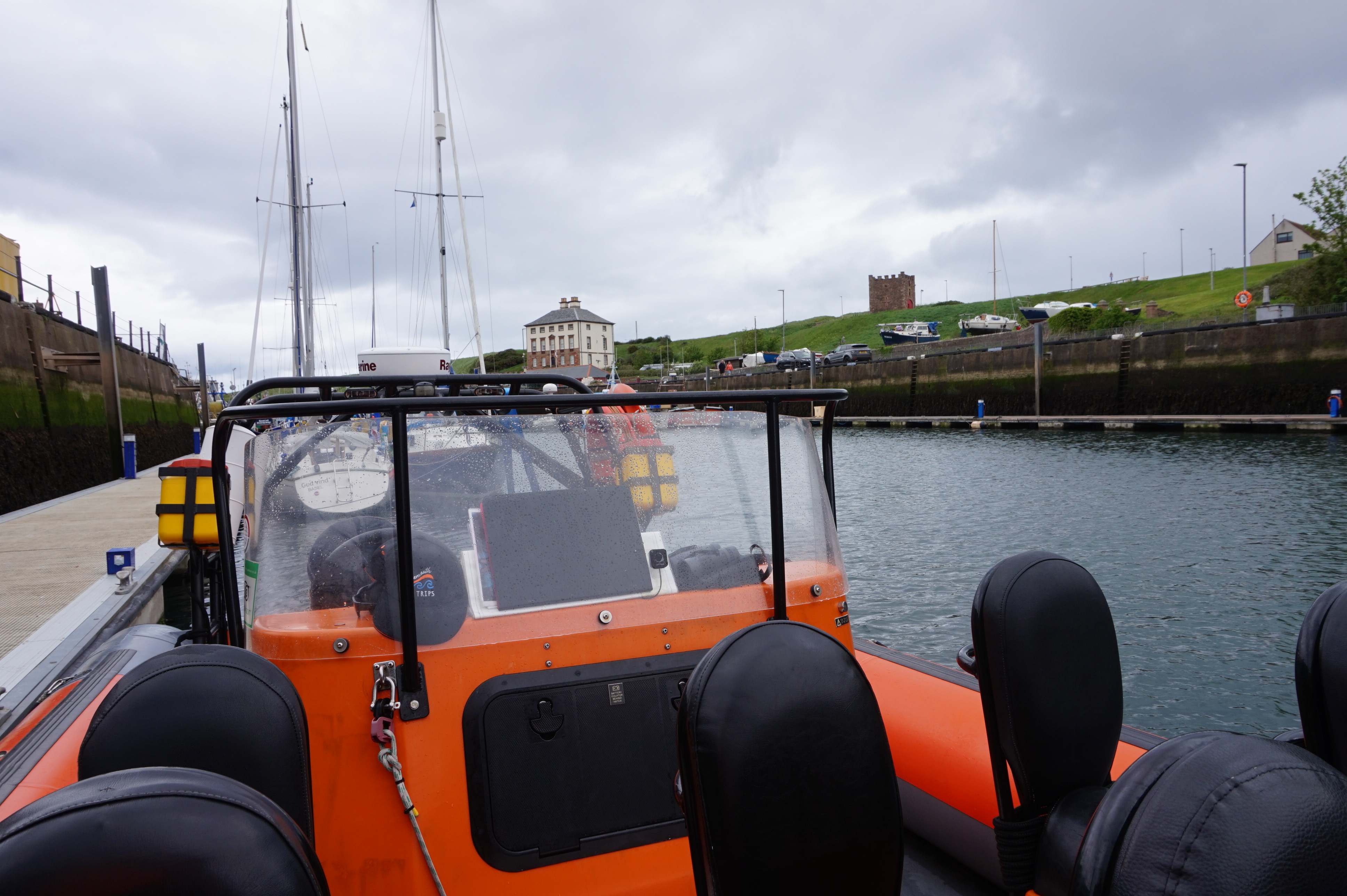
I continue immersing myself in the life of mathematician John Napier.  In relation to this, I had the amazing opportunity to travel to Fast Castle by land last summer, and, as of this spring (May 22) I had the amazing opportunity to travel to Fast Castle by sea.  I spent a month in the UK as I continue to try to piece together what was missed in 2020 when the pandemic brought my second sabbatical to an early end.  During this trip I stayed in Eyemouth specifically to be able to get a boat out to Fast Castle.  The little "castle" (tower) you see on the hill in the picture above is the airbnb where I stayed.  The day after I arrived, I took a RIB tour out of Eyemouth with Skipper Tim.

Heading out of the harbor - the initial pulling away (above) and picking up speed as we pass the Eyemouth headland on our way to Fast Castle.


As shared in multiple previous posts, I'm interested in this area because it was here that John Napier was contracted with Robert Logan to search for treasure at Fast Castle using his so-called sorcerous powers, technically his "craft and engine."  (The wording according to the contract is that "The said Jhone sall do his utter and exact diligens to serche and sik out, and by all craft and ingyne  .  .  .")  There have been many legends of treasure at Fast Castle that have existed for many centuries, right up to the present day.  This area was full of smuggling activity at one time.  The name Fast Castle is a corruption of Faux Castle, meaning False Castle, so called because "wrecking" by the hanging of false lights to lure ships onto the rocks was known to have taken place.  The Templar Knights may have hid treasure here.  There may be Spanish treasure relating to the "Affair of the Spanish Blanks" and a possible second Spanish Armada. The treasure may relate to one of those things, something else entirely, or nothing at all!  According to the contract, which was written up in 1594, there are diverse old reports and appearances that there should be within Robert's dwelling of Fast Castle a sum of money and treasure hidden, which is as yet unfound by any man (".  .  .  ther is dywerss ald reportis motiffis and appirancis, that thair suld be within the said Robertis dwellinge place of Fascastell a soum of monie and Poiss [treasure], heid and hurdit up secritlie, quilk [which] as yit is un fund by ony man.")  Other posts in this blog in which this is written of at greater length are at this link and at this link.  This is a place I had tried to get to for years.  It is quite remote, but, as mentioned above, last year I was finally able to get there by land, and this year I finally was able to get there by sea.  I've really wanted to get the fullest sense possible of this place.  Beyond this point, this post will be mostly pictures and videos with very few words.  I'm using the images for reference for talks I'll give and writing that I'll do.  (The videos contained here are very short - all but one are approximately half a minute each.)
Passing St. Abb's Head on the way to Fast Castle
The abundance of caves along the shoreline is part of what made this a haven for smugglers.  The two large caves to the right of the picture below are directly beneath the ruins of Fast Castle, one wall of which can still be seen standing and is near the far right of this picture.

Coming at Fast Castle from the south
It is thought that one of the caves at the base of the cliff connected to the castle.  If that's the case it likely would have been the large cave to the left in the pictures above and below.
Here is the same cave from above - photo taken on my previous trip to this location - 


Going around the peninsula to look from the north - 


And coming back around to the south (1:16)
Because of my interest in this place, I could have stayed for hours, but, eventually, it was time to head back in.  We did see some interesting sights on the way back as well, and all of it provides good background for my studies.
We took our time at Fast Castle, but heading back we zipped right along!
But we would slow down to check out some things like other caves and crags along the coastline - 


- and like dolphins swimming along with us!
Then zipping back toward Eyemouth - 
And returning home after one of the grandest adventures of these travels!