Showing posts with label John Napier. Show all posts

Tuesday, July 21, 2026

Treasure Hunt Contract


Fast Castle, Berwickshire, Scotland
So intrigued am I by the story of John Napier's treasure hunt that I've visited the site, the ruins of Scotland's Fast Castle, three times. I have been there twice by land and once by sea

Fast Castle, Berwickshire, Scotland
In July of 1594, mathematician John Napier entered into a contract with Sir Robert Logan to search for treasure at Logan's fortress of Fast Castle. There were longstanding rumors of treasure there, what it was (or is), we do not know. Perhaps they didn't either. Some possibilities are Templar treasure, a king's ransom*, plunder of wreckers**, and smugglers' hoards.
Fast Castle, Berwickshire, Scotland

Fast Castle, Berwickshire, Scotland
The castle is very nearly a complete ruin now, with only one significant portion of wall left standing, although if you look closely, and especially so on the north side, you can see more elements of the structure. As you approach the site, a long walk over farmland and hills, you initially see a promontory that looks to small to have held a castle. But as you move onto the promontory and continue walking, you see that it stretches on, tier after tier, and it becomes clear what a well-protected fortress this would have been.
Fast Castle, Berwickshire, Scotland
But my reason for writing today isn't to share about the site, it is to share about the contract itself. I spend a lot of time in archives, and this document, written in John Napier's own hand, is a manuscript I've wanted to access. Over the course of my studies and travels, John Napier has become the mathematician I am most interested in, and I seek to find every artifact related to him that I can.

I know from my readings that the contract was still in existence, despite the fact that its conditions specified that it was to have been destroyed. For years I've researched the whereabouts of this, reportedly, still-existing document. In one search, I read that it had been sold to a Napier collector and had later ended up in the collection of Trinity College, Cambridge, but this proved to be false. I imagined that it might be held in the National Library of Scotland or in the National Records of Scotland, but it is in neither of those collections. Searching for this manuscript has become a treasure hunt of its own for me.

So . . . I'd read in Napier biographies that the Napier-Logan Treasure Contract had not been destroyed, despite the terms of the contract, but I wasn't sure how that claim was being made. 

One biography ('memoir') was written by his descendant Mark Napier in the 1830s, and correspondence between Mark and the 9th Lord Napier about this project is held in the special collections of the National Library of Scotland. While reading that, I found a list that Mark had made of the items he was using from the family charter chest. Item 8.1 was "Contract betwixt Napier, the inventor of Logs and Logan of Restalrig." AHA! Now I had proof that the contract was still extant in 1832.
1830s Napier Correspondence, National Library of Scotland (shelf mark: MS 1663)
1830s Napier Correspondence, National Library of Scotland (shelf mark: MS. 1663, folio 22v)
I was so surprised and exited by reading this completely unexpected line that I just about fell out of my chair in the reading room. It was all I could do to remain quiet and not leap up and shout for joy!
Special Collections Reading Room, National Library of Scotland
I still didn't know where the actual manuscript was, but I did know for sure that it truly did continue to exist well beyond the 1594 date of its writing. Mark Napier accessed it in the family charter chest. But what happened after that? Did it get returned? Was it sold at some point, as one website would have me believe?

While reading another Napier biography, The Life and Works of John Napier by Rice, González-Velasco, and Corrigan, I noticed in their "Further Reading" section a book titled Gold at Wolf's Crag? An Inquiry into treasure at Fast Castle by Fred Douglas. This book, published in 1971, is no longer in print, but I was able to find it through a used bookseller.
Gold at Wolf's Crag? by Fred Douglas
By complete happenstance, I read through the acknowledgements one night, and there I saw, "Edinburgh Public Libraries for 'The Contract of Magic,' 1594." JACKPOT!
Acknowledgements, Gold at Wolf's Crag? by Fred Douglas
My next trip to Scotland saw me visiting Edinburgh's Central Library.
Central Library, Edinburgh

Central Library, Edinburgh
I contacted the library in advance asking if the document was still there and if I could access it. What I learned was that the item they held was a facsimile, a photozincograph, contained in Facsimiles of National Manuscripts of Scotland, Part III, published in 1871, a volume created at the command of Queen Victoria, who had a particular fondness for Scotland and wanted its historical documents preserved and promoted.
National Manuscripts of Scotland, Part III, Edinburgh's Central Library (shelf mark: F X DA 755)

Frontispiece, National Manuscripts of Scotland, Part III, CLE (shelf mark: F X DA 755) 

"Photozincographed by Command of Her Majesty Queen Victoria"

Napier-Logan Contract (LXXV) and Gowrie Conspiracy Document (LXXVI)
Napier-Logan Treasure Contact, Edinburgh Central Library (shelf mark: F X DA 755)

Contract Signatures of Robert Logan of Restalrig and John Napier, Fear of Merchiston
So this is as close as I've gotten to the original manuscript. This contract is written in John Napier's own hand. I write all this to share my excitement of being on "treasure hunts" of my own and also what it sometimes takes to move inch-by-inch toward what one is looking for in these researches. And, I have to say, that reading in Edinburgh's Central Library (and the National Library of Scotland as well) was an absolute joy!

Near the beginning of the volume is a list of "Places of Deposit of the Manuscripts." In it, I see that the treasure hunt contract (item 75) is, or at least was in 1871, in the Charter Room of Lord Napier at Thirlstane Castle. I have no reason to believe it is anywhere but still in the Napier Family Charter Chest. Though I would love to consult the original document, I don't think my want rises to the level of "need," especially given what I've been able to access already, so I'm not planning to contact Lord Napier. But who knows what may come about someday. Stranger things have happened over the course of my travels and researches.
National Manuscripts of Scotland, Part III, Edinburgh Central Library (shelf mark: F X DA 755)
National Manuscripts of Scotland, Part III, Edinburgh Central Library (shelf mark F X DA 755)


NOTES:

*In 1429, Fast Castle was the site of the robbery of 2000 merks, a part of a royal ransom payment on the way to the English king, Henry VI, for the ransom of James I of Scotland.

**The name Fast Castle derived from the earlier name Fause Castle (False Castle), so named because the inhabitants hung lights to make it look like there was a safe harbor there and then plundered the ships that broke up on the rocks below the castle.

Wednesday, July 9, 2025

John Napier Promptuary


John Napier's Promptuary - National Archaeological Museum of Spain (Madrid)
This spring was the first time my mathematical travels took me to Spain. The National Archaeological Museum of Spain, in Madrid, is home to the only known period example of John Napier's Promptuary. I've been focused on John Napier and his calculating devices for quite a few years, but I feared I would never have opportunity to see this one. I'm so glad this visit worked out. 

Drawers in the John Napier Promptuary

The drawers of the chest contain two types of strips for carrying out multiplication through horizontal and vertical placement. The thicker strips (central open drawer above) are covered in digits and form a vertical base when multiplying. The thinner strips (open drawer to the left) are laid horizontally atop the others. These thinner strips contain perforations that reveal digits on the thicker strips below them. I've included a picture of the set up below, but it's blurry due to how far away from me these strips were in the glass case and due to the darkness of the room, but hopefully you can get the idea.

Napier's Promptuary - multiplication using the strips
Results of the multiplication process are read diagonally down from right to left, any necessary carries being made diagonal to diagonal. This device is derived from Napier's earlier calculating device known as "Napier's Bones" or "Napier's Rod." Calculating can be carried out more quickly with this device than with the bones or rods. A couple of drawbacks to this device in comparison to the rods (bones) is that it is more difficult to create, and it cannot be used for operations other than multiplication.
Napier Promptuary - full display - National Archaeological Museum of Spain (Madrid)

Thankfully, this chest includes not only the strips described above but also a set of Napier's Bones (bottom left in the photo above). The bones were a widely used calculating device for hundreds of years and can be used in carrying out multiplication, division, and the taking of square and cube roots.
Napier's Bones - National Archaeological Museum of Spain (Madrid)


Napier's Bones - National Archaeological Museum of Spain (Madrid)

Napier's Bones - National Archaeological Museum of Spain (Madrid)
When I think of this Napier display in Madrid's Archaeological Museum, the phrase that comes to mind for me is "mathematician's toybox." There is so much more to this chest than meets the eye at first glance. 
Napier's Promptuary - National Archaeological Museum of Spain (Madrid)
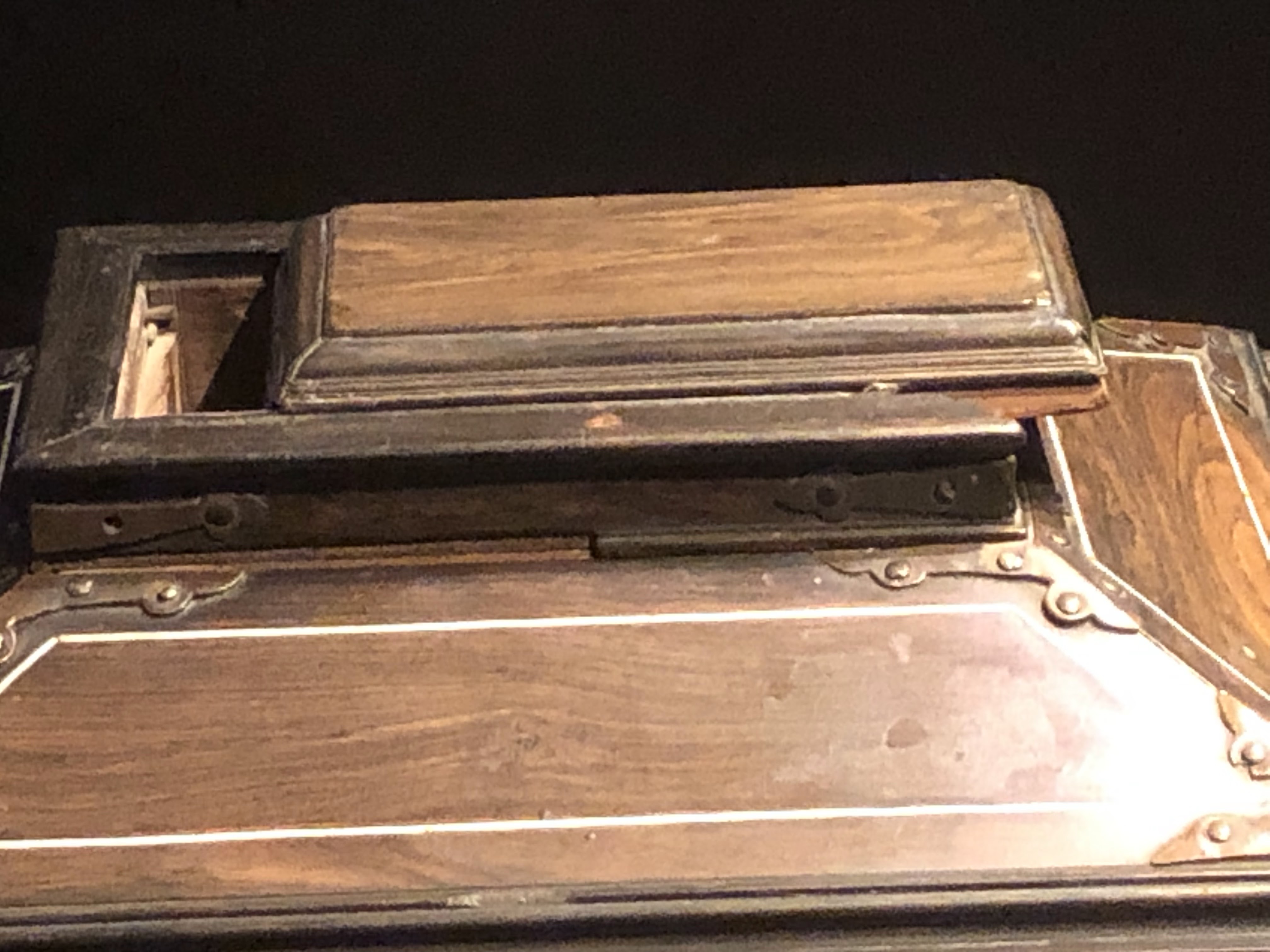
At the very top of the chest is a lid that's been left askew for easier viewing. This is the spot in which to tuck away Napier's Bones when you are done with your calculations.
Napier's Promptuary - National Archaeological Museum of Spain (Madrid)
At the base of the chest is a large drawer on which calculations can be carried out. To the right we see the multiplication strips of the Promptuary. On the left we see a plate listing powers of the digits starting with squares and going up to the seventh power. Below that reference plate is the square root plate for Napier's Bones. (If you flip that plate over, you'll find what you need for cube roots.)
Exponent Reference Plate and Napier's Bones Root Plate

Even the space on the interiors of the chest doors is not wasted. There are reference charts here too. On the left-hand door there is another reference chart for exponentiation of digits. Sadly, the right-hand door (third picture below) is damaged, and it was too hard for me to decipher. I think the chart on this side has to do with numbers relating to geometric figures.
Detail of left-hand door of Napier's Promptuary

Detail of left-hand door of Napier's Promptuary


Detail of right-hand door of Napier's Promptuary
Below are some different views for context.
Napier's Promptuary - National Archaeological Museum of Spain (Madrid)

Napier's Promptuary - National Archaeological Museum of Spain (Madrid)


Door of Napier's Promptuary - National Archaeological Museum of Spain (Madrid)
As I create this post I have the sense of joy again that I did when I visited Madrid's NAM this spring. Napier's Promptuary really does feel like a toy box for a mathematician. And it's so cool how you can pack it all back up - putting the bones in the top slot, pushing in the drawers, closing the doors, and locking it all up with a key. If you're ever in Madrid, I recommend a trip to the National Archaeological Museum to see this device. One hint I have for you, in case you get there but can't find the Promptuary, is to ask where the "abacus" is. Napier's Promptuary is one of the treasures of this museum and very well known, but it is known there as an "abacus." It is currently on the second floor and to the right, but museum displays can tend to move. :-)
National Archaeological Museum of Spain (Madrid)


Monday, July 18, 2022

Napier Finds


Since my first sabbatical in 2016, I have been to Edinburgh an astonishing (to me) five times.  John Napier has become a major focus for me, and as I've traveled back again and again I've been able to extend the range of my search for Napier-related items and places.  Although this was my fifth trip, I found additional things that were new to me in Edinburgh itself.  One of these items is something I'd been aware of before but hadn't been able to find easily.  It is the sculpted head of one of Napier's ancestors that adorns one of the pillars in St. Giles Cathedral.  I'm kind of surprised I hadn't seen it before since I am familiar with the Napier family coat of arms, but I guess the east window, which it is directly next to, usually commands my attention when I am in this end of the cathedral.

Napier Pillar, St. Giles Cathedral

Napier Pillar, St. Giles Cathedral

According to author Lynne Gladstone-Millar in the book John Napier: Logarithm John, this sculpture is of John Napier's ancestor Sir Alexander Napier who had "donated generously to the embellishment of St. Giles' Cathedral in 1460" and had commissioned this.
St. Giles Cathedral from the southwest

This time, rather than just wandering around and looking at all the pillars, I asked a guide if he knew were to find the sculpture.  This ended up being more beneficial than I had expected, as he also told me about a stained glass window that featured a Napier.  This window is in a side chapel in which James Graham, the Marquis of Montrose is buried. The window honors those who supported him.
Tomb of Montrose

The poem on the tomb was written by Montrose himself.

Napier is in the top right-hand corner.  This is either the son or grandson of John Napier.  I need to do a little more digging to find that information.  There is no date or first name here.  The dates for Montrose are 1612-1650, which seems to me would fit best with a grandson in terms of dates and age  .  .  .  whether son or grandson, the name would have been Archibald Napier.  Both did fight with him, and Alexander, the first Lord Napier (John's son) was 70 years old at the time.  Maybe it honors them both.

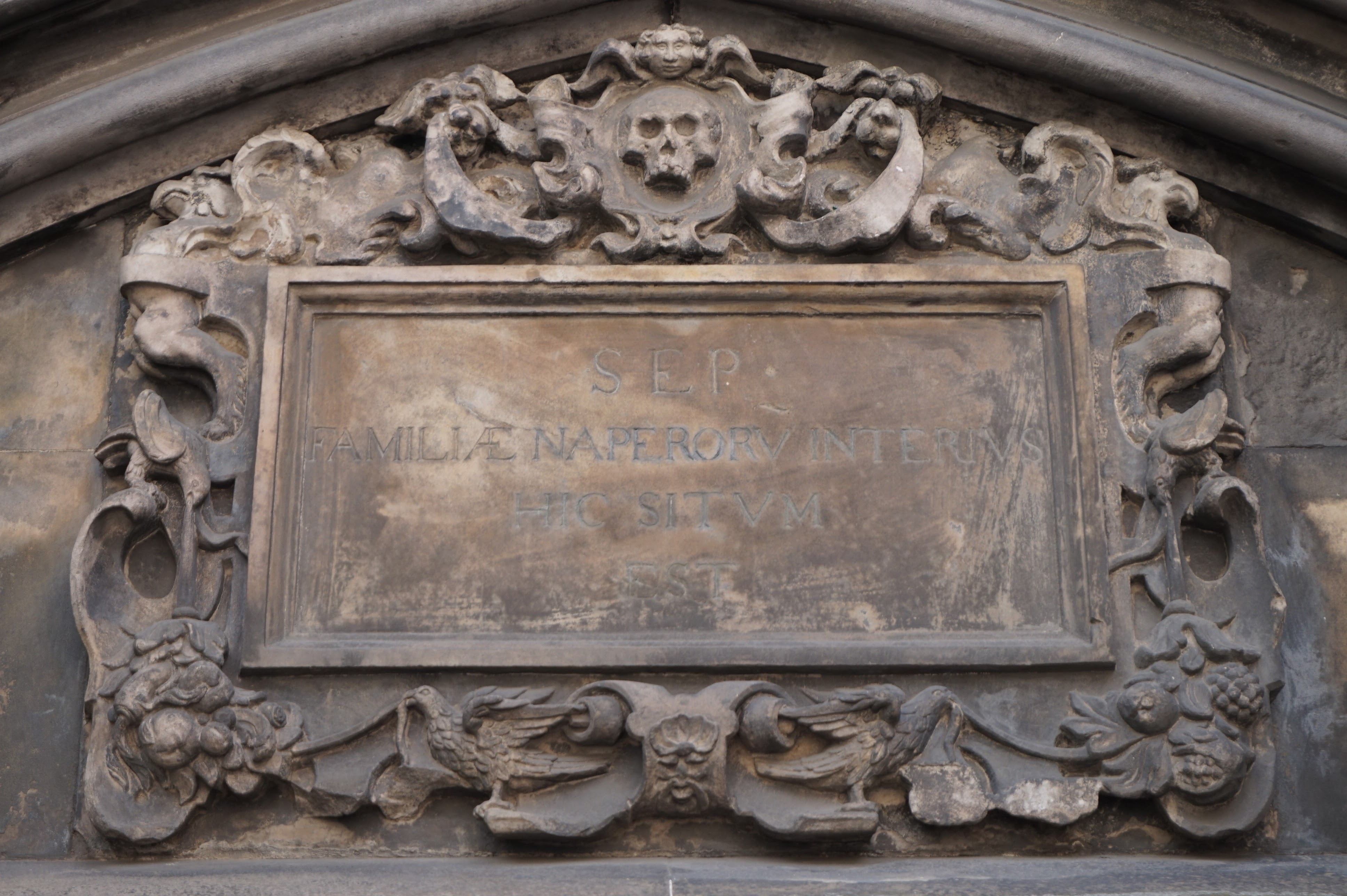
Heading back out, I visited the Napier memorial plaque on the exterior of the cathedral.  I'd seen this before.  I think I've posted it already as well, but I'm not sure in which post, so I'll include it here as well.  This is on the northeast of the cathedral.


SEP
FAMILIAE NAPERORV INTERIVS
HIC SITVM
EST

Because of this inscription, many think that John Napier is buried at St. Giles, but the more reliable information points to him being buried at St. Cuthbert's Parish Church, the church at which he served in the position of elder.  It is the case that St. Giles was historically where family members, his ancestors, would have been interred.

From here I headed out to Merchiston Tower on the campus of Edinburgh Napier University, Merchiston Campus in order to find the remains of a 16th-century gate that I had not noticed on previous visits but have since learned of.  I'm always looking for things that given me a better view of the lives of the mathematicians I'm studying, no matter how small a glimpse it may be.
Merchiston Tower Gate

Merchiston Tower Gate


Merchiston Tower Gate


Merchiston Tower Gate


Merchiston Tower Gate


Merchiston Tower Gate


Merchiston Tower Gate


Merchiston Tower Gate


Merchiston Tower Gate


Merchiston Tower Gate

 I realize now that I added some of these photos to an earlier post, a post on Merchiston Tower from when I had a guided tour inside.  That post with pictures of the interior and a map to where the gate is can be found at this link.  I did pop inside while I was here and revisited the Napier bust and the Napier display.


Napier's Rods - Modern Replica
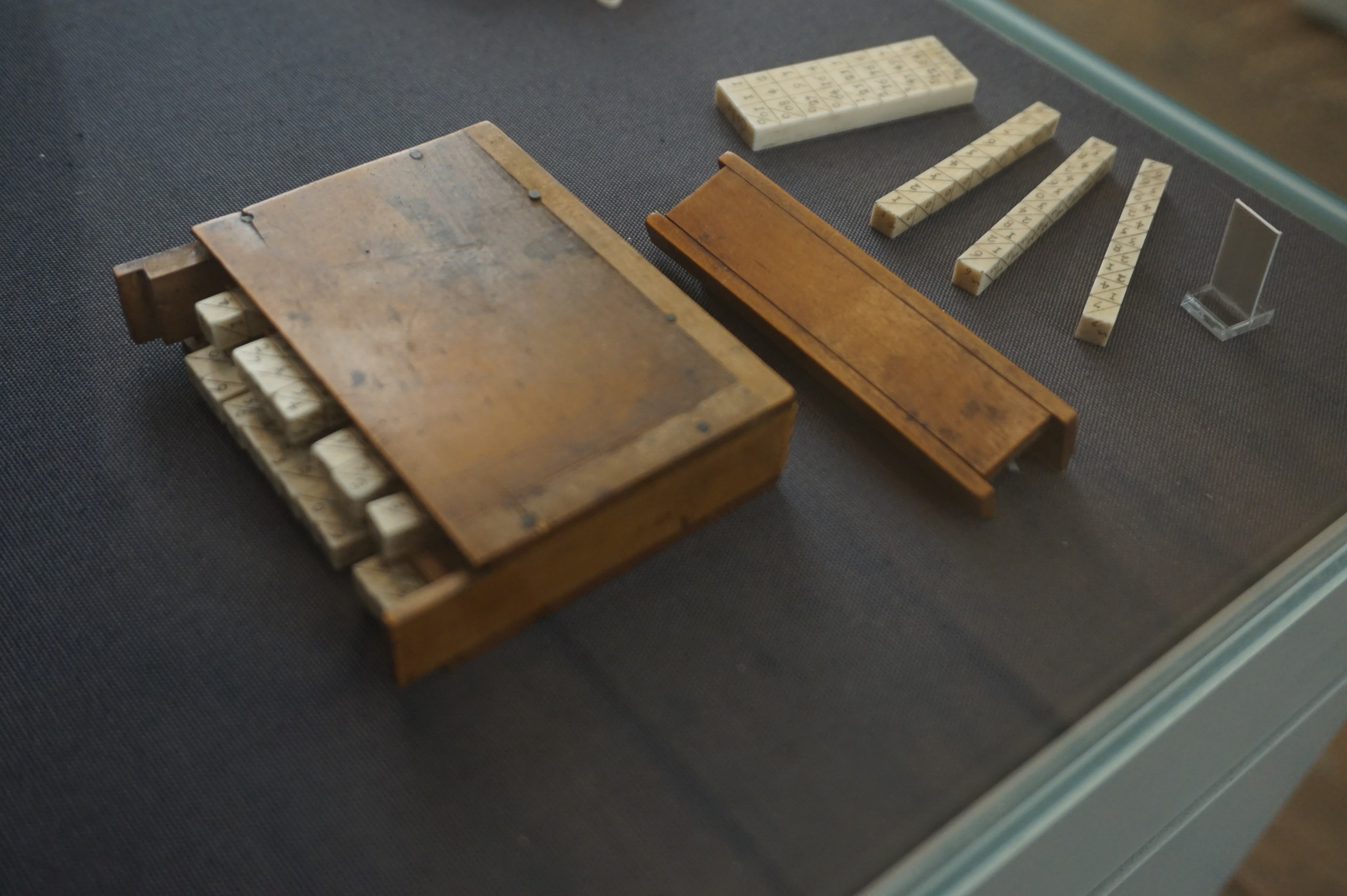
I've explored and seen so many "Napier things" since I began studying his life and work 6 years ago that I know it's a repeat to share Napier's Rods (Napier's Bones), but on this recent trip I did see displays that I had not seen before that contain Napier's Rods.  The fact that nearly every science museum I have ever visited throughout the UK and also in Paris contain sets of these rods that are hundreds of years old serve as testimony to me of their widespread and long-term use.  One place on this trip where I saw rod displays was at the History of Science Museum in Oxford.
Sometimes the rods are flat and single-sided.  Sometimes the rods are four-sided rectangular prisms.  They can be made of any number of materials, such as wood, ivory, or silver, and are generally held in a specially made carrying case.
The large rod on the right below is used for taking cube roots.  On the back are the necessary markings for taking square roots.


Of course, Napier's invention of logarithms was also used to create a device to speed up calculations, a device known as a slide rule.  Napier published his logarithms in 1614, and by the 1620s these were already being put into the physical form of a slide rule.  These were widely used for calculation from the time of their invention until pocket calculators became widely available in about 1974.  A 350-year-long run seems like a goodly span of time for a calculating device!
I'm realizing as I create this post that I have not posted about my time in St. Andrews in August 2021.  Here too I found a museum display (Wardlaw Museum) featuring Napier and Napier's Bones.

I visited St. Andrews because Napier was a student at the university there (though briefly).  As I continue to document Napier items and Napier places I'll have to be sure to write a post about that visit, but for today it's time to wrap up the writing!