Yea! Technology is cooperating, so I can finally post this!
The day before yesterday I posed a "teaser" in anticipation of this post. The teaser asked what Lord Voldemort (of the Harry Potter series) has to do with mathematician Colin Maclaurin.
Answer: They are buried in the same graveyard (but more on that later).
Colin Maclaurin (1698-1746) was 11 years old when he entered the University of Glasgow in 1709. He graduated with an MA degree three years later; his thesis was on gravity. He became a professor of mathematics at age 19 - the youngest person in the world to have become a professor until his record was broken recently in 2008. During trips to London he became acquainted with Sir Isaac Newton, who was quite impressed with him and helped pave the way for Maclaurin to take up a professorship at Edinburgh University. Maclaurin is know for his work in algebra and geometry, the special case of the Taylor Series Polynomial that is named for him, and many other mathematical works. He was also a founder of the Royal Society of Edinburgh.
One main thing I searched out relating to Colin Maclaurin was his grave, which I knew to be in Greyfriar's Kirkyard. This was my first experience trying to find a single stone in a large cemetery without help - quite a task!!! (As we saw in the
John Playfair post, cemeteries and kirkyards out here have lists of "celebrities" buried inside. Colin Maclaurin's name is about halfway down the list here.)
But where is he?
I found a lot of interesting things on the search - though I did hurry through, as it was getting dark and the closing hour wasn't posted on the gate. It would have been a bitterly cold and tremendously creepy place to be stuck for the night!
And there were memento mori aplenty!
Where is he?

Aha! There on the kirk wall, top right!
 |
| Colin Maclaurin's memorial on the side of Greyfriar's Kirk, Edinburgh |
OK, so I've already gone on a tangent, but most of us first hear of Colin Maclaurin in calculus class, so I think I'm allowed a few tangents in this post!
More about Greyfriar's Kirkyard
TANGENT #1
Greyfriar's Kirkyard is famous for Greyfriar's Bobby, a Skye Terrier who reportedly spent 14 years at the grave of his master, John Gray. Here is a sculpture of him taken "from life" not long before he died on January 14, 1872. Below this image is a picture of his grave, which is just outside the actual kirkyard - hallowed ground, so people only. At first when I saw the things that were left at his tombstone it struck me as messy and disrespectful - looked junky at first glance - not flowers and notes, but sticks and and an old boot - until I realized they were fetching sticks, a boot to chew on, etc. - very appropriate for a dog. As you can see in the picture below, everyone rubs his nose. I did too!
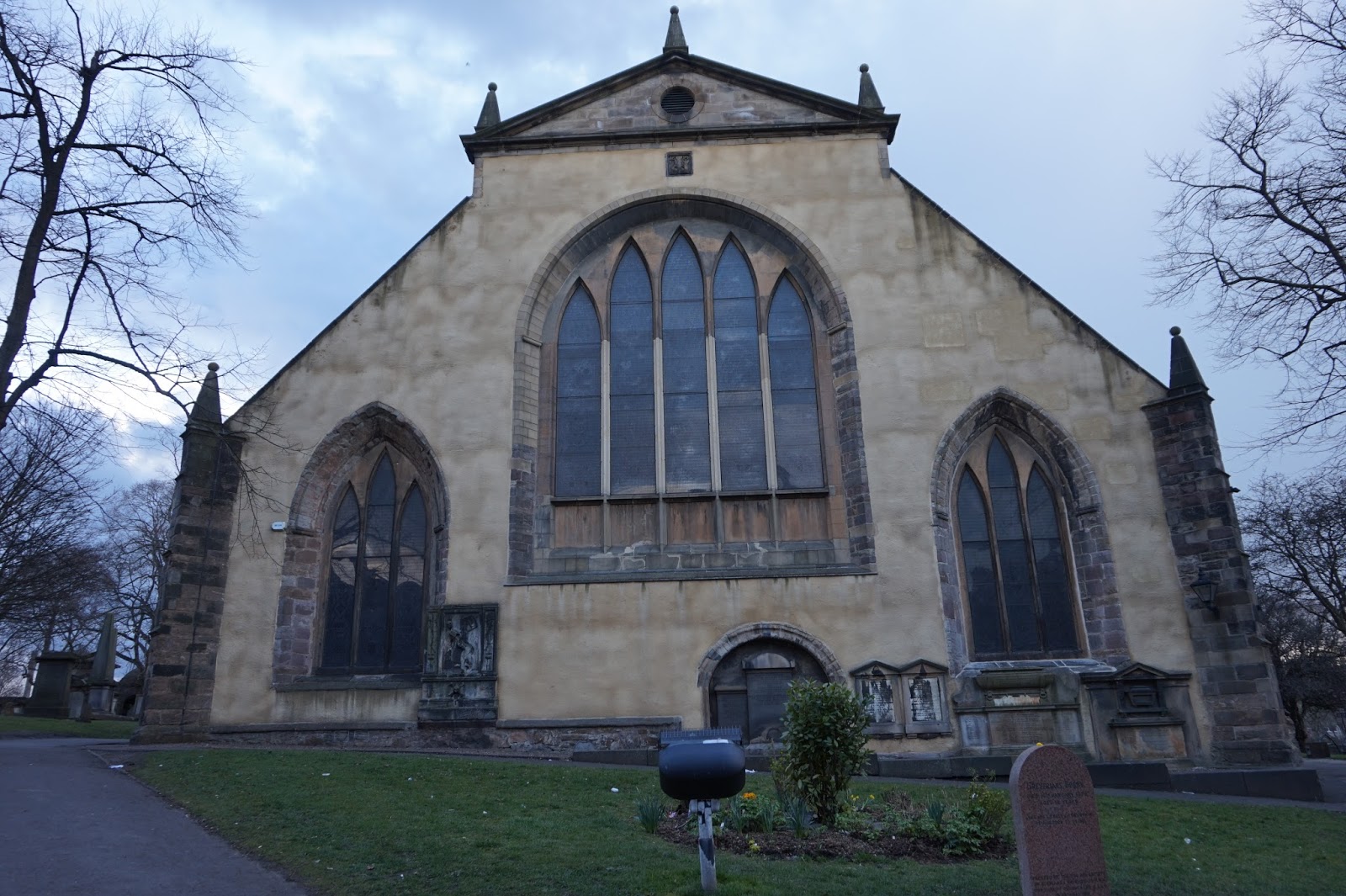
Here is the church with Greyfriar's Bobby's tombstone in front.
The church is tucked away behind businesses - cafes, shops, etc. - which overlook the kirkyard, as you can see in a picture higher up in this post (the one just after the "celebrities board").
TANGENT #2
One of the restaurants overlooking this kirkyard is The Elephant House, which is where JK Rowling did much of her early writing on the Harry Potter series. She is known to have wandered through the kirkyard frequently. Just after I found Maclaurin's stone I overheard a couple of ladies in the distance who seemed to be having an interesting conversation, so I jumped in and asked what they were talking about (don't want to miss out on anything while I'm here - will probably never be back!). That's how I learned of JK Rowlings wanderings here and that she likely drew on things here and nearby as inspiration.
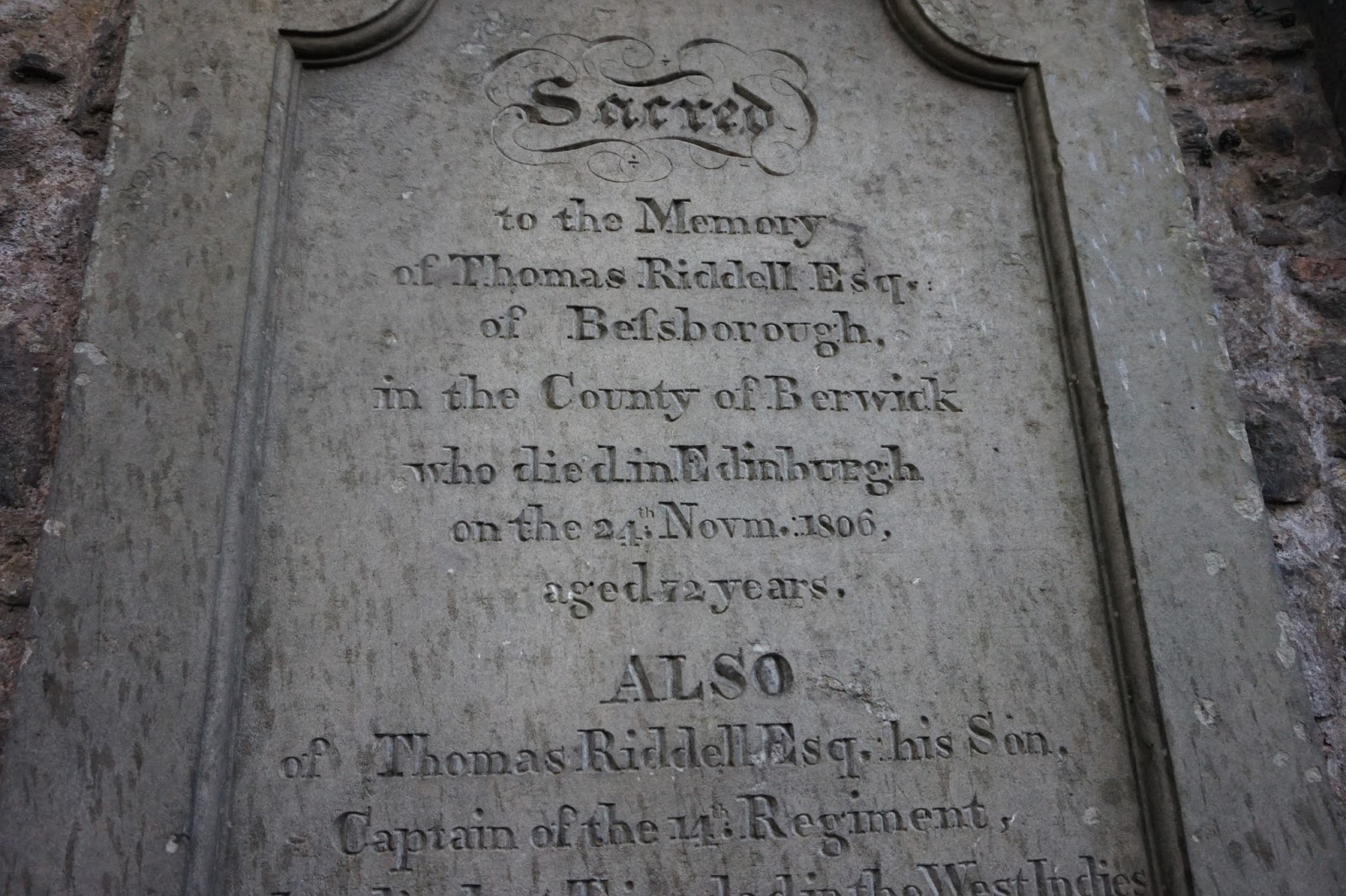
I never would have become aware of the following had I not crashed that conversation. Below is the tombstone of Tom Riddle, whose namesake now is Lord Voldemort. I wonder what this gentleman who died in 1806 would make of that!
Thomas Riddle's Stone is certainly much simpler than what is seen in the Harry Potter movies, but if you combine this name with some of the stones posted earlier, the puzzle pieces of inspiration seem to fit.
We also have a McGonagall whose stone is diagonally opposite that of Riddle in the Flodden Wall enclosed area of the cemetery.
Looking over the wall of the cemetery near the McGonagall grave is George Heriot's School, which is rumored to have inspired Hogwarts.
The name Potter also appears on a stone here and as the name of a nearby street and row (Potterrow).
I certainly got more than I bargained for - thinking I was only going to zip in and find Maclaurin's stone and head out - such a wealth of interesting things here! (I guess that's what happens when you pursue mathematics, you find lots of interesting things on the side!)