Showing posts with label introduction. Show all posts

Wednesday, May 8, 2024

Introduction to Sabbatical 2 REDUX


Girolamo Cardano (1501-1576) and Nicolo Tartaglia (1499-1557)
This post is coming to you from Venice. Four years after the initial attempt at this "sabbatical," I am finally able to finish what I started. I'd been granted a sabbatical for spring 2020. At this point we all know what spring 2020 held in store for our world. I was able to do a snippet of sabbatical that semester before Covid-19 closed our world down, but I never did make it to Italy. Here is a link to the description of "Sabbatical 2" from January 2020 if you're interested in the original intent.

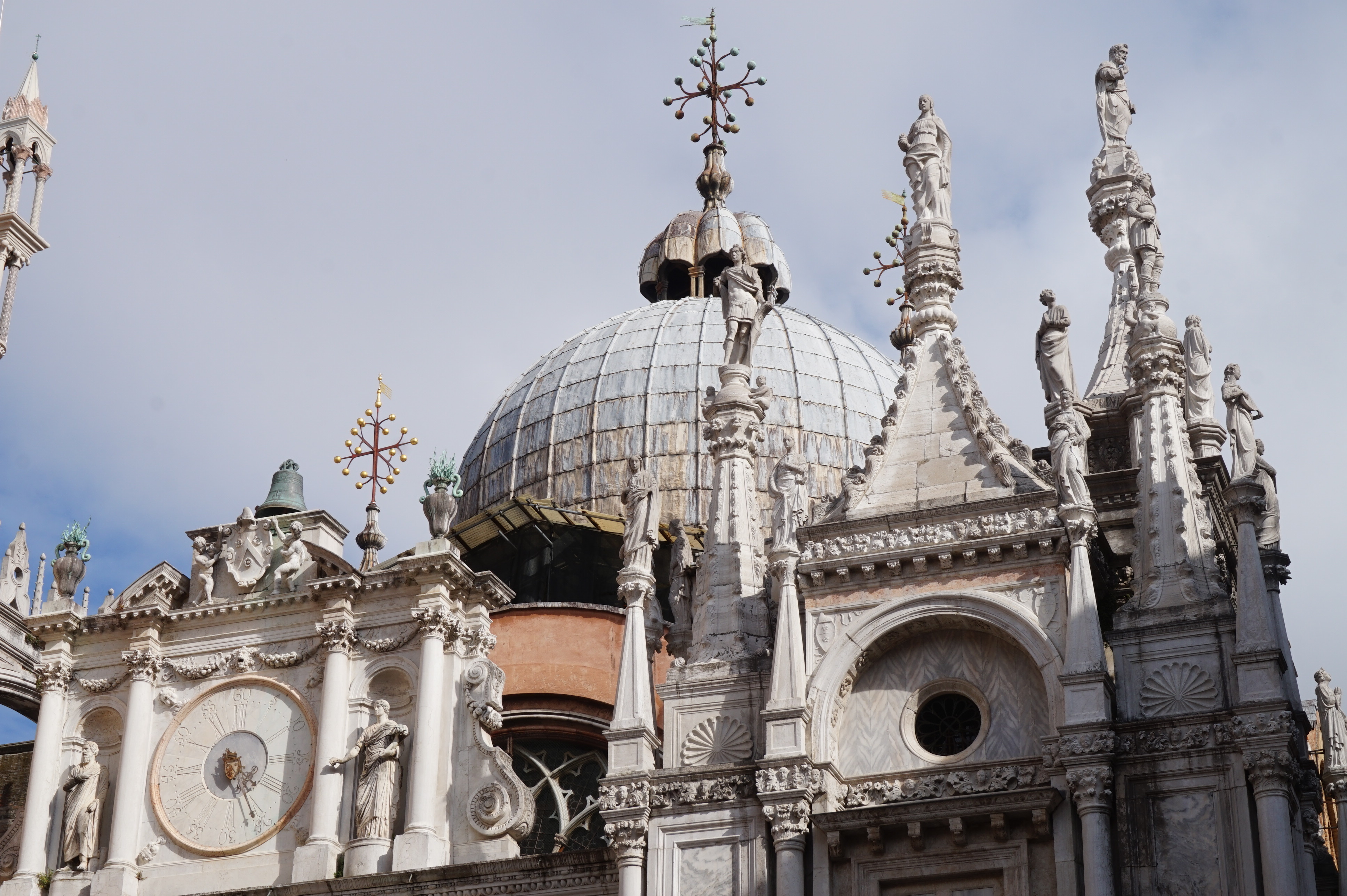
St. Mark's Basilica as seen from the Doge's Palace
These travels will involve a different itinerary than that of the original plan and post - especially since the UK part of that plan has been completed. I'm doing a big triangle in northern Italy with the intent of following the life of mathematician Girolamo Cardano. Other mathematicians and scientists will come into this as well, including but not limited to: Tartaglia, Cavalieri, Bombelli, Dee, Galileo, Copernicus, and del Ferro.
San Giorgio di Maggiore as seen from the Doge's Palace
While in Venice I'll be focused mainly on Caradano and Tartaglia whose mathematical feud is the stuff of legend. I know that British mathematician John Dee also spent time here - as is testified to in his signature and note in the book pictured below. The book is Opus novum by Jacopo Silvestri and is either the first or second book ever printed on cryptography, a favorite subject (among many) of Dee.
British Library - 8495.a.9 - Silvestri, Jacopo - Opus novum
As well as what I've mentioned above, there's a story about Cardano that I'll have to tell in a future post that has to do with him being fished out of Venetian canal he'd fallen into, saved by passers-by in a gondola. I'll wait until I've taken a gondola ride myself so I can write a little more first-hand on that. 
My posts may be a bit slow in coming, but there will eventually be many of them. It may even be that I finish this project once I'm back home early this summer. Blogging takes lots of time, especially if internet gets slow, and I need to be out there following in these footsteps (or oar strokes as the case may be!) while I'm here and have the chance. If you know me, and if you are following in May 2024, you can find lots more pictures on facebook, which is much faster for me to upload to, so those posts will go up daily. But I do hope you'll stick around and not give up on this math history journey even if some days pass between posts. Welcome along and ciao! :-)


Monday, January 20, 2020

Introduction to Second Sabbatical -- "Sorcerer Mathematicians of the Renaissance"

My first sabbatical was such an amazingly life-changing experience and has so positively impacted my students and my teaching, that it has been my dream to do something similar again.  During fall semester 2018 I worked hard to put together a worthy proposal, and approval was granted!
Cardano, Dee, and Napier
My previous sabbatical was focused on the history of mathematics from the Renaissance to the present in northern Europe, which was quite a wide sweep of history to try to take in.  This time my focus will be on three 16th-century mathematicians whom I refer to as "The Sorcerer Mathematicians of the Renaissance."  They are Girolamo Cardano (1501-1576), John Dee (1527-1609), and John Napier (1550-1617).
John Dee Exhibit, Royal College of Physicians, London 2016

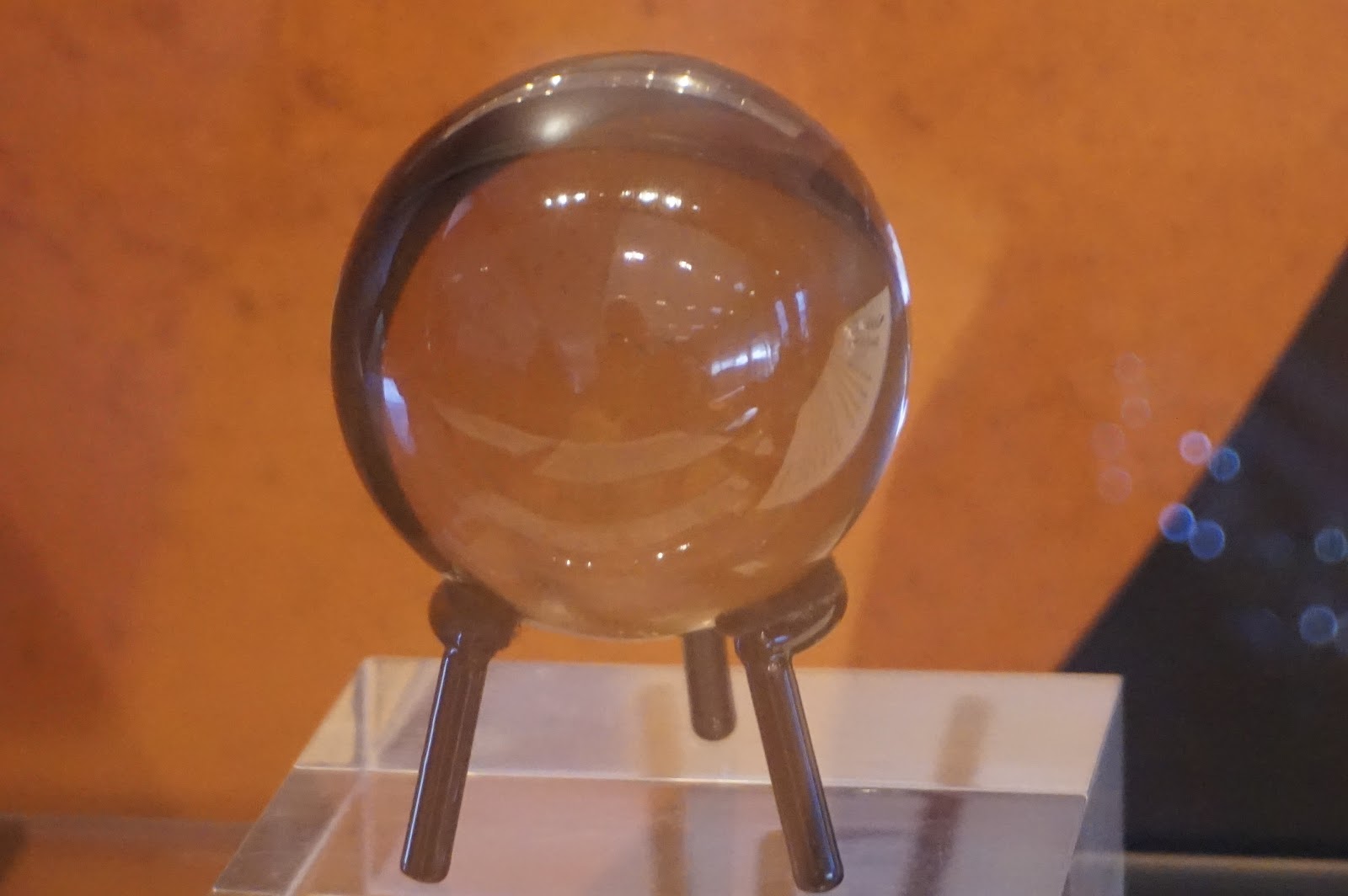
John Dee's crystal ball
Prior to my first sabbatical I had not heard of John Dee -- embarrassing to admit, but there it is.  Thankfully, while I was in London the Royal College of Physicians was hosting a John Dee exhibit along with a variety of other Dee events. I found myself captivated.  A book on display there linked John Dee with one of my favorite Italian mathematicians, Girolamo Cardano. I later learned that they had met, despite a quarter-century difference in their ages and despite living at such a distance from each other at a time when long-distance travel was onerous, to say the least!  This link was the seed of the idea for this second sabbatical.
Dee's copy, with his marginal notes, of Scaliger's "critique" of Cardano
Additionally during those first travels I learned more of John Napier -- also a Renaissance-era mathematician with a reputation for dabbling in the dark arts.  How could I resist opportunity to study these three more deeply and in conjunction with each other?  (And if any mathematicians are going to capture the imaginations of my students, wouldn't it be these three?!  Crystal balls, castles, the Spanish Inquisition, codes, feuds, spy-craft, the occult, lost treasure, etc., etc., etc.)
John Napier's Tower House/Castle, Edinburgh, Scotland 2019
Beginning March 12, 2020, I will be "walking in the footsteps" of these mathematicians as closely as possible.  I will be visiting places where they lived, studied, worked, worshiped, and died.  I will read in library and museum archives, focusing especially on original documents such as diaries and letters.  I will attend any and all talks, tours and events that I can find relating to these mathematicians.

Mathematically I will be studying their work on their terms, as they wrote it and understood it.  The Renaissance Era was as much a rebirth and flowering of mathematics as it was of art, music and literature.  These three mathematicians were deeply involved in this flowering that gave rise to the mathematics (and thus the technology) that we have today.  For example, in 1545 Girolamo Cardano published Ars Magna, or The Great Art, an extremely influential mathematics text that is a basis of our modern algebra.  John Napier created logarithms, an invention that so shortened the time needed for calculations that he is said to have “doubled the life of the astronomer.”  John Dee worked with mathematics relating to navigation and calendar reform and is the first person to have used the term “British Empire,” a phrase he coined in his role as adviser to Queen Elizabeth I.

Though their mathematical contributions are profound, there is much more than mathematics that attracted me to these three.  John Dee may have been a spy for Queen Elizabeth I and is thought to have inspired Ian Fleming’s James Bond character as well as Shakespeare’s Prospero and Marlowe’s Dr. Faustus.  What kind of life must he have lived to have inspired such a diversity of fictional characters?!  Girolamo Cardano was the second most renowned physician of his day and was also a gambler and an astrologer who was imprisoned by the Inquisition for, ostensibly, casting a horoscope of Jesus Christ.  John Napier was an elder in his church, but he was also considered a sorcerer by his neighbors.  That was a very fine line to walk, particularly in the 16th century when people were burned at the stake for witchcraft. Because of his reputation as a sorcerer, he was contracted to use his skills to search for treasure in Scotland’s Fast Castle.  

There is a great deal more to what I am doing and exploring, but hopefully that gives a sense of the journey -- enough to tempt you to follow along!
Speaking of the journey, I had these maps up on the wall of my office all last semester in order to encourage and inspire myself.  Never having traveled prior to 2016, I learned in my first sabbatical that I'm a pretty "manic" traveler, don't know how to rest and take down time -- but I also don't necessarily want to rest or take down time because this is my chance to access so much!  I'll be staying in 11 different cities over the course of 8 weeks and will be taking side-trips to other cities as well.
In Italy my focus is mainly Cardano (though while I'm there I'll also look into Tartaglia, Bruno, Fibonacci, Pacioli, Somerville, etc.).  I will be, at the very least, visiting the cities of

Rome
Naples
Florence
Vinci
Pisa
Bologna
Urbino
Venice
Padua
Milan
Sirmione
Pavia

In England I'll focus mainly on Dee, and in Scotland I'll focus mainly on Napier.  The cities I'll be visiting, at the very least, in the United Kingdom are


London
Oxford
Eyemouth
Edinburgh
Gartness
St. Andrews

I have been researching this with varying levels of intensity since my last sabbatical, and this research has now shifted into very high gear.  I need to go in with a lot of knowledge in order to get as much out of this as I possibly can.  I plan to begin regular blog posts a few days after landing in Rome on March 12, so watch this space in order to learn about those "Sorcerer Mathematicians of the Renaissance!"


PS  This blog is a continuation from my previous sabbatical, so all the posts from those travels can be found below.  

PPS  As of February 25, 2020, word of coronavirus outbreaks in northern Italy may result in significant changes to the above plans.  I fly out (would have flown out) in two weeks.  Now I'm uncertain as to plans  .  .  .


Friday, July 29, 2016

Introduction/Conclusion

Having concluded my mathematical travels, and desiring this blog to work as a reference for my students and to be comprehensible for others who come across it, I feel it's important to put up this final post in order to round things out and provide an overview.  This will serve as a conclusion for those of you who have followed me on my travels, and it will serve as an introduction for those of you just now finding this blog (including my future students).
Tram to from the airport into Edinburgh - my first stop in Europe
This blog covers my mathematical travels from spring 2016, which were undertaken as part of a sabbatical focused on the history of mathematics from the Renassaince to the present in northern Europe.  The map at the top of the post shows my stops.  These travels were profoundly impacting to me, and I believe the outcomes will resonate throughout my teaching over the rest of my teaching career.  Multiple goals were achieved through this travel, but one of the biggest is that of having walked in the footsteps of the famous mathematicians from the last 500 years in such a way that I will be able to bring them to life for my students.  I hope that through doing this I will be able to help make math more approachable and interesting to my students and to people in my community by truly putting a human face on mathematics.

I hope this final post relating to my mathematical travels in northern Europe will serve as a sampler of what is to be found in the previous posts of this blog.  I will include some links here to other posts, as well as a wide variety of pictures.  There is also a search bar on the top left, and a list of labels on the right that can be used to search for specific topics, places and people of interest.  ENJOY!
 Mathematician Mary Somerville (1780-1872), who eventually tutored Ada Byron (yes, that Byron), who was to become a mathematician herself.  Mary grew up in Burntisland, Scotland.  Part of what inspired Mary to study mathematics was the natural world around her - especially stars she could see out of her bedroom window and the Burntisland beach and tide pools near her childhood home.
 My intent was to walk in the footsteps of the mathematicians I was studying, and I did that very literally!  I wanted to experience what inspired them so I can use it to inspire others!
Mary had extended family who lived further south in Scotland, in the borderland town of Jedburgh.  Her uncle was the minister at Jedburgh Abbey (seen in ruins above) and lived on the Abbey grounds.  Mary and her cousins would swim in the Jedwater (also seen in the picture above).

As well as having walked in Mary's footsteps, I also accessed her papers and read correspondence between the Somerville and Byron/Lovelace families housed in Oxford's Bodleian Library.  The lives of Mary Somerville and Ada Byron Lovelace opened up before me in amazing ways as I read their letters to each other.
The Radcliffe Camera - one of the Bodleian Reading Rooms in Oxford
A folder containing correspondence between Mary Somerville and Ada Byron Lovelace
 While in Oxford I also accessed the archives at Queen's College Library.  Here I found the rumors that mathematicians are lazy to be confirmed for me!  In reading a first edition copy of Robert Recorde's Whetstone of Witte, I came across the place where the equals sign was used for the first time.  Recorde wrote that he decided to create the equals sign because he was tired of the "tedious repetition"of writing the words "is equalle to" between both sides of all of his equations. He created that small symbol = that we all recognize immediately today.  He decided to make the symbol of two parallel lines of the same length, as he put it, "bicaufe noe.2. thynges can be moare equalle." (The reading of 16th century English proved a bit challenging, but in a fun way, like a treasure hunt!)
The view from my table at Queen's College Library, Oxford
My table at Queen's College Library, Oxford, with the 1557 first edition Whetstone of Witte waiting for me
 I chose each of my destinations solely with regard to connections with mathematics and mathematicians.  Another mathematician I was interested in at Oxford is a person most of us know better as a literary figure: Lewis Carroll.  Actually, his "day job" was that of being an Oxford don of mathematics - on the side he was a writer and photographer - very accomplished in those areas!
 Carroll's Alice stories were inspired by a real person, Alice Liddell, the young daughter of Carroll's dean at Christ Church, Oxford.  Carroll often took Alice and her sisters boating and also to the then newly opened Oxford University Museum of Natural History (see above), where they encountered some of the "beasts" that make an appearance in his works (see below).
Lewis Carroll is not the only whimsical mathematician I came across in my study and travels, another such is Dr. John Dee (1527-1608).  Given what I've learned I can't believe I hadn't come across him before; he's everywhere in popular culture - appears frequently in modern fantasy, horror, and historical fiction novels, may have been the model for Prospero in Shakespeare's Tempest and Christopher Marlowe's Doctor Faustus.  He even shows up in an Iron Maiden song and a PlayStation video game!

Dr. Dee was an adviser to Queen Elizabeth I.  At the time in which he lived science and magic were not well-distinguished, and scholars such as himself could be expected to do such things as draw up horoscopes and cast out demons.  Though this was expected, it put men such as he in danger of being associated with the occult, which did happen to him.  He then fell out of favor with the Queen and died in poverty and obscurity.  And yet, as we've seen, he lives on in literature, music, games and even an opera!

Pictured below are some of his mystical implements, including his crystal ball and obsidian scrying mirror.  These items were on display at London's Royal College of Physicians, on loan from the British Museum.
Dee is not the only mathematician of this era to have been considered by some to be a sorcerer.  Another such is John Napier (1550-1617), a Scottish nobleman and elder in the Presbyterian Church, whose castle tower is pictured further down in this post.

As well as visiting beaches, museums, libraries and universities where mathematicians lived, worked and gained inspiration, I also visited gardens, woodlands, crypts, castles, cemeteries, cathedrals, homes and classrooms associated with mathematicians and their lives - some photographs of which follow this paragraph.  Also included in the posts on this blog are commentary about the very real joys and very significant struggles of traveling abroad for the first time and traveling solo.  Although the travels were independent and solo there were three cities in which I met with fellow mathematicians who proved to be of tremendous help to me, so this post closes with pictures of each of them to whom I feel tremendous gratitude!
Tuileries Garden, Paris, where Mary Somerville spent time convalescing
Forest of Gottingen, Germany where David Hilbert walked with colleagues and students
Crypt of the Pantheon in Paris - tomb of Joseph Louis LaGrange (top, left, back)
Merchiston Tower - which remains of the castle of John Napier
Pere Lachaise Cemetery, Paris - burial place of Germain and Fourier
Window dedicated to George Goole in Lincoln Cathedral
View out of Sir Isaac Newton's bedroom window of the famous apple tree that he said inspired him
Cavendish Laboratory Classroom of James Clerk Maxwell - Cambridge
Dr. Piers Bursill-Hall & doctoral student Richard Chapling - Centre for Mathematical Sciences - Cambridge
Dr. Samuel James Patterson  - Mathematisches Institut - Gottingen, Germany
Dr. Manfred Stern of Halle, Germany and I having lunch and talking math at the famous Auerbachs Kellar, Leipzig


Thursday, November 26, 2015

Introduction

As fall semester 2015 comes to a close and final exams loom my sabbatical is finally beginning to feel like it will be a reality.  It's been a long time in coming!  I began writing my proposal in August 2014, got word it had passed committee in November 2014, and learned in spring 2015 that it had been approved by the board - HURRAY!  

My travels, which will begin in March 2016, will take me to Scotland, England, France and Germany to seek out the history of mathematics from renaissance times to the present in northern Europe.  (Given the state of things in the world currently, I certainly hope such travel is still possible four months from now when I am scheduled to go!)


Beginning back in August 2014 and continuing to the present I have been reading, researching, planning and making contacts with European universities.  One year ago today, Thanksgiving Day 2014, I received my first response from a university, Oxford, letting me know of possibilities that are open to me there of touring the Mathematical Institute and of accessing the archives of Queen's College, Oxford, to consult a first edition (1557) of Robert Recorde's Whetstone of Witte in which the equals sign is first developed and in which our familiar symbols for plus and minus appear for the first time in an English text.  


Since that first contact I've received favorable responses from many universities, including Heidelberg, Halle, Gottingen, Cambridge and the Sorbonne.  I've also received a great deal of information and encouragement from mathematicians and historians of mathematics with whom I have been in contact, most particularly Professor William Dunham, author of The Mathematical Universe and Journey Through Genius.  

This endeavor is a combination of a travel-sabbatical and of an independent-study sabbatical.  Below is a picture of the books I have committed to reading this spring.  The top nine I will read in full.  Of the five compilations on the bottom of the stack I'll be reading about 800 pages. 


I know that as I read these I will be led to other readings as well.  My additional related reading has already begun with an autobiography of mathematician Mary Somerville and with an autobiography of mathematician Julia Robinson.  Thankfully I have my own pretty substantial mathematics library close-to-hand in my home office.


As well as reading and continued travel planning and communications, my spring will consist of laying out talks I will give at Modesto Junior College and CSU Stanislaus in fall 2016 and the beginnings of rewriting curriculum for the liberal arts mathematics classes I teach and looking into ways in which I can incorporate elements from the history of mathematics to bring mathematics more to life for my students in remedial classes as well.  One of my goals is to come back better equipped to help my students and those in our community have a deeper appreciation for the beauty and history of mathematics.