 |
| Gondolas near St. Mark's Square, Venice |
For much of my life I had heard of mathematician Nicolo Tartaglia only in the context of his feud with Girolamo Cardano, a story in which he seems to be merely a foil who comes off poorly against the more well-known mathematician. We only have so much time in math history courses, so I fear that this unfair portrayal is the norm, and I'd like to right that wrong at least a little bit in this space.
 |
| Venice and the Bridge of Sighs |
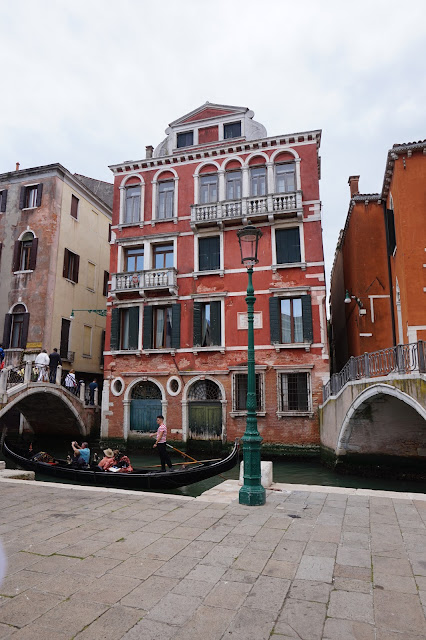
The pictures here are only from Venice, as I have not had a chance to visit his birthplace of Brescia nor Verona where he lived from his late teens to his early thirties. He did spend the last 23 years of his life in Venice, a place at the forefront of printing during the Renaissance and where books were widely available even even to those without a lot of money, and he was certainly one without a lot of money.
 |
| Clock in St. Mark's Square, Venice |
 |
| Clock in St. Mark's Square, Venice |
But let's step back in time a moment.
Nicolo was born in Brescia in 1499 or 1500. His father was a postman known as 'Micheletto the Rider' who rode out to take messages to surrounding towns. Micheletto was murdered while out on delivery when Nicolo was 6 years old. And this family that had been poor sunk into abject poverty.
 |
| Nicolo Tartagalia - Rijksmuseum via Wikipedia - Public Domain |
And, if things weren't hard enough already, when Nicolo was about 12 years old, the French invaded his home town. Nicolo's mother hid the family in a cathedral for refuge, but the soldiers were out for blood and killed 46,000 residents of the city - including civilians seeking sanctuary in churches. Nicolo's head was slashed with a saber, and he was left for dead. His jaw and palate were sliced through. Nicolo's mother could not afford medical help, so she nursed him back to health best she could on her own. Miraculously, he lived, but he was left with a stammer, hence his nickname 'Tartaglia,' which means stammerer in Italian. He kept a full beard all his adult life in order to cover the scars.
 |
| From Correr Museum, Venice |
When he was 14, there was a little bit of money to provide him with at least enough education to be able to write the alphabet, but the money ran out by the time he reached the letter K. From that day on, he was self-taught. He wrote, "I never returned to a tutor, but continued to labor by myself over the works of dead men, accompanied only by the daughter of poverty that is called industry."
Despite these harsh conditions, he rose to a level of mastery in mathematics that was such that he wrote one of the most fundamental books on mechanics (applications of mathematics to artillery fire) in the Renaissance. He was also the first Italian translator (from the Greek) and publisher of Euclid's
Elements. He also developed a method for solving certain forms of cubic equations - something prominent mathematician of the era, tutor to Leonardo da Vinci, Luca Pacioli had declared impossible.
 |
| The Winged Lion of Venice |
In some sense it was controvery over the cubic that was his "downfall," and why he is often unfairly characterized, but that is another story for another post (which I will link
here once posted). As far as I can tell, Tartaglia has never truly received the degree of credit he deserves for his work or for how he overcame the many serious obstacles of his early life. His time in Venice often saw him teaching arithmetic/practical mathematics in order to eke out a living. He sometimes had to take his customers to court when they "paid" him with something like a worn-out cloak rather than the agreed-upon monetary compensation.
 |
| Near Chiesa di San Francesco della Vigna, Castello, Venice |
 |
| Venice, Italy |
 |
| Venice, Italy |
 |
| Venice, Italy |
Below is an image of St. Mark's Square in Venice very near the time of Tartaglia's life. Other than the style of clothing, I can attest that not much has changed - at least not from this view - between his time and ours.
 |
| "Processione in Piazza San Marco" by Cesare Vecellio (1586) Correr Museum |
Not a great picture, nor perfectly lined up, but a quick snap of my lunchtime view of this same piazza in May 2024 posted for comparision:
 |
| View over St. Mark's Square from the Correr Museum cafe May 2024 |
In Venice, Tartaglia lived on Calle del Sturion in the San Polo sestiere (neighborhood) roughly between the Rialto Bridge and Campo di San Silvestro.
 |
| Map showing C. del Sturion, Campo di San Silvestor, and the Rialto Bridge |
 |
| Rialto Bridge |
 |
| Rialto Bridge |
 |
| View from the Rialto Bridge |
Tartaglia expressed in his will that he wished to be buried in Chiesa di San Silvestri. While many churches in Venice are freely open to the public, I found I was unable to get into San Silvestri - at least not the main sanctuary. I was able to get into a small chapel on the southeast side that was open for prayer. I do not know for certain if Tartaglia was buried in this church. I'm assuming he was, and we know that this was his wish. He died at age 57 or 58 in 1557.
 |
| Chiesa di San Silvestri |
 |
| Chiesa di San Silvestri |
 |
| Chiesa di San Silvestri |
 |
| Chiesa di San Silvestri |
 |
| Chiesa di San Silvestri |
This math history trip to Venice was to have taken place in spring 2020 as part of a sabbatical, but we all know what happened that shut down our world at that time. When I was planning that trip and looking into Tartaglia's life and work, I came across a poem written in the form of a letter to Tartaglia that moved me deeply. The author is Jessica Huey, who was a student at Cal State Fullerton at that time, and the poem was published in
The Journal of Humanistic Mathematics (Volume 10, Issue 1, January 2020). I wrote Jessica asking permission to share her poem, and she graciously gave that permission. I think she has given here a beautiful tribute to Tartaglia, and I believe he more than deseves it!
A Letter to Niccolo Fontana de Brescia
by Jessica Huey
Dear Niccolo,
How are you?
I have heard much about you.
I wish I could say it was all good things,
But I cannot.
I heard about your solution to the cubic.
How it must hurt to gain so much knowledge,
Yet not be credited for sharing it with the world.
Or, to be more accurate, when Cardano shared it with the world.
I heard about your other contributions to math,
Like arithmetic and number theory, the tetrahedron’s volume, and translating Euclid’s Elements.
How it must hurt to master math to such depth,
Yet not be honored for it.
I heard about how you got your scars,
The ones that you hide behind your beard, as well as the ones inside that no one can see.
How it must hurt to go through what you did,
And speak but not be heard.
I heard about the loneliness.
I know it hurts.
It hurts me too.
I don’t want to sympathize
Because sympathy can hurt,
And it can add to the pain that may already be there.
I want to empathize
Because empathy can heal.
With understanding comes relief
And with relief comes healing.
I too have spoken and not been heard.
I too have shared and not been credited.
I too have lived and been hurt.
I hope this brings you some relief.
I hope this doesn’t pain you to hear this, all these years (and centuries) later.
Your deathday happens to be in exactly a week.
I hope that by remembering you and sharing your story, this brings strength to you
As well as to others.
Someday we may meet, in the sky,
And you can tell me your story,
Yourself.
From,
Jessica
P.S. I wish I could’ve been at your math battles. Will you tell me about them someday?


