In March of 2016 I paid my first visit to Burntisland, Scotland, home of Mary Fairfax Somerville (1780-1872). This was part of my initial sabbatical, and one of my posts about that is at this link. Since that time I have read her memoirs and have found her life story compelling and relatable. The picture above is of her home, and the picture below is of her church (or "kirk") through the gate. Because the religious life of her childhood impacted her strongly and because it reminds me a bit of my own strict Calvinist upbringing, I made it a goal on this trip to get inside her childhood church: Burntisland Parish Church, which was built in 1592. It took some doing, but eventually connections were made, and a mid-week visit was possible. As it turned out I had basically three guides with me while there, so it was a VERY informative time!
Burntisland is right on the Firth of Forth, so it has always had a close relationship with sailing and shipbuilding and other seafaring ventures, hence the ship on the gates of the kirk. The kirk itself is directly north of the outer harbor.
Above the door is 1592, the date the church was built. I might not have noticed the upside-down anchor if it hadn't been pointed out to me. Hebrews 6:19 calls hope the anchor of the soul, so an anchor is a Christian symbol of hope. The fact that this anchor is upside-down represents that the place of our hope is in Heaven.
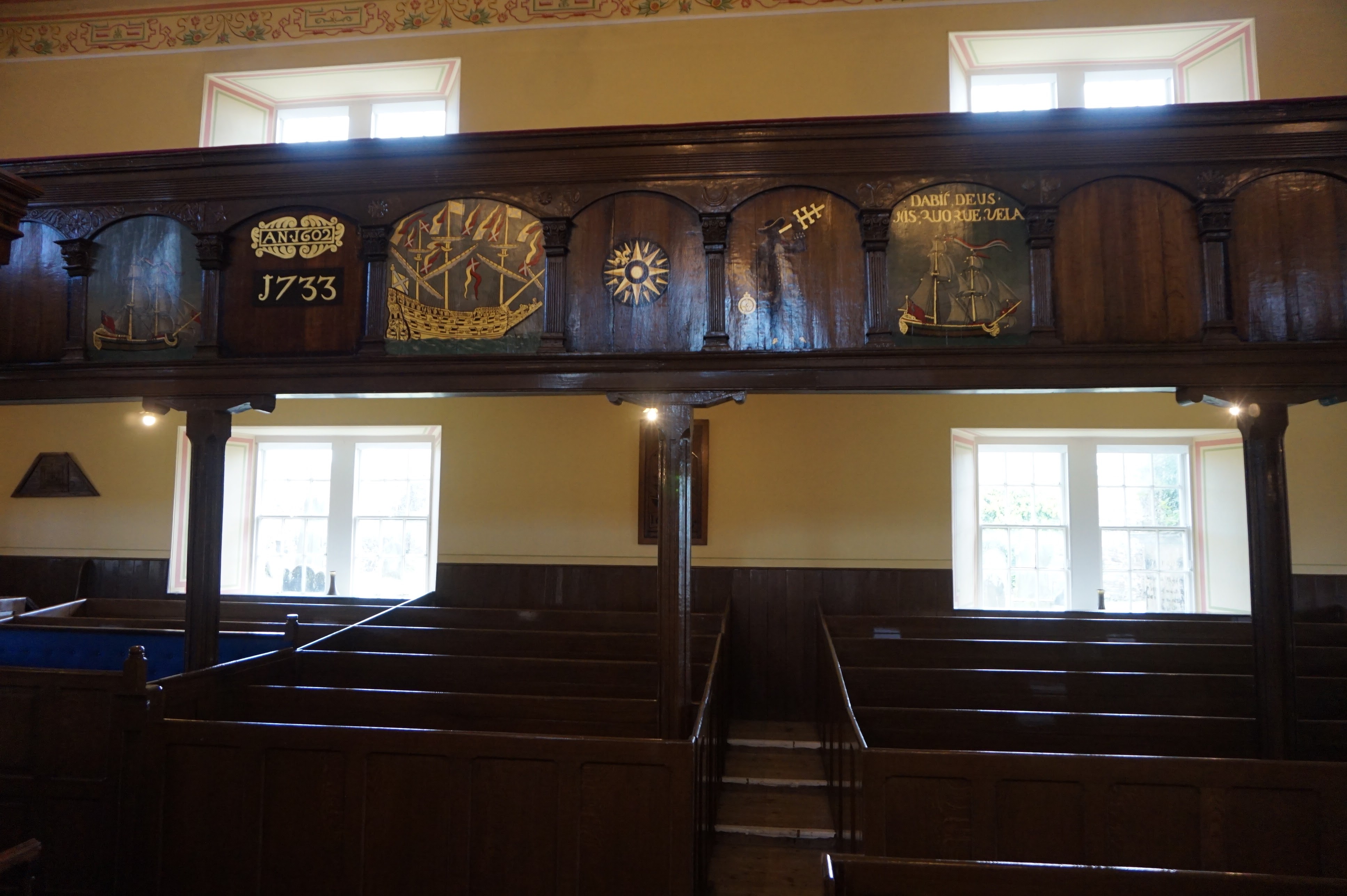
I had known from Mary's memoirs about the paintings on the panels in the church. These have recently been restored, but they remain the dates and images she would have seen in her time.
This church is one of the first built after the Scottish Reformation. It is in the shape of a square, which is unique in Scotland. In the video below this picture you'll hear the man who was telling me about the church say that there may be a few like this in France and perhaps one in the Netherlands but that it is pretty rare in general. The square shape is intended to model a family sitting around a table listening to the word of the Lord.
As stated in the video, the church originally had stools or chairs but not pews, which were added somewhat later (1606). The "box pew" in the picture below, just to the side of the magistrates pew (lined in red to the right), is the pew of the Somerville family. It is to the left as you enter through the church doors.
The magistrate's pew is pictured below in a painting that hangs in the Burgh Council Chambers. The people seen in this painting are all real individuals (later than Mary's time, or at least later than her childhood days here) and are named in the picture two below this one.
Below I'm looking from the wall of the church toward the Fairfax pew. I caught Toby and my other guide unaware, but I was taking video and pictures so quickly while trying to take in all that was said . . . we really didn't have a lot of time here, but there was much to take in! The magistrate's pew can be seen as well, lined in red and currently used as a stand for the projector for music during services, which you can see if you look closely. They've definitely become a lot more casual, and lively, I imagine, since Mary's time.
There was so much to learn about this church beyond what I was interested in relating to Mary Fairfax Somerville. One of those things is that this is where the General Assembly of Scotland met in 1601, and it is the first time that the idea of an official English translation of the Bible was presented to King James. About a decade later the result was the King James Version of the Bible!
The church is lined with plaques relaying every aspect of its history.
Another fact I learned is that the organ was donated in 1909 by Scottish-American philanthropist Andrew Carnegie! (This was also after Mary's time here, of course.) He attended this church on one of his visits to Scotland, and he was so taken with it that he asked the pastor if there was anything they needed. The pastor said that an organ would be nice. A few days later, there was an organ sitting at the front door (for them to put together, as he believed in the importance of working with one's own hands).
Renovation work was done in the 1990s, which would coincide with the 400th anniversary of the church. This included painting of the ceiling, which was done by the painter Michelangelo-style -- lying on his back. When he finished, the roof ended up getting damaged somehow, and he had to start over!
Looking up, I found it hard to believe that this is a flat painting. The circles surrounding the center seem to me to pop out as spheres.
Here is the organ donated by Carnegie.
We spent time in the kirkyard as well as in the kirk itself. If I were to have looked over the kirkyard wall in the distance I would have been able to see the outer harbor and the Firth of Forth -- and Edinburgh landmarks, I imagine, such as Arthur's Seat and Castle Rock. I know I'm able to see those from the beach, so I'm sure I could have seen them from here as well.
Around on the back corner is a second entrance that is specifically for sailors. Apparently they were promised this when the church was first built, but it was put in somewhat later.
Here too there is the upside-down anchor, reminding us that our hope is in Heaven.
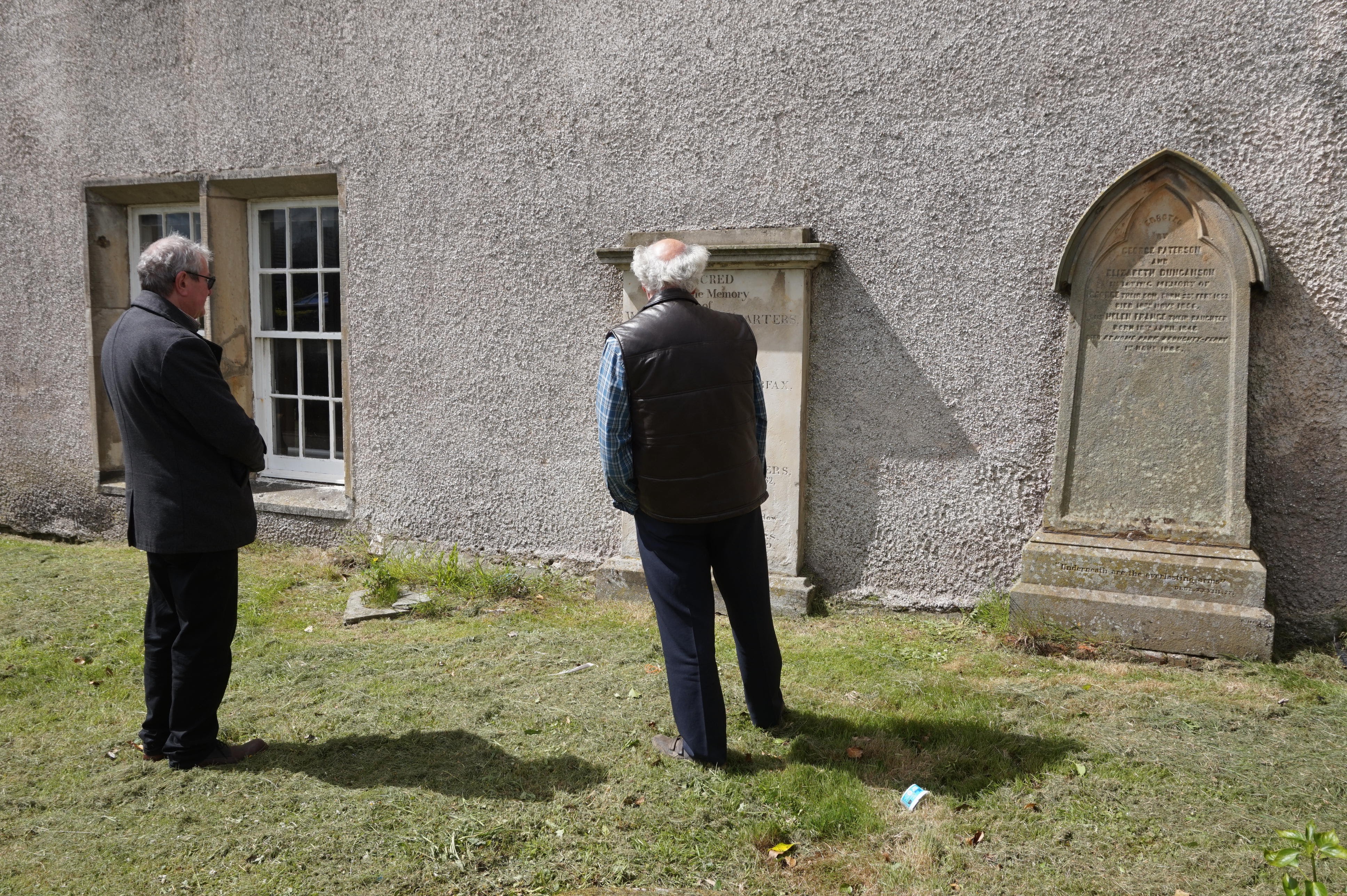
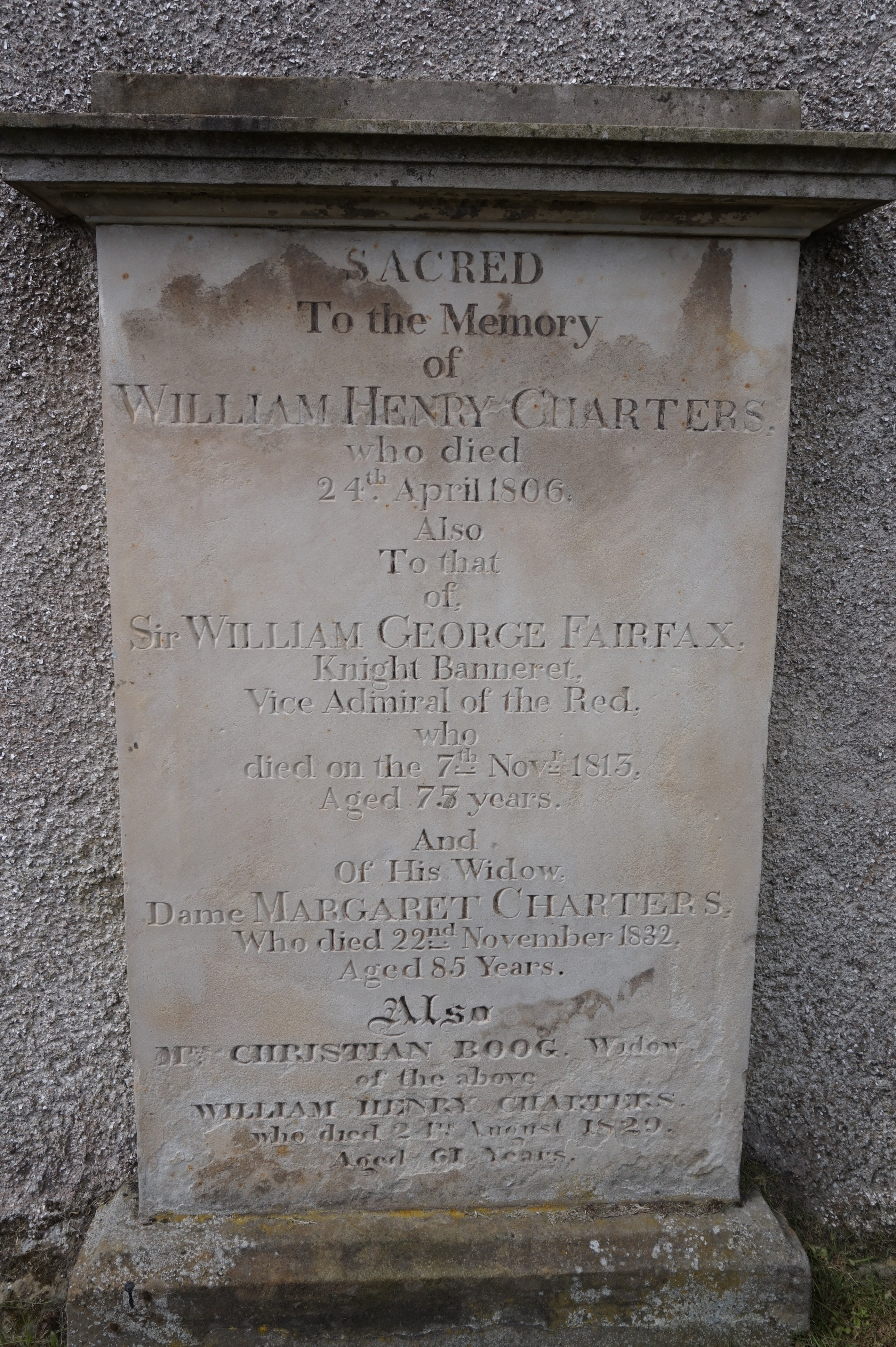
I keep referring to Mary as Mary Fairfax Somerville, because she was part of the Fairfax family of Burntisland. Her father, Sir William Fairfax was a vice admiral in the navy and is buried here behind the kirk, as is her mother Margaret Charters and her grandfather William Charters.
Below is the northeast corner of the kirkyard.
And then we walked back around to the front - looking funerary art and hearing stories of people buried here.
The tombstone pictured below contains a lot of iconography including a skull on the top right, scales on the left, a backwards 4 with masonic symbols on the right, and a memento mori on the bottom, along with crossbones and an hourglass (tempus fugit).
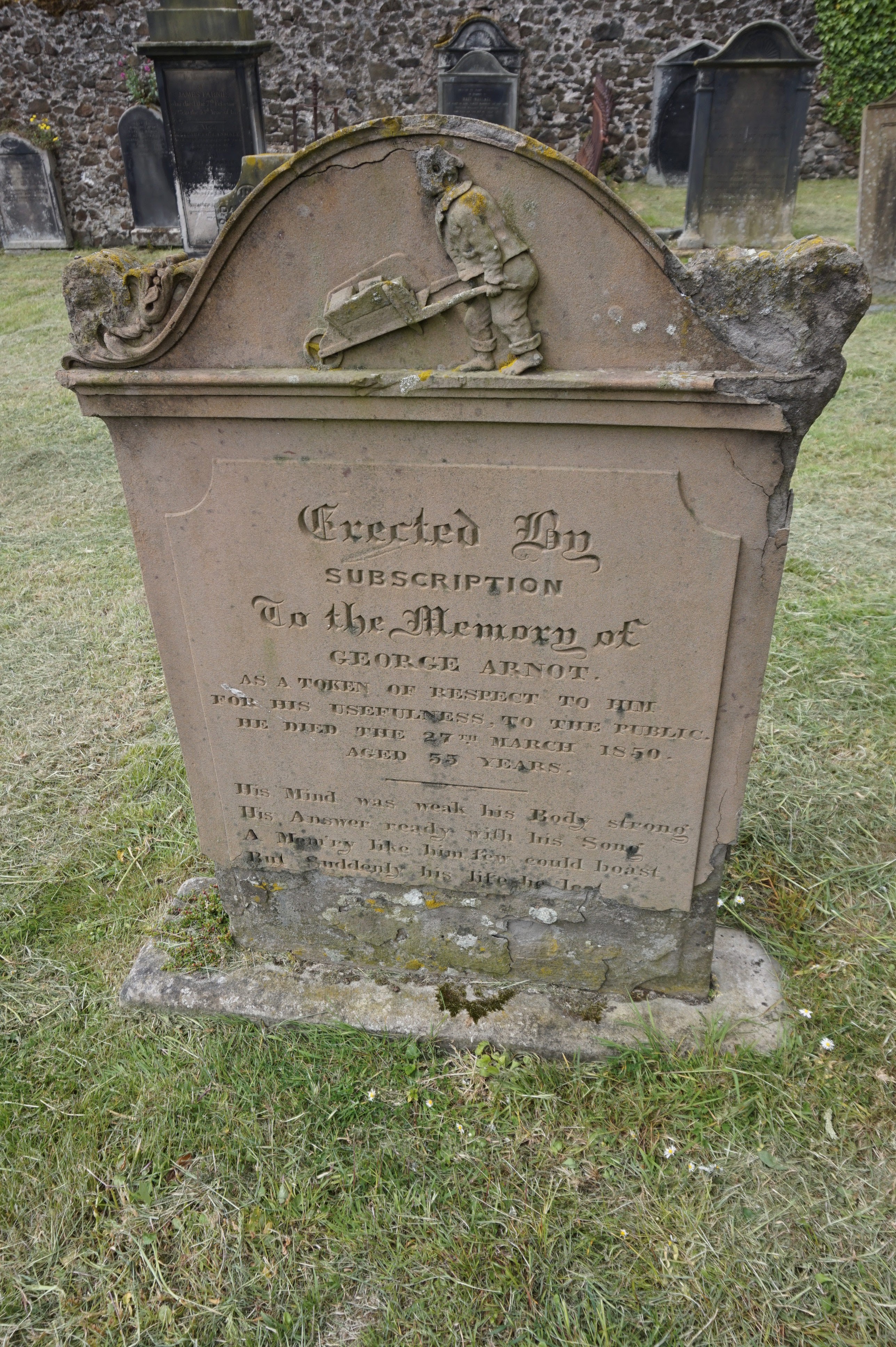
The story of George Arnot, tombstone pictured below, is quite an interesting one. (George's life was within Mary's; he was born 15 years after she was, and he died 32 years before she did, but I don't know if she would have known him, as she married and moved to London in 1804 when he was only 9 years old -- although she did return to Scotland in 1807 when her first husband died, so I really don't know. But his story is definitely worth telling whether she knew him or not.)
Apparently George was a bit odd in a way that 19th century townsfolk wouldn't have had a name for. He was like the Forrest Gump of his day. Notice that on his stone he is pictured barefooted; that is because he went barefoot year-round, no matter the weather. He was in some ways cognitively slow, and yet he had a prodigious memory. For example, if someone was housebound and had to miss church, he would go to their house and share the sermon with them word-for-word and also the hymns! Just by hearing the sermon he immediately had it memorized. He worked as some sort of a laborer, and was well-loved but probably a bit ostracized as well. As a joke, someone put snuff in his beer one night, and it killed him. The townspeople felt terrible and all chipped in for the tombstone for him, at the bottom of which are the lines:
His Mind was weak his Body strong
His Answer ready with his Song
A Mem'ry like him few could boast
But Suddenly his life he lost
After finishing our brief but full time at the kirk and kirkyard, we headed back to the Burgh Cambers where the Heritage Trust Museum is. We were treated to a PowerPoint presentation on the life of Mary Somerville by Ian and then given a tour of the Burgh Chambers. Downstairs is a wonderful museum with quite a variety of displays. One thing that interested me most were the panels discussing the history of crossing the firth. Mary's family had to board a ferry in order to cross from Burntisland to Edinburgh, which is something that Mary's mother was very fearful of but which they had to do.
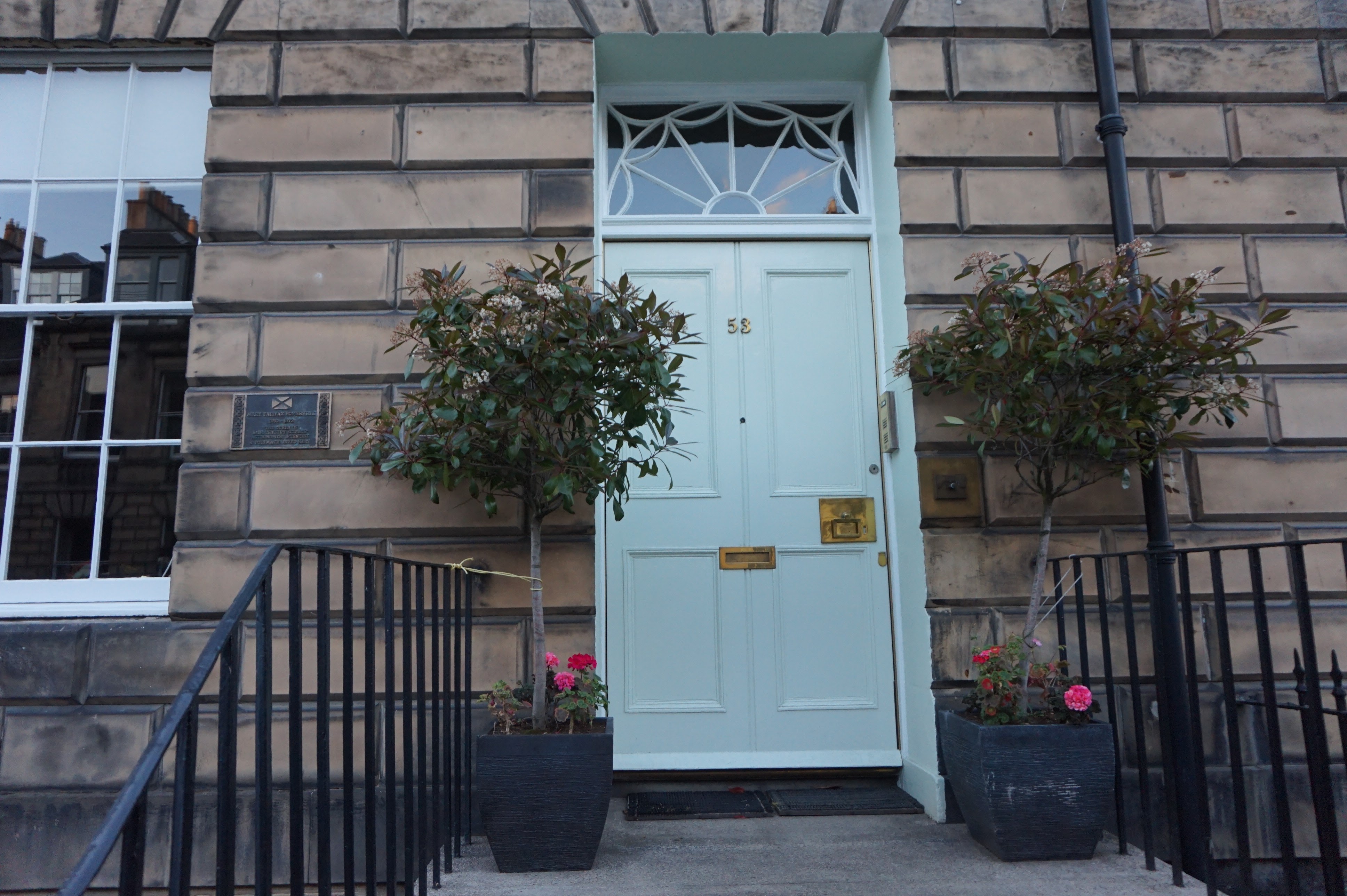
That evening, when I was back in Stockbridge, I walked to Edinburgh to look for the Fairfax family home there, which I did find. Ian's PowerPoint included the address, but Toby had made the comment that the street may have been renumbered since then. I knew there was supposed to be a plaque next to the door, and when I went to the address I'd been given I didn't see the plaque, so I walked the length of the whole street and finally found it -- one of many mathematical treasure hunts I've been on in my travels!
She lived at what is now 53 Northumberland Street in Edinburgh's New Town.
There was a beautiful sky that night. I wish I hadn't waited so long to take pictures of it, but I was too focused on finding and photographing Mary's house to catch this before it lost some of its glory -- still pretty, though!
I begin with the picture above rather than a picture of Mary Somerville herself because it was the natural world surrounding her in her home of Burntisland on the eastern coast of Scotland, just north of the Firth of Forth, that was her first inspiration. According to her biography, which was written by her daughter but largely using her own words from journals and letters:
" . . . as a lonely child, she wandered by the seashore, and on the links of Burntisland, collecting shells and flowers; or spent the clear, cold nights at her window, watching the starlit heavens, whose mysteries she was destined one day to penetrate in all their profound and sublime laws, making clear to others that knowledge which she herself had acquired, at the cost of so hard a struggle."
Burntisland Beach - looking north
Burntisland Beach
Shells on Burntisland Beach
The Links
And here is Mary's house from which she looked through her window at the stars at night:
Childhood Home of Mary Somerville
Setting of Mary's Childhood Home
There is a small yard in back.
Mary Somerville's Childhood Home
As you can see in the plaque above the door, Mary's father was a naval officer. He was away at sea when she was born, so Mary was born in Jedburgh, at the home of an aunt and uncle, rather than here in Burntisland. Later her father became a vice-admiral.
The plaque says that she was a well-known mathematician and astronomer, and she certainly was in her day. One of the things that she did was to translate Pierre-Simon, Marquis de Laplace's work Méchanique céleste. He later told her that of all women only she and Caroline Herschel understood his work. She received a letter from renowned Cambridge mathematician George Peacock that he and Dr. William Whewell had chosen her translation to be used
"Dr. Whewell and myself have already taken steps to introduce it into the course of our studies at Cambridge, and I have little doubt that it will immediately become an essential work to those of our students who aspire to the highest places in our examinations . . ."
She wrote other books as well. She was particularly interested in analysis and wrote a book on curves and surfaces of the second and higher orders and also wrote a book titled, Physical Sciences. She had the honor of presenting her Physical Sciences to the Duchess of Kent, who was the mother of Queen Victoria, of this she writes:
"I had the honour of presenting a copy of my book to the Duchess of Kent at a private audience. The Duchess and Princess Victoria were alone, and received me very graciously, and conversed for half an hour with me. As I mentioned before, I saw the young Princess crowned: youthful, almost child-like as she was, she went through the imposing ceremony with all the dignity of a Queen."
So Mary Somerville certainly reached to the heights, but the beginnings were not so easy for her. So let's go back to the beginning . . .
Her birthplace was the Jedburgh Manse, home of her uncle The Reverend Dr. Thomas Somerville (1741-1830), whose grave in the south choir chapel of the ruins of Jedburgh Abbey is shown below.
Ruins of Jedburgh Abbey
Looking toward the great west entrance of Jedburgh Abbey
While preparing for these travels I spent a great deal of time reading about Mary Somerville's life and work. She came from a well-respected though not wealthy or noble family. Her father's family, the Fairfaxes, were distinguished, and her mother was related to several prominent Scottish families. When I read she'd been born in the Manse of Jedburgh, I took that to be a manor house or mansion. I knew the manse to have been entirely ruined, but I hoped to find something marking the spot on my travels. I asked about it at the visitor information building in Jedburgh, but no one there knew. And then I came across the following:
This was an exciting moment for me! Looking it up later I found that a manse is the home of a Presbyterian minister. The manse would have been on the grassy area in the picture below - right by the ruins. It would probably have extended into the foreground as well. The remaining houses in this area were demolished in 1974 in order for archaeological studies of the ruins to take place.
Location of the Manse of Jedburgh
Here is what Mary has to say of the Manse, and of time spent in Jedburgh with her relatives:
"My uncle's house—the manse—in which I was born, stands in a pretty garden, bounded by the fine ancient abbey, which, though partially ruined, still serves as the parish kirk. The garden produced abundance of common flowers, vegetables, and fruit. Some of the plum and pear trees were very old, and were said to have been planted by the monks . . . . An inland scene was new to me, and I was never tired of admiring the tree-crowned scaurs or precipices, where the rich glow of the red sandstone harmonized so well with the autumnal tints of the foliage. We often bathed in the pure stream of the Jed. My aunt always went with us, and was the merriest of the party; we bathed in a pool which was deep under the high scaur, but sloped gradually from the grassy bank on the other side. . . . The evenings were cheerful; my aunt sang Scotch songs prettily, and told us stories and legends about Jedburgh, which had been a royal residence in the olden time. She had a tame white and tawny-coloured owl, which we fed every night, and sometimes brought into the drawing-room . . . . I was always glad to return to the manse."
Here is the Jed or "Jed Water" of which she speaks. It is directly below the abbey.
Jed Water, Jedburgh
Jed Water, Jedburgh
There is just so much to say about her life and her work, and this has gotten so long already. I'll close with some words of what I find most interesting about her, but I need to direct you to her biography for more (biography, autobiography).
So far nothing has been said of her struggle, and it was a struggle for ANY woman born in 1780 who wanted to study mathematics. Her initial interest in the sciences came from her own observations of the natural world - the beach near her home and the stars outside her window. Later, while at a friend's house, she was shown a women's fashion magazine with color plates in it; also in it she found a math puzzle that had x's and y's in it. When she asked what those were, her friend, Miss Ogilvie, said, "Oh, it is a kind of arithmetic: they call it Algebra; but I can tell you nothing about it." Mary remembers going home and looking through all the books to see if they could tell her what was meant by Algebra.
Another draw to mathematics came when she was taking art lessons from the well-known Scottish painter Alexander Nasmyth. Nasmyth was primarily a landscape painter, but he is probably best known for his portrait of his friend, and national Scottish hero, the poet Robert Burns.
Nasmyth's Portrait of Robert Burns, National Portrait Gallery, Edinburgh
The inspiration she received from Nasmyth happened in the form of an overheard conversation - again, in her own words:
"One day I happened to be near him while he was talking to the Ladies Douglas about perspective. He said, "You should study Euclid's Elements of Geometry; the foundation not only of perspective, but of astronomy and all mechanical science." Here, in the most unexpected manner, I got the information I wanted, for I at once saw that it would help me to understand some parts of Robertson's "Navigation;" but as to going to a bookseller and asking for Euclid the [Pg 49]thing was impossible! Besides I did not yet know anything definite about Algebra, so no more could be done at that time; but I never lost sight of an object which had interested me from the first."
By impossible she meant that a woman could not go to a bookseller and purchase mathematics books for herself. She did study what she could at home - asking questions of her brother's tutor and picking up what she could from him. Her parents discouraged her, and she had enough household chores to keep her busy until night-time, so she took to studying in her room by candle-light. When her mother heard of this she instructed the servants to take Mary's candles way. Mary continued to find ways to study, which concerned her father so much that he exclaimed to her mother, "Peg, we must put a stop to this, or we shall have Mary in a strait jacket one of these days. There was X., who went raving mad about the longitude!"
Mary had to fight against familial and cultural stereotypes against women studying mathematics. Women were expected to be "accomplished" - able to stitch and sketch, play pianoforte and perhaps speak another modern language - but studying mathematics was thought to be so mentally strenuous for a woman that she could go crazy. When she married, her husband also did not encourage her studies, but her first husband died a couple of years after their marriage. After his death, her inheritance gave her more freedom to pursue her studies. She later married her first cousin, Dr. William Somerville (son of the uncle at whose home she'd been born), and he encouraged her in her studies. By this time she was 32 years old. She accomplished much after this, but one wonders to what heights she would have risen had she been allowed to study from an early age.
She remained mentally active until her death in 1872 at nearly 92 years of age - having commented at age 89 that she was still well able to do the Calculus.
So, finally a portrait of this mathematician - and I should add that her family expressed later that they wished a portrait would have been made of her when she was even younger. Apparently she was a great beauty, and during her young-adulthood and attending social functions of the day in Edinburgh she was known as "The Rose of Jedburgh."
Portrait of Mary Fairfax Somerville (National Portrait Gallery, Edinburgh)
This portrait is part of a special collection at the National Portrait Gallery regarding the accomplishments of women in the late 18th and early 20th century. Note the last sentence of the plaque below about the year in which women were finally granted the right to study for degrees at university.
As you can see, I found myself in quite august company! Queen Victoria is on the far right.