John Napier's Promptuary - National Archaeological Museum of Spain (Madrid)
This spring was the first time my mathematical travels took me to Spain. The National Archaeological Museum of Spain, in Madrid, is home to the only known period example of John Napier's Promptuary. I've been focused on John Napier and his calculating devices for quite a few years, but I feared I would never have opportunity to see this one. I'm so glad this visit worked out.
Drawers in the John Napier Promptuary
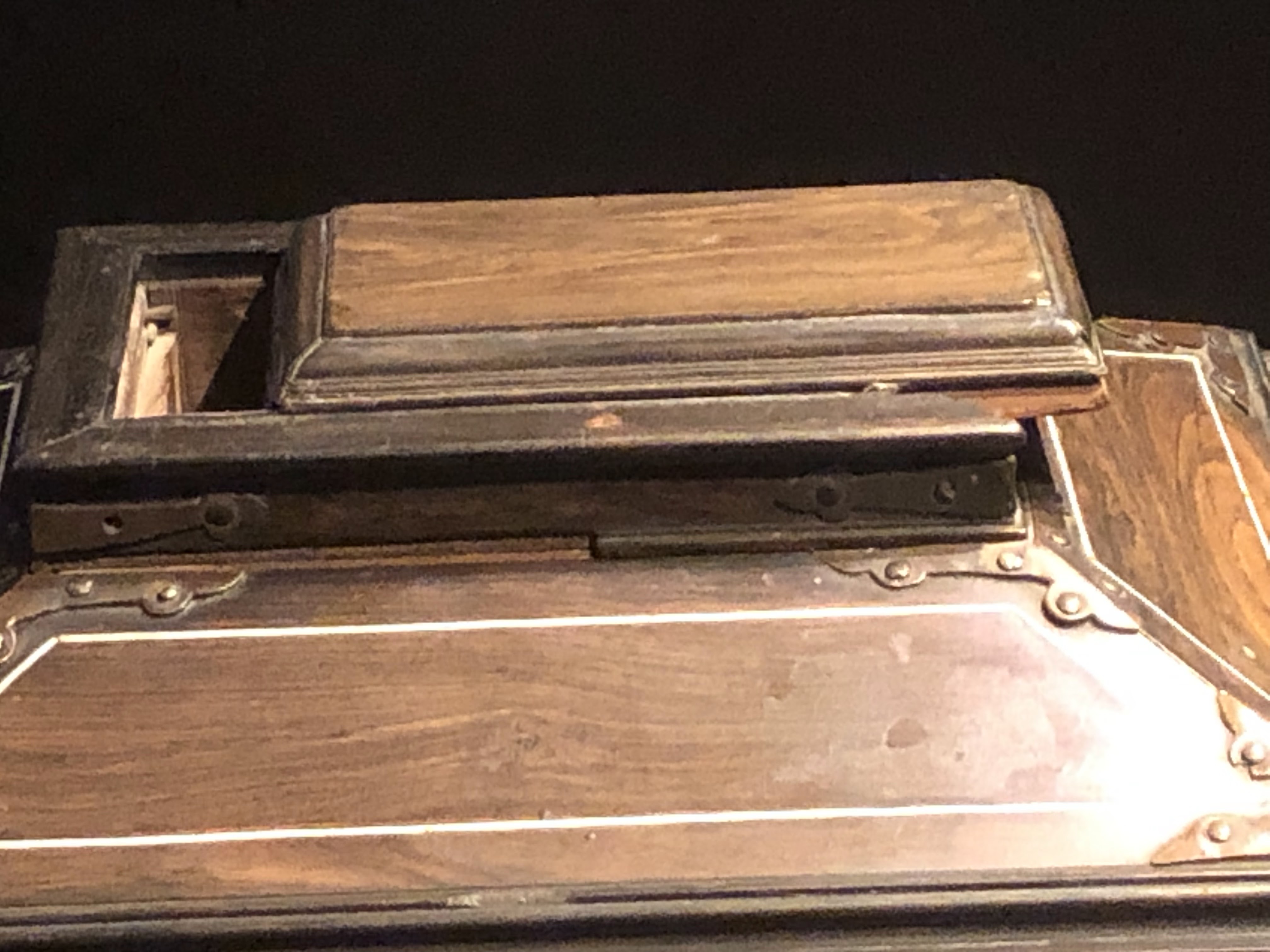
The drawers of the chest contain two types of strips for carrying out multiplication through horizontal and vertical placement. The thicker strips (central open drawer above) are covered in digits and form a vertical base when multiplying. The thinner strips (open drawer to the left) are laid horizontally atop the others. These thinner strips contain perforations that reveal digits on the thicker strips below them. I've included a picture of the set up below, but it's blurry due to how far away from me these strips were in the glass case and due to the darkness of the room, but hopefully you can get the idea.
Napier's Promptuary - multiplication using the strips
Results of the multiplication process are read diagonally down from right to left, any necessary carries being made diagonal to diagonal. This device is derived from Napier's earlier calculating device known as "Napier's Bones" or "Napier's Rod." Calculating can be carried out more quickly with this device than with the bones or rods. A couple of drawbacks to this device in comparison to the rods (bones) is that it is more difficult to create, and it cannot be used for operations other than multiplication.
Napier Promptuary - full display - National Archaeological Museum of Spain (Madrid)
Thankfully, this chest includes not only the strips described above but also a set of Napier's Bones (bottom left in the photo above). The bones were a widely used calculating device for hundreds of years and can be used in carrying out multiplication, division, and the taking of square and cube roots.
Napier's Bones - National Archaeological Museum of Spain (Madrid)
Napier's Bones - National Archaeological Museum of Spain (Madrid)
Napier's Bones - National Archaeological Museum of Spain (Madrid)
When I think of this Napier display in Madrid's Archaeological Museum, the phrase that comes to mind for me is "mathematician's toybox." There is so much more to this chest than meets the eye at first glance.
Napier's Promptuary - National Archaeological Museum of Spain (Madrid)
At the very top of the chest is a lid that's been left askew for easier viewing. This is the spot in which to tuck away Napier's Bones when you are done with your calculations.
Napier's Promptuary - National Archaeological Museum of Spain (Madrid)
At the base of the chest is a large drawer on which calculations can be carried out. To the right we see the multiplication strips of the Promptuary. On the left we see a plate listing powers of the digits starting with squares and going up to the seventh power. Below that reference plate is the square root plate for Napier's Bones. (If you flip that plate over, you'll find what you need for cube roots.)
Exponent Reference Plate and Napier's Bones Root Plate
Even the space on the interiors of the chest doors is not wasted. There are reference charts here too. On the left-hand door there is another reference chart for exponentiation of digits. Sadly, the right-hand door (third picture below) is damaged, and it was too hard for me to decipher. I think the chart on this side has to do with numbers relating to geometric figures.
Detail of left-hand door of Napier's Promptuary
Detail of left-hand door of Napier's Promptuary
Detail of right-hand door of Napier's Promptuary
Below are some different views for context.
Napier's Promptuary - National Archaeological Museum of Spain (Madrid)
Napier's Promptuary - National Archaeological Museum of Spain (Madrid)
Door of Napier's Promptuary - National Archaeological Museum of Spain (Madrid)
As I create this post I have the sense of joy again that I did when I visited Madrid's NAM this spring. Napier's Promptuary really does feel like a toy box for a mathematician. And it's so cool how you can pack it all back up - putting the bones in the top slot, pushing in the drawers, closing the doors, and locking it all up with a key. If you're ever in Madrid, I recommend a trip to the National Archaeological Museum to see this device. One hint I have for you, in case you get there but can't find the Promptuary, is to ask where the "abacus" is. Napier's Promptuary is one of the treasures of this museum and very well known, but it is known there as an "abacus." It is currently on the second floor and to the right, but museum displays can tend to move. :-)
Mobius strip sculpture in front of Gottingen Observatory - once home to Gauss and then Dirichlet and then Riemann
Where to begin?!
Gottingen is absolutely bursting with mathematical history. As I mentioned in my other post on Gottingen, it included the likes of Gauss, Dirichlet, Riemann, Clebsch, Klein, Hilbert, Minkowski, Noether, and Mobius. It was THE most important place for mathematics in the world from the time of Hilbert and Klein in the last decades of the 1800s until just before 1933 (Hitler's advent as Chancelor of Germany - at which point he got rid of the Jews and the women from Gottingen University, so there was pretty much no one left to do mathematics).
Today (Friday, May 6, 2016) I had opportunity to meet with a professor from Gottingen, Dr. Samuel James Patterson, to whom I am profoundly grateful for his having shown me around the Mathematisches Institut and its Collection of Mathematical Models and Instruments, of which he was previously curator. I'm also grateful for all that he shared with me in conversation regarding the personalities of the famous mathematicians of Gottingen, the history of mathematics and physics in Gottingen, the history of the university and institute there, and for directing me toward points of interest that hadn't shown up in my research before I arrived.
Dr. Samuel James Patterson of the University of Gottingen
Mathematics Institute, Gottingen - from the front - the top of the "T" (Bunsenstrasse 3-5)
Mathematics Institute, Gottingen from the back
Aside - physicists as well as mathematicians were active in this building, and it was in this area out back where, through the conversations of these physicists, that quantum mechanics was born, so I felt it quite a stunning privilege to be here for multiple reasons!
Another view from the back - bottom of the "T"
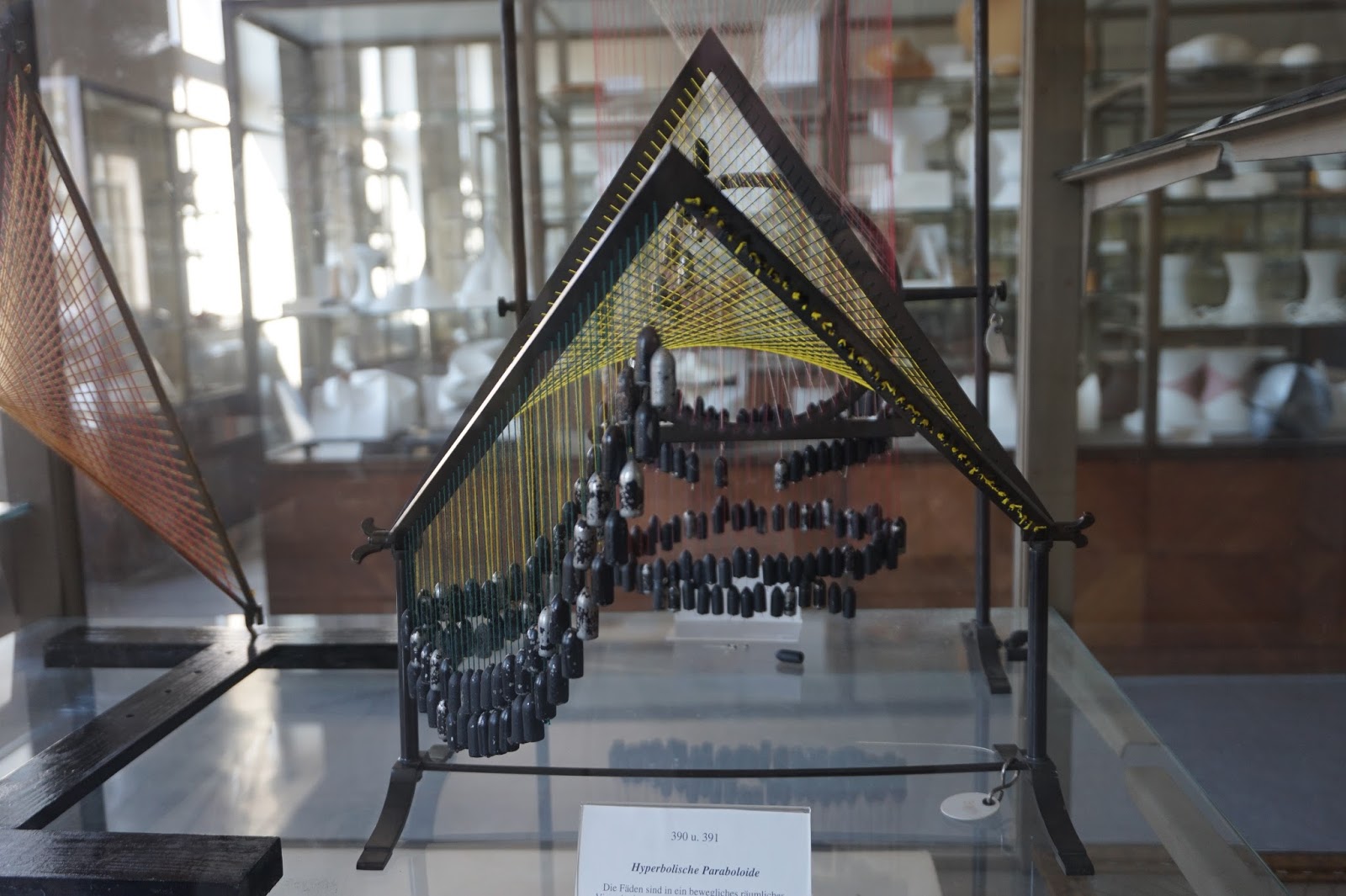
The Collection of Mathematical Models and Instruments, which is housed on the second floor of the Mathematisches Institut, displays wonderfully the history of mathematical activity in Gottingen. It stretches back to paper models of polyhedra and other mathematical shapes hand-made by Gauss's teacher in 1780 (paper being made differently then than now!) - continues through models made by Felix Klein (1849-1925) and into the mechanical calculator era - and all the way up to the present with a fractal clock and a screen showing computer-generated models! A small sampling is given in the pictures below - beginning with the paper models of 1780.
The famous Mobius Strip
The next two images are of models that Klein himself made in order to visualize what he was studying. These two images are followed by a video of a screen display on the wall here of these types of objects as they can be studied through today's technology.
The next two images are of Klein bottles - objects with interesting topological properties. These do not date back to Klein but were donated to the collection somewhat recently by someone who noticed they did have a Klein bottle, which seemed to them a travesty!
And let's just continue with a few more samples that I can't resist posting:
A Riemann Surface
Calculating Devices
This piece of the collection reminds me of my office!
The collection was begun by Felix Klein prior to the construction of the Mathematical Institute Building. At that time it could be found in a corridor on the third floor of the Auditorienhaus, the center of mathematical activity at Gottingen at the time, where the famous mathematical library, the Lesezimmer, had been founded by Klein as well. For more information and more pictures, see my post on David Hilbert.
Gottingen University Auditorienhaus
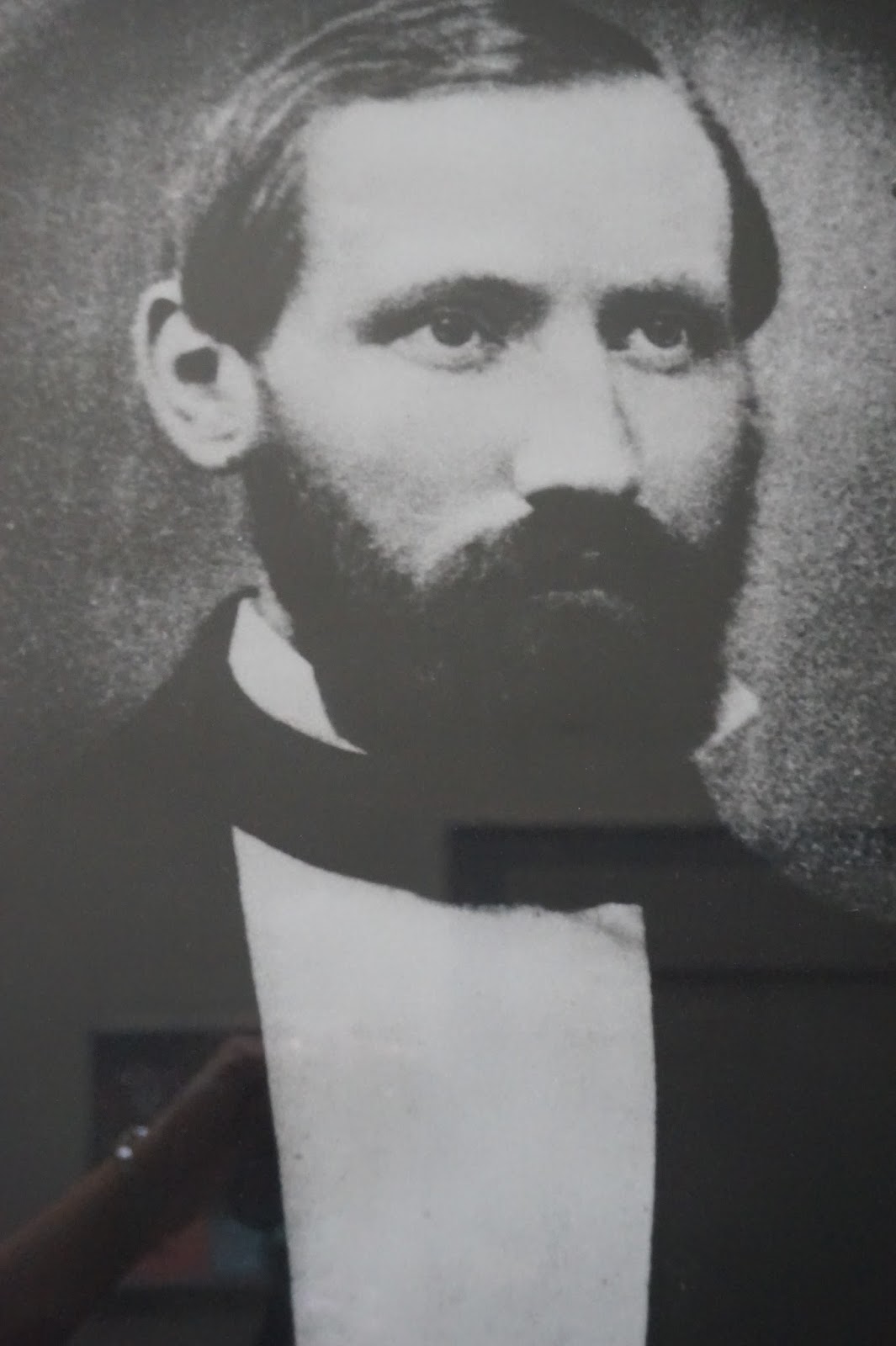
Back to the Mathematics Institute, there are pictures of famous Gottingen mathematicians lining the halls -
Carl Friedrich Causs
Felix Klein
Bernhard Riemann
David Hilbert
Hermann Minkowski
Emmy Noether
- as well as interesting posters outside offices of professors.
Do you know the story behind this? Hint: it's located above a door.
As well as the Auditorienhaus and the Mathematisches Institut, another building in Gottingen associated with mathematics and mathematicians is the observatory. It was home (successively) to Gauss, Dirichlet and Riemann. Each would have lived in rooms on the left as you face the front (the west side).
Observatory from the back (facing south)
Inside the back courtyard - facing southeast
Wing of the observatory where the living quarters would have been (west)
There were places relating to the history of mathematics wherever I looked in Gottingen. The two images below are of the Gänseliesel, or "Little Goose Girl" fountain, which stands in front of the Rathaus (medieval town hall). It is a tradition of Gottingen University students to kiss her upon graduating with a Ph.D.
I found in my time in Gottingen that the mathematicians and physicists of the town are both highly honored and also taken a bit for granted. Many Gottingen streets are named after mathematicians and physicists. Homes where famous mathematicians lived bear plaques identifying them. Other buildings also bear plaques in honor of mathematicians. There are also statues and busts of famous mathematicians and physicists. (Some of the pictures following, as well as others in the post, are repeated in other posts, but I want this to be complete, so I am including them more than once. See posts on Hilbert and Gauss for more such pictures.)
Here are some examples of these items:
Home of Hermann Minkowski - colleague and best friend of David Hilbert
On the front of the Mathematics Institute
Yet for all the honor, they are also to some degree an everyday fact of life here. First we see the bust of David Hilbert in the Mathematics Institute, as adorned by students studying nearby. Then we see Gauss's grave, which I approached on pilgrimage, as if it were Mecca, and then found myself having to process the fact that people were picnicking in front of it! I wish I could remember how Dr. Patterson put it exactly when I bemoaned this state of affairs to him - something along the lines of, "We always have Gauss with us."
Dr. Patterson explained to me that where Gauss is buried, which was once the Albani Cemetery is now part of a city park, Cheltenham-Park. It is no longer used as a cemetery, and only the most prominent stone were left.
As you can imagine the town cemeteries are filled with famous mathematicians of the past. Alfred Clebsh is buried in a small cemetery just north of the town center, not far from the Auditorienhaus.
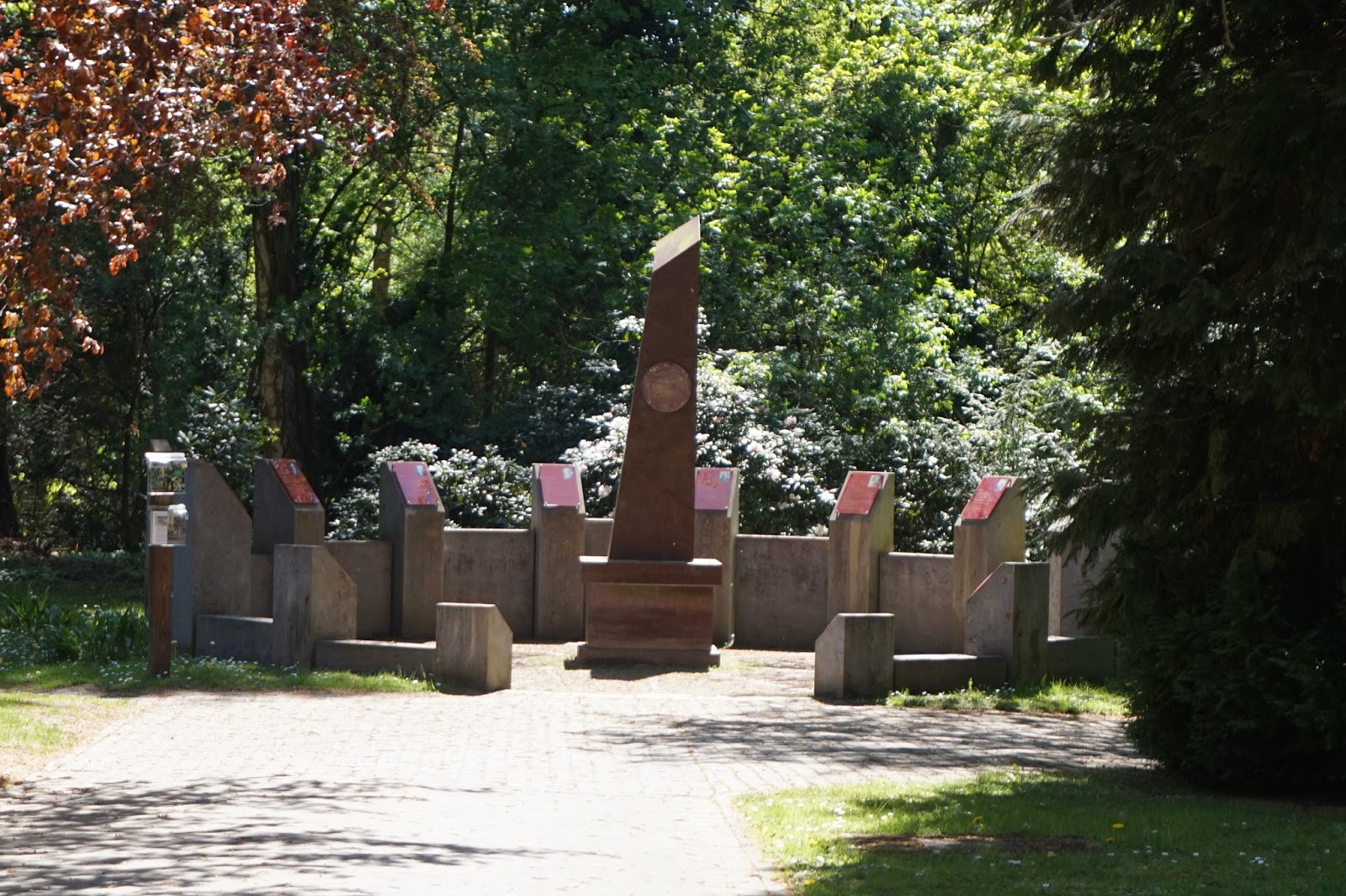
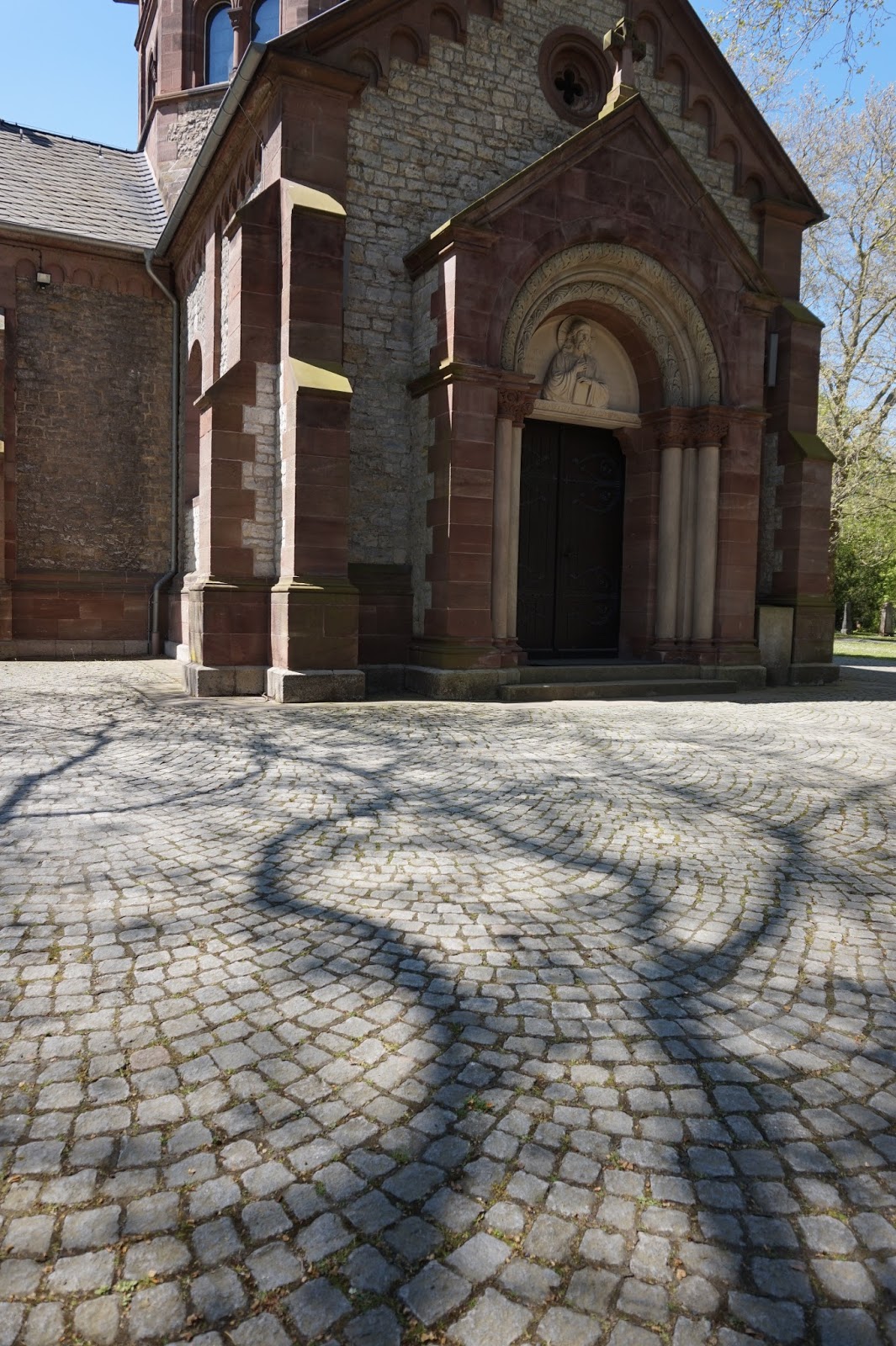
And then there is the Stadtfriedhof or "city cemetery" just west of the town center, which contains the graves of many mathematicians and physicists and also contains a "Nobel Circle," an area honoring all the Nobel Prize winners associated with Gottingen.
If you know of a cemetery with more famous mathematicians, physicists and Nobel Prize winners, please let me know, because I'd love to visit it. Here is the monument to the nobelists, the "Nobel Rondell":
I spent a lot of time in cemeteries during my travels - Greyfriars Kirkyard in Scotland, Highgate in London, Pere Lachaise in Paris, and many others - all were strikingly beautiful and profoundly interesting, but I found this one to be by far the most calming and peaceful to visit.
The "Nobel Rondell" is near this pond, and many of the nobelists are buried in this area.