Showing posts with label Oxford. Show all posts

Monday, January 26, 2026

The Humble Grave of Henry Briggs


Grave of Henry Briggs (Henricus Briggius) in the chapel of Merton College, Oxford.
Today's post honors mathematician Henry Briggs who died on this date, January 16, in the year 1630. He was a man who held two prominent professorships and who contributed tremendously to the development and speedy adoption of logarithms - an invention that revolutionized calculation so dramatically that they were said to have "doubled the life of the astronomer."

Despite his prominence, Briggs was modest, humble, uninterested in wealth, and content with a quiet life of study. Fittingly, his tombstone in the chapel floor of Merton College bears only his name: no dates, no titles, no heraldic sheild, no list of achievements. Just the Latin form of his name: Henricus Briggius. Compare this with the memorial - also in Merton Chapel - of his contemporary and patron Henry Savile - heraldic sheild around his head, bust situated atop the world and flanked by Chrysostom, Ptolemy, Euclid, and Tacitus, and above it all, an angel playing a trumpet.
Memorial to Henry Savile (1549-1622) - Merton College, Oxford
Prior to teaching in Oxford, Briggs was the first professor at Gresham College, London, from which later arose the Royal Society. It was during his time at Gresham that he made the arduous journey to Edinburgh to meet the inventor of logarithms, John Napier; the journey today is about 4 hours by train; back then it was a formidable 4-day-long journey by horse and coach.
Gresham College, London today

Lion atop the gates to Napier's castle of Merchiston (Edinburgh)

Napier's Home, Merchiston Castle, from above
Briggs first visited and collaborated with Napier in the summer of 1615 and then went back in the summer of 1616 - each time staying for a month. He had plans to return in the summer of 1617, but Napier died in April. Briggs picked up the baton, constructing tables of base-10 logarithms, and promoting them in the scientific community, leading to their wide adoption.
Merton College, Oxford
A few years after these visits with Napier, Briggs moved from Gresham College, London to Merton College, Oxford, when he was appointed first Savilian Professor of Geometry at Oxford by Henry Savile himself. When I visit here, I feel I've traveled back in time - all the way back to the time of Briggs himself.

Merton College, Oxford

Merton College, Oxford
Chapel Tower, Merton College, Oxford
Chapel Door (left), Merton College, Oxford
Merton College, Oxford
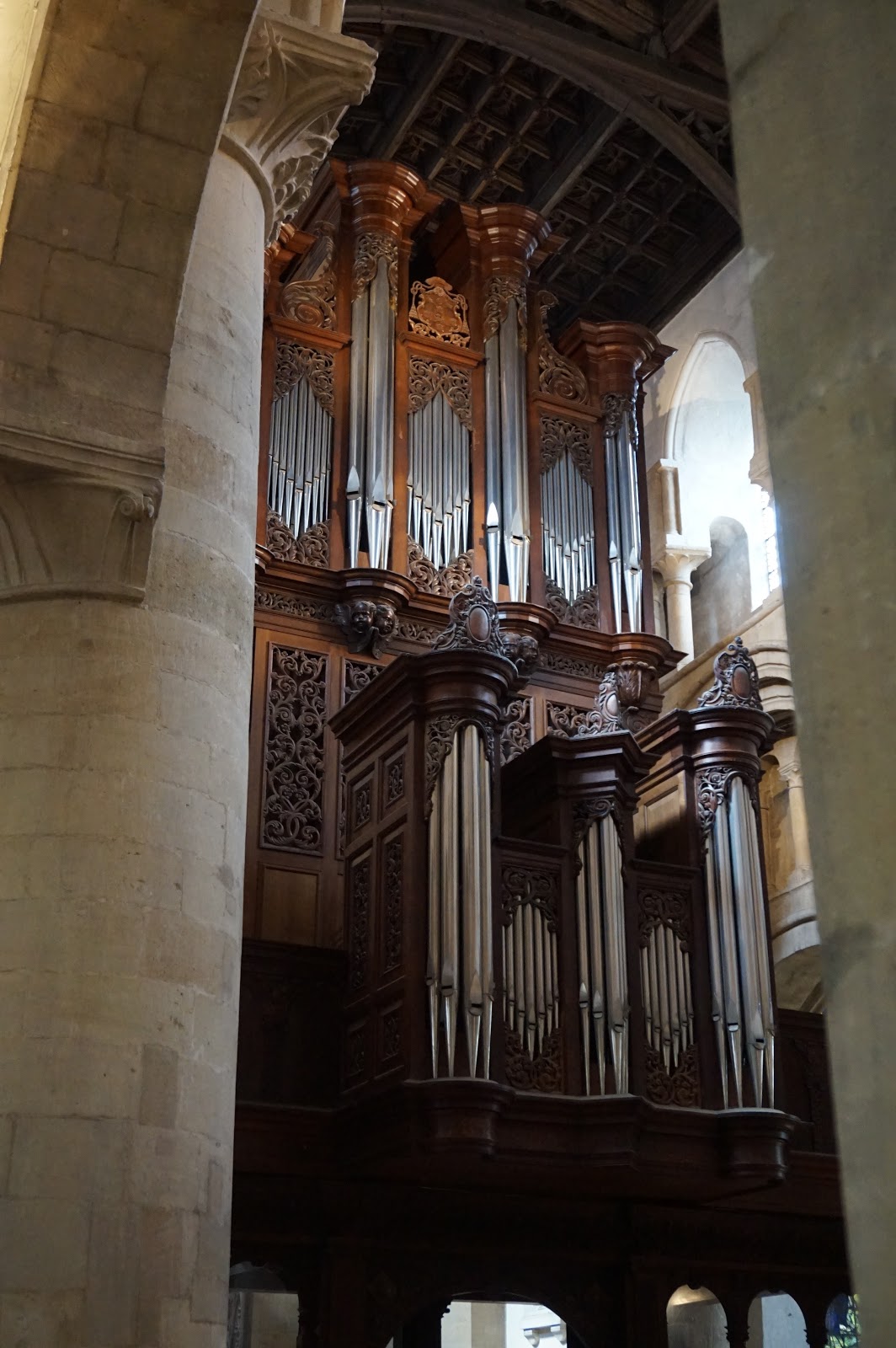
The magnificence of the organ in Merton College Chapel never fails to take my breath away, but this organ, of course, was not there in Briggs's time (was installed only about a decade ago).
Merton College, Oxford

Merton College, Oxford
Barely visible on the left and right of the pillars on either side of the organ are the elaborate memorials to Henry Savile, pictured earlier in this post, and of Thomas Bodley, he of the Bodleian Library. About 15 feet to the left of where I'm standing to take this picture is the simple stone of the humble, yet brilliant man, Henry Briggs, and it is from my vigil at his stone that I take my leave of you today.
Tomb of Henry Briggs, Merton College, Oxford


Saturday, April 23, 2016

Charles Lutwidge Dodgson


This display in the Museum of Natural History in Oxford is about the real Alice - the character in the books having been based on a real person.  Well, this post is about THE REAL LEWIS CARROLL.  His name was actually Charles Lutwidge Dodgson (1832-1898), and mathematics was his "day job."  He earned the Christ Church, Oxford, Mathematical Lectureship in 1855 and held it for the next 26 years.  His Fellowship at Christ Church, Oxford, gave him the privilege of living at Christ Church for the rest of his life provided he did not marry and that he prepared for holy orders, which is simply what was expected of Fellows living at the college at that time.

Museum of Natural History, Oxford
In 1856, Henry Liddell became dean at Christ Church.  Dodgson (Carroll) became very close to the Liddell family, especially Henry's wife Lorina and three of their children - the daughters Lorina, Edith and Alice.  He would sometimes take them to the Museum of Natural History (pictured above and below), and some of the characters in the Wonderland books came from creatures they saw here.  In particular it is likely that Dodgson represented himself as a Dodo because he had a stammer, so his name sometimes came out "Do-do-dodgson."

Museum of Natural History, Oxford
Dodo skeleton and taxidermy at Museum of Natural History, Oxford

Lewis Carroll enjoyed entertaining others.  This began early in life when he entertained his siblings.  He even used puzzles and riddles in his mathematics lectures at Oxford in order to engage his students.  He especially loved entertaining children.  I noticed in reading a biography of him that he used many of the same magic tricks that Mathemagician Arthur Benjamin, professor at Harvey Mudd College, uses today.

His friendship with the Liddell family involved excursions by boat, first with the son, Henry, and later with the daughters.  On July 4, 1862 Carroll invented the outline of the story we now know as Alice in Wonderland while out rowing with a friend and the girls.  Alice pressed him to write it down, and, after a long time, he finally presented her with a manuscript of the story, originally titled Alice's Adventures Under Ground.  

Writer George MacDonald, a pioneer of fantasy writing, was a friend and mentor of Lewis Carroll (and also influenced C. S. Lewis, J. R. R. Tolkien, Madaleine L'Engle and others).  It was after the family of George MacDonald had read the manuscript and after the MacDonald children had received it especially enthusiastically that Carroll took the manuscript to a publisher.  The rest, as they say, is history!

From the Alice display in the Museum of Natural History, Oxford
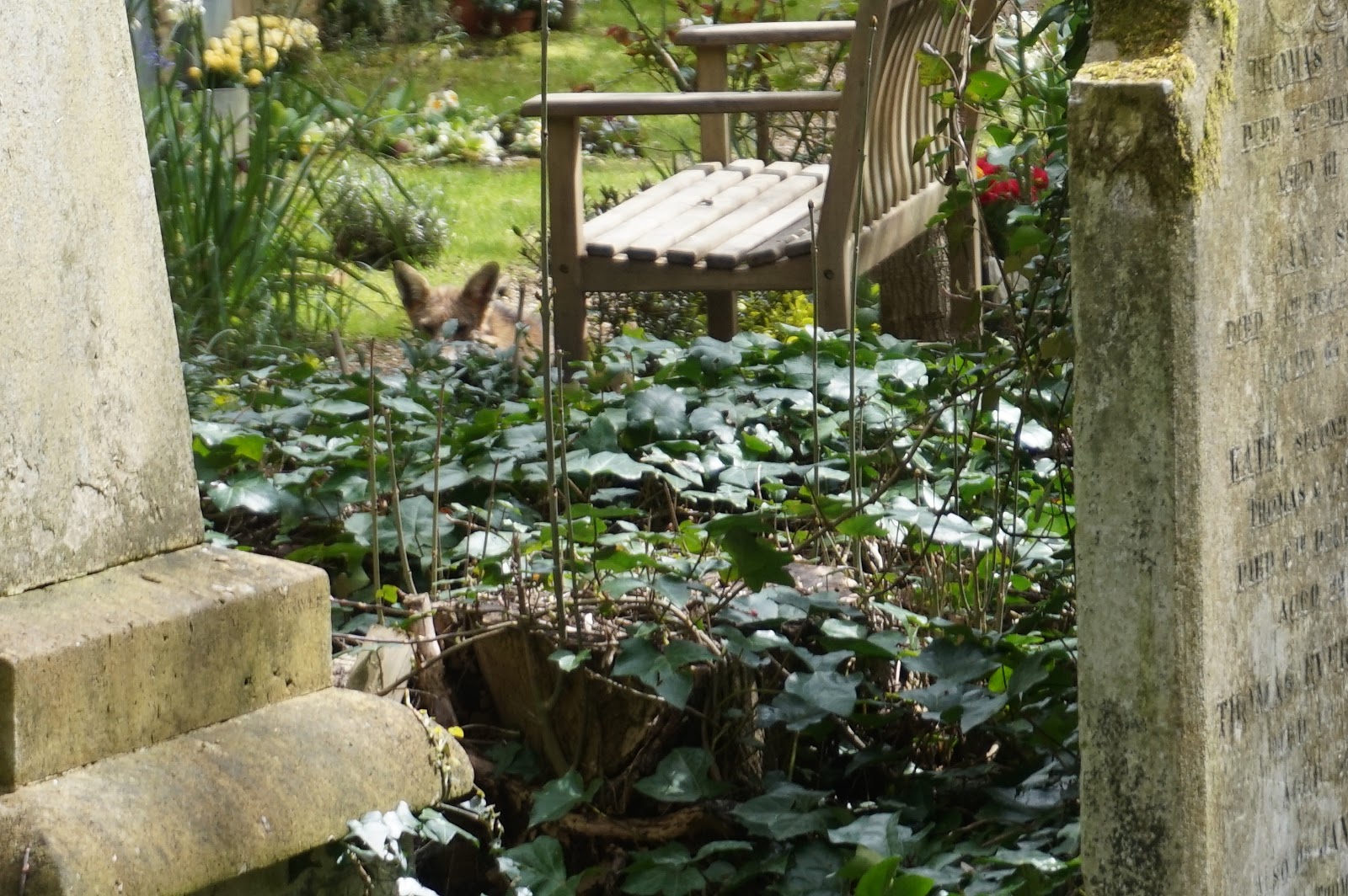
Another influence on Carroll was the pre-Raphaelite circle, including the Rossetti family - Dante Gabriel and Christina.  Below is an imagine of the Rossetti family plot in Highgate Cemetery, London.  Christina is buried here, and her name is on the flat stone on the ground.  The picture below is of a fox in the cemetery, which is a haven for wildlife.

Rossetti Family Plot - Highgate Cemetery, London
Fox in Highgate Cemetery, London (west)
Had Carroll not been remembered for his writing, he would have been remembered as the second-greatest photographer of the Victorian Era and the greatest photographer of children.  He was a very gifted artist, but, sadly, his reputation (as a person) has waxed and waned over the last century.  Many photographs he took of children were nude photographs, but he always took such photographs with the permission of the parents.  Also, it was the fashion of the time to take such photographs.  His writing too has gone through the scrutiny of Freudian psychology long after the fact, and people have come up with some pretty "interesting" and not so complimentary interpretations.  I side with Carroll biographer Robin Wilson who writes, "Sadly much nonsense has been written about Dodgson's friendships with children  .  .  .  .  Subjecting him to modern 'analysis' rather than judging him in the context of his time is bad history and bad psychology and says more about the writer than it does about Carroll."  

To that I say, "Amen!"

Here are some pictures of Christ Church College, Oxford.

Christ Church Cathedral as seen from the cloisters

Organ of Christ Church Cathedral

Court of Christ Church College, Oxford

Entrance to Christ Church, Oxford as seen from the road

A view of the entrance of Christ Church College from the court
In terms of mathematics, he worked particularly in geometry, logic, linear algebra and recreational mathematics.  Dodgson discovered a method for finding determinant of matrices that significantly shortened the process, especially for matrices of order 4 or larger; it is called his method of condensation.  He did excellent mathematical work with ideas relating to electoral reform.  In general, however, he was a very conservative mathematician who did not really break new ground, so none of his books have proven to be of enduring importance.

I am going to touch on two of his books, however.  I have enjoyed looking into The Game of Logic, which seems to me to include a method that would be an improvement on Venn Diagrams in working with syllogisms.  Another book that has endured has done so for historical purposes, and that is his work Euclid and His Modern Rivals.  Then, as now, there were arguments about how mathematics (and other subjects) should be taught.  For centuries Euclid's Elements was taught as if it were the Bible - with students actually memorizing its books and propositions by number as if they were chapters and verses in the Bible.  Others in his day wanted to use different geometry texts in which exploration and discovery were emphasized more than memorization, which sounds quite familiar to me in what is going on today with our pendulum swing between "back-to-basics" movements and "discovery-based" learning, as we are seeing right now with the Common Core fights raging around us.  Clearly this is nothing new.

I recommend Robin Wilson's 2009 biography Lewis Carroll in Numberland: His Fantastical, Mathematical, Logical Life.  I especially enjoyed excerpts from Carroll's (or should I say "Dodgson's") diary in which he expresses his thoughts about his teaching - his feelings when things went well and his self-doubt when things went poorly.  I found it impacting, eye-opening and touching to read about Lewis Carroll in Lewis Carroll's own words.


Sunday, April 17, 2016

Oxford Readings


Why, yes, yes I do take pictures of absolutely everything.  Why do you ask? :-)


Above is a close- up of the cover of the book I was here to consult.  It is a first edition (1557) Whetstone of Witte by Robert Recorde.  It is the first time the + and - signs are introduced into an English-language text, and it is where the equals sign is invented.  The author explains that he chose to use two parallel lines of the same length because he is tired of the "tedioufe repetition" of writing "is equalle to" between sides of every equation.  He chose two parallel lines of the same length "bicaufe noe.2. thynges, can be moare equalle."  It was interesting to see that the length of his equals sign (and his plus sign and his minus sign) was longer than the length of the word "bicaufe."

I took many pictures of the INSIDE of this book too, and it is a delight!  Seriously!  It proved to be an amazing, exciting treasure hunt!  It was definitely English I was reading, but, as you can see above it took some amount of deciphering - and part of that was not just the different spellings of words but also the font that was used in the the printing.  It took me quite a long time to figure out that what looked like "bse" was actually "use" even though I had context and two-thirds of the word figured out!

Unfortunately those pictures I cannot post, as I have pretty much sworn on my life and the lives of all my offspring for generations to come that the pictures I took of the contents are for my own research and not for print or electronic publication.  I feel OK having given the brief quotes above, as those can be found all over the place on the internet, and they are things I had seen and read previously - and therefore could have written here - prior to having opened this book.

Below is the shelf that kept catching my eye on my left side as I read.  And the picture beneath that is a larger view of the inside of the library.  Some day I'd like to camp out in this library for about 6 months!


Queen's College Library, Oxford
At the Bodleian my reading was different - correspondence rather than a book.  And it just now struck me today that some of the correspondence I read is EXACTLY 300 years after what I read in Queen's, 1557 and 1857.  The challenges of the reading were different.  Here the language is much closer to that of today, but it was hand-written.  The writing is exquisitely neat, but it is done in very small print with a quill pen, and that did prove to be a challenge.

Over the year and a half that I'd been preparing for this trip I came to have a strong interest in the life of Mary Somerville; the correspondence I read in the Bodleian was between Somerville & Grieg families and Byron & Lovelace families.  In other words the family of Mary Somerville (who married Captain Samuel Greig) and the family of Ada Augusta Lovelace (daughter of Lord Byron).

I was anticipating reading letters from Mary Somerville, but it seems her papers contain letters to her rather than from her - at least for the most part.  I was able to read about three-fourths of the correspondence, and, while I was initially disappointed at not finding letters written by Mary I became so taken up in the the stories of the lives as I read them that it became a more profound experience than I could have ever imagined it would be!

I'm not above admitting it's kind of fun to feel elite once in a while!

The Mackerras Reading Room in the Bodleian Library
There were two boxes of correspondence of the size you see pictured above and below.  This is a "pencils only" reading room.  All pens and other unnecessary items were stored in a locker downstairs; necessary items could be taken into the reading room in a clear, plastic bag.


Again, I can't show contents, but I can, in my own words, share what impacted me.  First of all I hadn't realized there was such a strong and lengthy connection not only between Mary and Ada but also between their families.  There was a deep and abiding caring for one another that in some instances almost made me weep as I read.

Three things stand out most of all as I reflect on what I read - but I'll share those only briefly now, as I will be doing a post solely on Ada very soon.  The first was a letter from Ada's mom (Lady Byron) to Mary regarding her pleasure at what a good influence Mary was on Ada - her scientific focus helping Ada keep a "balanced mind."  The second was to Mary from a young Ada asking if Mary would be her chaperone to a party Charles Babbage was putting on (actually, there was more than one such letter about more than once such occasion - the age difference between Mary and Ada is 35 years).  The third was a letter to Mary's son, Woronzow Grieg, from Ada's doctor in her final illness.

Thursday, April 14, 2016

Transitioning to "The Other Place"

I'm a "Bodleian Reader" :-)
I arrived in Oxford (or "The Other Place" as those in Cambridge call it - of course I'm finding out in Oxford that it is Cambridge that is referred to as "The Other Place").  The first thing I did was to head to the Bodleian to get my reader's card.  Though they had just closed moments before I arrived they graciously made an exception and went ahead and made my card for me.  Tomorrow (Friday), I'll be reading correspondence between mathematicians Mary Fairfax Somerville and Ada Byron Lovelace in the special collections of the Bodleian.

Actually, earlier in the day I'll be at the library of Queen's College, Oxford, in their special collections, consulting a first edition Whetstone of Witte (1557) by Robert Recorde - the book which contains the first recorded use of the equals sign and the first use in an English text of the plus and minus signs.

Anyone recognize this building?

So, as you can imagine, this is all super cool - especially having a card to the Bodleian (for which I had to take an oath, by the way, among other things!) -  but I'm having a really hard time appreciating it right now because I've been super sick for over a week now - but more on that later.

I was pretty worn out upon arrival, which took five hours composed of bus, train, tube, train, bus - via London - but which I have come to find out could have been accomplished by one bus straight from city to city.  I missed the second train, didn't have time for lunch, etc.  So once I finished up at the Bodleian I asked if there was an Italian restaurant nearby.  I needed something hearty and tasty that would make me happy.  I never did find it, but after walking further than I should have needed to I looked up and saw this, which I immediately recognized - was planning to eat there at some point anyway, so that settled it.  (Anybody know why this is famous?)


They make a wonderful macaroni and cheese - and just as I skipped the whiskey in Scotland, I'm skipping the beer in England - sorry folks, I realize that to some of you this sounds like heresy, but it's lemonade for me!


This morning I went to the Mathematical Institute, Oxford and toured the Andrew Wiles Building with its Penrose Tiles out front.


The entry is paved with Penrose Tiles.  I was told by my guide that because those who lay tile are inclined to form patterns and because the point of Penrose tiles is to be unpatterned, that Sir Roger Penrose himself had to be out here guiding the process so that the tiles were laid in the properly unpatterned way!


Roger Penrose - he of the tiles - has an office here and remains active at age 84.  I imagine Andrew Wiles has an office in this building named for him, but I didn't think to ask.  I did, of course, have lunch in the Cafe Pi.


So there's definitely cool stuff going on here, but I have to say I miss Cambridge and my connections there.  Thanks to Dr. Piers Bursill-Hall - who went so far beyond merely answering a question for me - doors were open to me like crazy, and I was able to see so many colleges and their chapels - and to eat in Trinity Hall (thanks to Richard!) - as well as to work in the Centre for Mathematical Sciences - and eat there too!

Yes, I have two libraries open to me here in Oxford and got a half-hour tour of the Mathematical Institute this morning, but this place feels like a really closed book.  At least at Cambridge even if I'd had no connections and was a tourist I could have paid to get into a variety of colleges:

St. John's Cambridge - open to tourists for a fee

Another Cambridge College - open to tourists for a fee
 Here's an Oxford college.  Can you tell?  Can you tell which one it is?  Can you get in?  Do you see the bouncer, um, I mean "porter" standing guard in black and white in the entry?
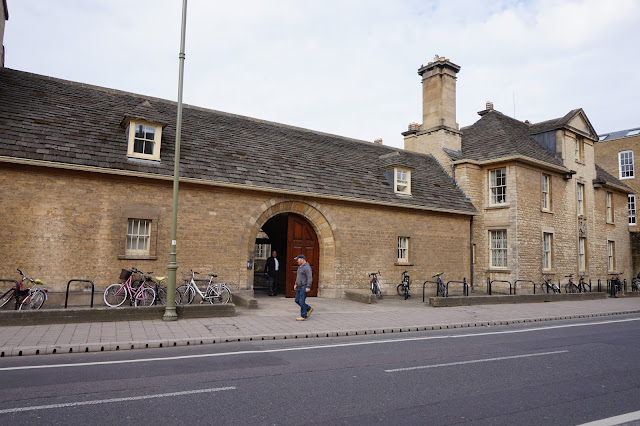

Oh, wait, what's that tiny, little sign just inside the left of the arch?  Oh! This is Somerville College!  I'd hoped to visit it because of my interest in Mary Somerville.  Maybe I will just leave it at this for this one.  If I were feeling better I might try, but not so much right now.  It just feels very closed-off here compared to Cambridge.


Obviously I miss my contacts - had no idea in advance that they would take me on board as they did.  Here's one of our LATE dinners in "The Core" of the Centre for Mathematical Sciences.  Many stories were shared, many math puns were bantered about, and, though I can't speak for them, a good time was certainly had by me!  Brilliant company, absolutely brilliant!


I was not feeling well then either, but somehow it's easier to deal with illness when one is not entirely and utterly solo.  I'm just going to be brutally honest, as awesome as a sabbatical in Europe sounds, when one has had a fever for over a week, feels like they've got bronchitis, cannot stop coughing, has a touch of stomach flu and also other very uncomfortable physical stuff going on too - it ain't pretty - especially when living in a small, cheap hotel room with pharmacies a half hour walk away and restaurants a half hour walk away and when there's no one around to look out for you or bring you stuff when you feel miserable.  (Piers took good care of me in Cambridge - got me to a pharmacy for cough meds and paracetamol - connected me by phone with a nurse who told me this is viral so no antibiotics - fine, but I wish I could get over it!  And now I'm totally solo and still just as sick if not sicker.)

If I didn't feel so miserable this would be kind of funny: when I open my mouth to ask someone something I actually do not know if any sound is going to come out at all or not.

Part of this is probably my own fault.  Just because a schedule can be put together like a tidy jig-saw puzzle with no gaps doesn't necessarily mean that it should be, I suppose.  If the idea of driving in totally foreign territory with a reversed car in a country that drives on the opposite side of the road than one is used to sounds TERRIFYING - especially if one isn't even really comfortable driving in their home country where everything is familiar - then perhaps the added stress could weaken the immune system.  And, though this piece couldn't be helped, being served breakfast by someone at a B&B (10 days ago) who kept complaining about how she's been really sick and just can't get well probably didn't help the situation - just some thoughts.

Here's a snap of part of my schedule:


But right now it just kind of looks like this:


If any of you reading this are of a praying persuasion, I would sure appreciate prayers.  Thanks!