|
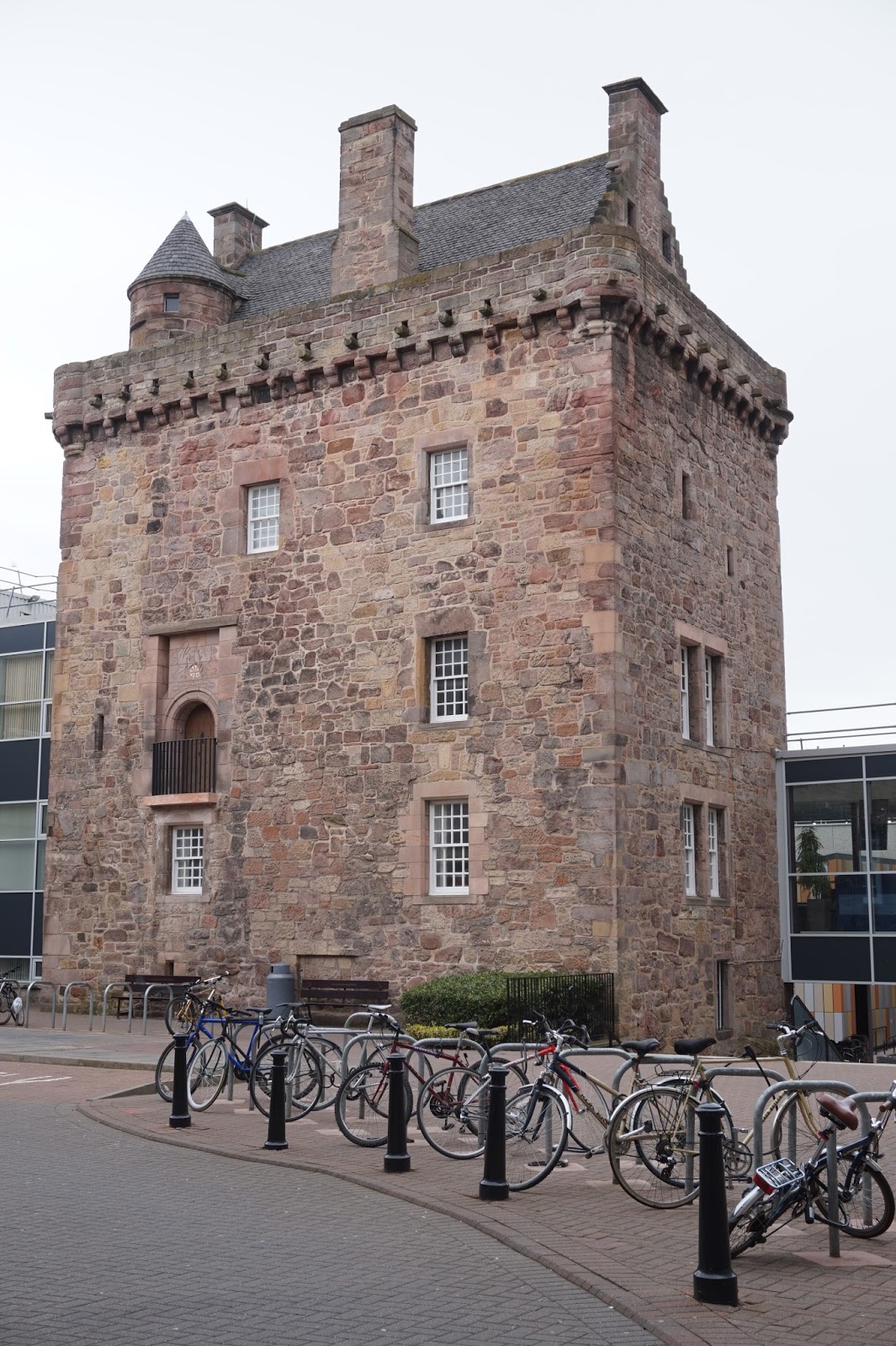
| Near Napier University, Edinburgh, Merchiston Campus |
John Napier (1550-1617) was THE reason I decided to include Edinburgh on my trip. His life is one of the most intriguing of all the mathematicians I'll be researching. I had planned to stay in Edinburgh just a couple of days, mostly just in order to get pictures of Merchiston Tower (his birth-place) along with seeing sights that would have been familiar to him - the Firth of Forth - Edinburgh Castle and Arthur's Seat, which still dominate the skyline - St. Cuthburt's Church, which he attended and where he served as elder - etc.
In my studies prior to leaving, however, I learned of so many other famous and interesting mathematicians associated with Edinburgh, such as
Colin MacLaurin,
Thomas Bayes,
John Playfair,
James Clerk Maxwell,
Peter Guthrie Tait, and, most especially,
Mary Fairfax Somerville, that what was going to be a two-day stay extended to a six-day stay instead! But, back to Napier for now . . .
 |
| Merchiston Tower |
He lived in a CASTLE! How many mathematicians can you say that about? He was the 8th Laird of Merchiston. In mathematics he's mostly known for inventing logarithms*, popularizing the use of the decimal point, and creating a calculating device known as Napier's Bones or Napier's Rods. He also developed plans for inventions for wartime machines similar to those that had been devised by Archimedes and Leonardo da Vinci - a means of focusing the sun's rays on enemy ships so as to burn them, a submarine-like device, and a tank-like device. He also developed advances in agriculture to improve the yield of crops.
 |
| Napier Tower within Napier University, Edinburgh, Merchiston Campus |
Most non-mathematicians do not look back with wistful pleasure on their days of learning logarithms in intermediate algebra class (especially those of us who learned them before calculators, back in the day when we used the tables printed in the back of our textbooks). The development of logarithms was such a helpful breakthrough, however, for navigators, astronomers and others - simplifying their calculations so much that Napier was said to have "doubled the life of the astronomer." So impressed was Oxford mathematician
Henry Briggs** that in 1616 he traveled to Edinburgh to meet this great man. Napier was honored to receive such a visitor, an Oxford mathematics professor. When Briggs finally arrived he and Napier - so mutually impressed with each other - stood and stared at one another for nearly a full quarter hour.
Napier was born not long after the Protestant Reformation, and he "was a religious extremist, but one in a world of religious extremes."*** Out of his convictions he wrote a book titled
A Plaine Discovery of the Whole Revelation of St. John (1593), in which he claimed the current pope, Clement VIII, was the Antichrist. Though we today view his discovery of logarithms as his most important work it was this religious book that he considered the most important work of his life. He also used the book of Revelation to predict the timing of the end of the world (between 1688 and 1700). I, for one, am very thankful that he was wrong about this!
What I find most interesting about Napier is that he was so clever that he appeared to have magical powers. His servants and neighbors considered him to be a sorcerer or necromancer, and it seems it suited his purposes to allow, and even encourage, that sense of him to remain. It is said he carried a black spider around with him in a box, as if it was his "familiar." He also had a pet black rooster that was considered by some to be a familiar also.
Here are a couple of stories of his cleverness - or perhaps magic!
One of Napier's servants had been stealing from him, so he gathered all of his servants in order to determine who the thief was. He lined them up outside a darkened room and told them that his familiar black rooster in the room would be able to tell him who the thief was. The servants were instructed to go, one at a time, into the room and pet the rooster. This did enable him to determine who the thief was. (HOW?) He had covered the black rooster in coal dust. The innocent servants had no fear of petting the rooster and came out with blackened hands. The thief, under the impression that Napier was a sorcerer, had reason to fear and did not touch the rooster, and therefore was the servant who came out with clean hands.
Other than a thieving servant, Napier faced the problem of the seed and grain in his fields being eaten by his neighbor's pigeons. Napier warned the neighbor that if the birds flew into his fields again he was going to catch them and keep them. The neighbor just laughed at him. The next time the pigeons flew into his field, Napier was out there picking them up and putting then into a sack. (HOW?) He had soaked peas in brandy and sprinkled them in the field. Napier was able to pick up the pigeons because they were drunk and unable to fly.
*****************************************************************
For as much as Napier was a stunningly clever man, he cannot truly have been considered to be a sorcerer - at least not by anyone in power. During his lifetime people who practiced the dark arts were executed. (King James VI of Scotland, who ruled during Napier's lifetime, is the only monarch ever to have written a treatise on witchcraft, bringing new vigor and determination to those who persecuted witches.) Not only was Napier not executed, but he, as we've seen earlier, was a profoundly religious man. In fact, he was an elder in his church, St. Cuthbert's Parish Church in Edinburgh.
The current building was erected in the late 19th century, but though it is not the building that he would have worshiped in, it is the site at which he worshiped and is the local congregation of which he was a part. Also, he is buried here (though the exact location of his grave is not known), and he is memorialized within the church.
 |
| St Cuthbert's Parish Church, Edinburgh (east facade) |
 |
| Interior view of east of church |
 |
| St Cuthbert's Parish Church, Edinburgh (west facade) |
 |
| Napier Memorial (in foyer of church just past the sanctuary doors) |
 |
| Napier Memorial - St. Cuthbert's Church |
In the first picture above you'll see that his name has been Latinised to Ionnas Neperi. We write his name as "John Napier," but
he never spelled his name that way. His first name was sometimes spelled Jhone. His last name was spelled at various times as Napeir, Nepair, Nepeir, Neper, Napare, Naper, and Naipper - but never Napier. From what I understand this wasn't uncommon at that time and even Shakespeare, that great literary figure who was almost an exact contemporary of Napier, did not always spell his own name the same way each time he wrote it.
*****************************************************************
During my time in Edinburgh I visited as many sites as I could associated with Napier. One such site is Lauriston Castle, which was the home of John Napier's brother Alexander. (A home had existed at this location since medieval times, but the earlier home was destroyed in 1544, and a tower house was rebuilt here in 1590 by Napier's father for Napier's brother.)
 |
| Lauriston Castle, Edinburgh |
At the back of the castle are sweeping lawns that drop down to sheep pastures and then to the waters of the Firth of Forth. These grounds are made good use of still today. In the next two pictures you can see people playing on the croquet fields. Local people with whom I spoke let me know that they had been here to a production of a Shakespeare play the previous summer and that this venue hosts many different events for the community. Also on the grounds are two famed gardens - the Rose Garden and the Japanese Garden.
 |
| Lauriston Castle from the back |
*****************************************************************
A bit more of John Napier's cleverness before closing. I made mention early-on in this post of Napier's Bones, also known as Napier's Rods. This was an early calculating device invented by Napier that was so useful that Sir Isaac Newton used these and recommended them for use in repetitive computation. I own a copy like the set pictured below. The size of it is about 9 inched long by 9 inches wide. In order to use it you remove the bones from the frame put together the digits that create the number you wish to multiply. If I wish to multiply 8 by 523, I would take out rods 5, 2, and 3 and set them next to each other in that order, and I would go down to the 8th row, adding along the diagonals to get my answer. There is a second set of rods in the frame below the first set in case a digit is doubled in a factor you are working with.

While at Lauriston Castle I was told that an original set of bones had been recently found and were on display at The National Museum of Scotland, so, so much for a little down time on Sunday afternoon, off I ran to the museum instead of back to the hotel. Once I was in the building it was quite a treasure hunt to find the display housing these in this 5-story museum in which staff wasn't quite sure where it was - one person sending me one way and one another. Once I was in the right room the black rooster in the case should have caught my eye immediately!
Along with the rooster are two sets of Napier's Bones and two precursors to the slide rule, which used logarithms in order to do calculations. These were invented by someone other than Napier but using his ideas.
 |
| Napier's Bones |
You can see the similarity of the set above to my set. I was somewhat disappointed to find out that neither of these sets were original to Napier. One set is 17th century, and one is 17th or 18th century, but upon reflection I think it says something about his invention that it was still being used 100 years and more after his lifetime!
This set is quite small, and I've included the next picture for scale. The white cube in the center is the size of a 6-sided gaming die. I stood there wondering why these were made so small! I guess it makes them convenient to carry, but did people have better eyesight then than we do now? Each set comes with a carrying case.
 |
| Two sets of Napier's Bones |
Napier is certainly a mathematician with whom I am especially impressed!
 |
| John Napier |
*****************************************************************
* To be fair I should add that Swiss craftsman
Joost Burgi (1552-1632) is also credited with having invented logarithms. Both men were born in the 1550s, so, apparently, this was an idea whose time had come - as with Newton and Leibniz both having independently invented calculus in the mid-to-late seventeenth century.
** Henry Briggs followed up on Napier's work and developed the base 10 logarithms, which, along with log base e, are the most common logarithms used today. In fact, they are known as common logarithms or Briggsian logarithms.
*** Quoted from Julian Havil's book
John Napier: Life, Logarithms and Legacy (2014). Note that at the time Napier wrote his
Plaine Discovery there were rumors that Catholic King Philip of Spain was going to invade Scotland, and that the Spanish Armada had just sailed 5 years previously.