I've always wanted to visit the British Library and had never had a chance previously. This is my third visit to London, so I guess the third time really is the charm! Though I do post about important libraries and museums, most of my posts on this "mathsab" blog are about mathematicians and are for use as reference for my students. I was so excited to be at the British Museum and British Library, however, and was excited for so many reasons, that I've let this post become very personal. I think my liberal arts students will be OK with that - seeing a bit of music and literature and archaeology and geography - and also seeing that I too am interested in subjects beyond mathematics.
Precious books and permission to access them! Wahoo!
I love the inscription at the top of the card. I am here to do research, but I know I will find inspiration and enjoyment. In fact, that has already begun! The library itself is just jaw-droppingly beautiful, and, among other things, it has a very large exhibition room where anyone can wander in and see treasures from many fields: music, science, literature, geography, etc. I'll give a visual tour of the library and exhibitions first and then zoom in on what it was the drew me here very specifically.
The Terrace Restaurant
The following photographs are but the smallest sample of what is contained in the exhibition rooms.
God is Our Refuge (Mozart, age 9)
Earliest known printed world map to show America (an extension of Asia)
Jane Austen's writing desk with a letter to her brother Frank on top
Some of the Angria juvenilia by Charlotte Bronte
The Gondal Poems by Emily Bronte
Those of you who know me well are probably surprised I was capable of taking pictures of the above Bronte works rather than fainting dead away from excitement! Are you kidding me?! Emily Bronte's poetry in her own hand! (I can't help but think how upset Emily was when her sister Charlotte got into her things and discovered these poems. Emily was so private, yet here this is on display for all the world to see . . . of course they had ended up publishing after that episode, so . . .)
And above we have the philatelic collections, and below we have books, books, BOOKS!!!
OK, so certainly all of the above was way more than enough to draw me here! But I am actually traveling on sabbatical to study The Sorcerer Mathematicians of the Renaissance, and I was here for Dee, John Dee.
I wish I could show pictures here of this scroll unrolled. I may be able to in a later post; I just need to write the permissions department at the library and get an OK first. It contains the genealogies of John Dee and Queen Elizabeth I (hence their relationship to each other, which Dee was trying to promote as he sought position at court), and these lines of descent go all the way back to King Arthur and his father King Uther Pendragon! The scroll is filled with beautiful calligraphy, paintings of heraldic shields, and a self-portrait by Dee (thought to be the only extant contemporary likeness of him). I touched and handled this scroll, hand-drawn in the 16th century by John Dee. I know I'm repeating myself, but I can't stress strongly enough how surprised I was to be able to access this scroll. Dee has become a very popular cult/occult figure, and this scroll is well over 400 years old. It just goes to show you what kinds of doors can open to a math professor on sabbatical, and I am humbled and privileged in this!
*****
After that I almost can't write about anything else, but later that evening I also went to the British Museum. Here too the focus was Dee. I had already seen Dee's items on display at the Royal College of Physicians four years ago, but I wanted to see them in their usual home - different display, might hit me differently, who knows. I'm going to wait to share pictures of that display, but I will share other images of and from the British Museum.
King Nebuchadnezzar II's Babylon
Mummies
I don't usually spend too much time in the Egyptian section. It's amazing and everything, but the history goes back so many thousands of years that my brain can't process it, and I end up feeling like I've fallen into a black hole!
I do always gravitate to two items when I am at the British Museum: The Rosetta Stone and the Elgin Marbles. In the first picture below I'm actually wearing a shirt that I just bought that has the Rosetta Stone on it, but the lighting is such that you'll just have to take my word for it. (I don't normally buy souvenirs, but for this I made an exception! It'll be a good shirt to wear in my classroom when I'm teaching multiplication with Egyptian numerals!)
OK, I know some of you do read Greek. How ya doin' with the lower script in the image below?
Elgin Marbles:
Why did I not realize that the actual original of the Royal Game of Ur would be on display? This was another moment of nearly fainting.
The Babylonian tablet below contains directions for the game - the earliest known set of directions for a board game - and it was museum curator Dr. Irving Finkel who painstakingly translated the directions and therefore revived this once universal game!
In the following YouTube Dr. Finkel talks a little bit about this discovery and translation. He is a hero of mine, and I was keeping my eyes open hoping to see him at the British Museum! (But then I really would have fainted - though only after getting a selfie with him!)
And may I just say, DR. FINKEL, SIR, YOU ROCK!!!!
OK, I don't know where to go from there, so I'll stop. That was an awful lot of excitement in one day! I'm posting this on my fourth day, and I have no idea how I'm going to keep up with this! There is just too much awesome stuff!
As mentioned in my introductory post, a goal I have in my research is to study the work (and lives and ideas) of these mathematicians on their terms. Keep in mind as you read, though, that I am a math professor digging into history that I'm passionate about and that I am not a history professor trained in methods of historical research. So I will study my Renaissance mathematicians on their terms as best I can. In my previous sabbatical most of the mathematicians I researched lived in the 19th century; in this sabbatical I'm focused on the 16th century, and that makes QUITE a difference!
To put this in perspective, my great-grandfather, whom I knew and interacted with, was born in 1877. Also, my "first best friend," our next door neighbor when I was a little kid, was born in 1890. She was part of my life for 20 years. So it feels to me like the 19th century is within my reach, so to speak. This is not even close to being the case with the 16th century - a time before the industrial revolution and before the Age of Enlightenment - a time when there was no distinction between alchemy and chemistry nor between astrology and astronomy. The New World had been "discovered" by Europeans only 9 years prior to the birth of Girolamo Cardano. This was an era of cataclysmic change -- an era of Renaissance and of Reformation. Europeans had only known One World and One Church for over a thousand years prior to this, and suddenly there were two worlds and multiple churches. Trying to truly get my head into a 16th-century mindset feels like traveling to an utterly different universe.
Egyptian Rosicrucian Museum (front entrance), San Jose, California
As a professor of mathematics I teach math -- seems obvious, right? But in the 16th century a mathematics professor would have primarily taught astronomy and astrology; the math would have been seen mainly as preparation for those other, more important topics. Among other things, astrology was considered an important part of the practice of medicine. Part of diagnosing a patient involved determining the impact of the heavens on their health and life. Many scholars of the time were also alchemists, as was Sir Isaac Newton a full century later! Yet today we consider astrology and alchemy to be pseudoscience at best, and perhaps even demonic at worst. And yet I know Cardano, Dee and Napier to have been not only intellectual giants but also devout Christians. If I am to try to understand these scholars and their work on their terms -- at least to the degree that I can, I need to work on wrapping my mind around alchemy and astrology as used and seen in their world, in their time. And so, as a start, I set off for the nearby Egyptian Rosicrucian Museum in San Jose, California in order to see their newly installed alchemical exhibition.
Reproduction of an Alchemists Workshop
Reproduction of an Alchemists Workshop
Mathematician John Dee studied the works of the English Augustinian canon and alchemist George Ripley (1415-1490). This Rosicrucian museum has a replica of a Ripley Scroll, an alchemical document with references to the philosopher's stone. None of the 23 original such scrolls in existence were created by Ripley himself, but many do contain poetry associated with him and are therefore named for him.
Reproduction of a Ripley Scroll, Egyptian Rosicrucian Museum (2020)
I was privileged last summer to have seen one of the 23 originals still in existence. It was being displayed publicly for the first time and was at Edinburgh's Royal College of Physicians.
A Ripley Scroll, Royal College of Physicians, Edinburgh (2019)
I made this trip to San Jose about a month ago and had at that time written a lot of words in what remains of this post. Since that trip I have done a great deal of reading, and I have found even more deeply the truth of the maxim "The more you know, the more you realize you don't know!"
A sample of the eclectic collection of books I've been reading on the alchemy and astrology of my mathematicians.
As Alexander Pope so wisely writes:
A little learning is a dangerous thing;
Drink deep or taste not the Pierian spring:
There shallow draughts intoxicate the brain,
And drinking largely sobers us again.
So I have cut most of the rest of my words - will leave this mainly to pictures - and will leave it simply as evidence of my first foray into this area of study.
Alchemical Mandala: Azoth of the Philosophers
Prayer Chamber and Work Area of an Alchemical Laboratory
Replica of the Emerald Tablet of Hermes Trismigestus
So, given that my studies involve the Renaissance Era, why was I at a museum focused on ancient Egypt? Well, the word alchemy itself comes from the Arabic word "al-khemiyah," which literally means, "the black soil of Egypt." The Emerald Tablet (replica pictured above), written using the Phoenecian alphabet, is the core text of alchemy and is said to have been written by the Egyptian priest Hermes Trismigestus ("Thrice Greatest Hermes"), who is associated with the Thoth, the Egyptian god of science. Alchemy goes back at least as far as Greco-Roman Egypt, and it spread throughout Europe, Africa and Asia. It differed by varying degrees in different times and different places, but the Renaissance was a time of looking back to ancient sources, and so its Hermetic and Platonic foundations (which also became mixed with Christianity -- Hermes' writings being seen as priscia theologia) were honored above changes in alchemical practice and thought that had come about in medieval times.
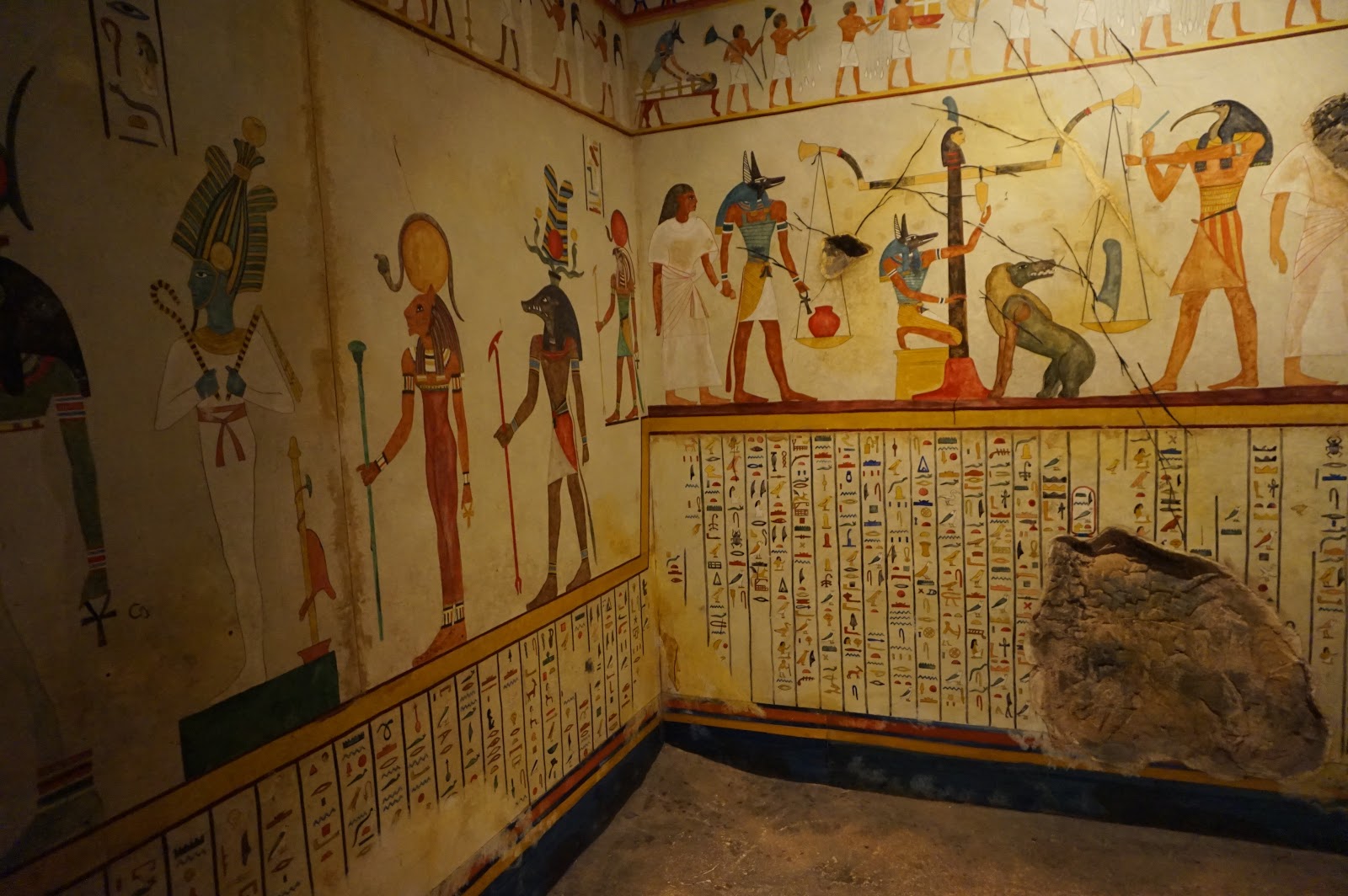
I'll close here with other images from the Egyptian Rosicrucian Museum and am looking forward to the European part of my explorations.
Note the x-ray of the Mummy below the Mummy
Post Scipt: I should be leaving in 6 days for my Europe travels and studies, but things are still up in the air as the new coronavirus COVID-19 situation continues to develop. It's very weird to be gearing up as much as I am and to be so close to my departure date and to not be sure if it's going to happen or not.