|
| Babbage's Difference Engine |
Ada, Countess of Lovelace (1815-1852) was born Augusta Byron, daughter of the poet George Gordon, Lord Byron and his wife Anne Isabelle Milbanke. They were married in January of 1815 but separated in January 1816 when Ada (as she was nick-named by her father) was one month old. Four months later he left the country and never saw her again. Despite this, and his reputation as a womanizer (one woman with whom he had a publicly well-known affair called him "mad, bad and dangerous to know"), Ada requested to be buried next to her father in the family vault at the Church of St. Mary Magdalene, Hucknall, England.

A poet of Byron's stature would normally have been buried in Poet's Corner at Westminster Abbey, and his remains were sent there, but the Abbey refused to bury him there for the reason of "questionable morality." (The Abbey finally put in a memorial stone to him in Poet's Corner in 1969; he died in 1824.) Following are more pictures of Lady Ada and Lord Byron's resting place at Hucknall, which seems quite proud to have them both there.
The light you see shining up out of the grave is for a wreath that was given at the time of his death that has been well preserved and proudly displayed.
There's also an opening that allows for viewing into the vault.
Along with the grave, there are also wall plaques and a stone in the floor. The marble stone in the floor was sent by the King of Greece. Lord Byron had died in Greece - having given money to the Greeks for their war of independence from the Ottoman Turks. His money went to refit the Greek fleet. Byron had planned to be part of the attack on the Turkish-held fortress of Lepanto, but he fell ill and died of his illness. The Greeks saw him as a hero, and the marble slab in the floor of the church in Hucknall was given by the King of Greece.
Though Ada never knew her father, she was fascinated by him and came to call herself a "poetical scientist."
 |
| Portrait of Lord Byron - Charlotte Bronte Bicentennial Celebration - National Portrait Gallery - London |
Ada's mother, on the other hand, did everything she could to make sure that Ada did not grow up to be a crazy poet like her father. Anne Isabelle (Annabella, as she was known) made sure that Ada's instruction was focused on mathematics and science in order to make sure she developed a disciplined and balanced mind - rather than an insane, poetic mind. This is in strong contrast to other female mathematicians prior to the twentieth century, all of whom I know had a tremendous struggle to gain mathematical education due to societal or familial concerns that studying mathematics would be too much for a woman's mind to handle and would perhaps drive her mad.
One of these other female mathematicians who had had to struggle in order to study mathematics and whose family feared she would go mad (her father said they would have her in a strait-jacket if she didn't stop studying mathematics) was
Mary Fairfax Somerville of whom I
posted earlier. She was 35 years Ada's senior and became one of Ada's math tutors. Another of Ada's math tutors was
Augustus de Morgan, but though he was her tutor, even he felt that mathematics was too much for the mind of a woman in general. He wrote to her mother that women should avoid doing hard mathematics - "the reason is obvious - the very great tension of mind which mathematics requires is beyond the strength of a woman's physical power of application." In the same letter he stated, however, that Ada unquestionably had as much power as would require all the strength of a man's constitution.
Mary Somerville and Ada developed a close friendship, as did their families. Mary mentored Ada, and it was Mary who introduced Ada to
Charles Babbage, he who developed ideas for early computing devices - the Difference Engine and the Analytical Engine - and is considered by some to be a father of modern computing. He is described as a pre-eminent polymath among the many polymaths of his day - involved in mathematics, inventing, philosophy and mechanical engineering.
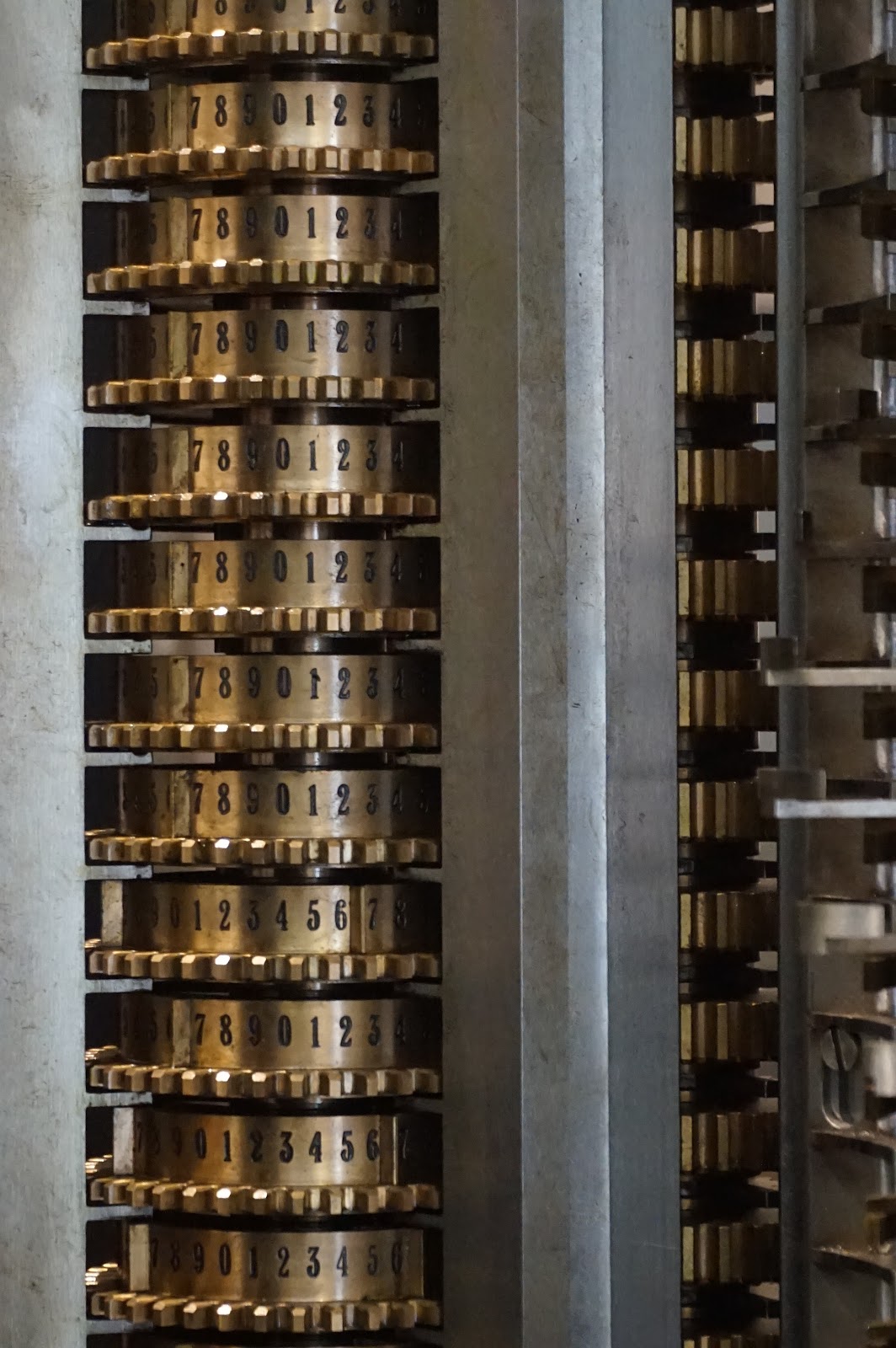
The pictures below and the picture at the very top of this post are of the uncompleted Difference Engine on display at the National Science Museum, London.
Babbage was not the only well-known personage with whom Ada was in contact. Among other acquaintances were Michael Faraday and Charles Dickens. Ada's life was one of privilege, and at one point she nearly became a lady-in-waiting to Queen Victoria.
I had opportunity as part of these studies to read the correspondence between the Byron/Lovelace and Somerville/Grieg families, and it was amazing to see this relationship unfold. Early-on Ada's mother writes to Mary Somerville of her appreciation for the affect she has on balancing Ada's mind. Later Ada herself writes to Mary and sweetly asks her if she will be her chaperone to go to parties put on by Babbage so that she could interact with him and learn more about his computing machines. Ada threw herself into understanding the Analytical Engine, and saw, even more than Babbage did, the full extent of what it could do. She saw that the hardware was only half of the story - and that the computer needed software if it were to be able to calculate any type of equation (Babbage's vision having been mostly about number-crunching and creating tables of logarithms).
 |
| Ada Byron Lovelace - from a display in St. Mary Magdalene Church, Hucknall |
 |
| Display at St. Mary Magdalene Church, Hucknall |
 |
| From a display about Ada in St. Mary Magdalene Church Hucknall |
In her twenties Ada said to her mother that she wanted to compensate for her father's misguided genius, expressing that if he had transmitted any portion of his genius to her that she wanted to use it to bring out great truths and principles. She is indisputably the world's first published computer programmer. She saw the possibility of interchanging numbers and symbols, and one example of her vision is that of an engine that might compose elaborate, scientific music. After her death her works seems to have been forgotten for a while, but when
Alan Turing was working on building The Bombe to help break the German Enigma Code during WWII he came across Ada's work, and it is thanks to him that her work has come fully to light. A new programming language developed in 1986 and used by UK air traffic control is called ADA, which is very fitting since Ada had invented a mechanical bird when she was young; now Ada has finally gotten to fly!
There's so much I wanted to share about Ada that I fear this post is very disjoint! I think that any commentary about her life needs a book, or maybe an epic poem, rather than a blog post! But this is the best I can do for now.
 |
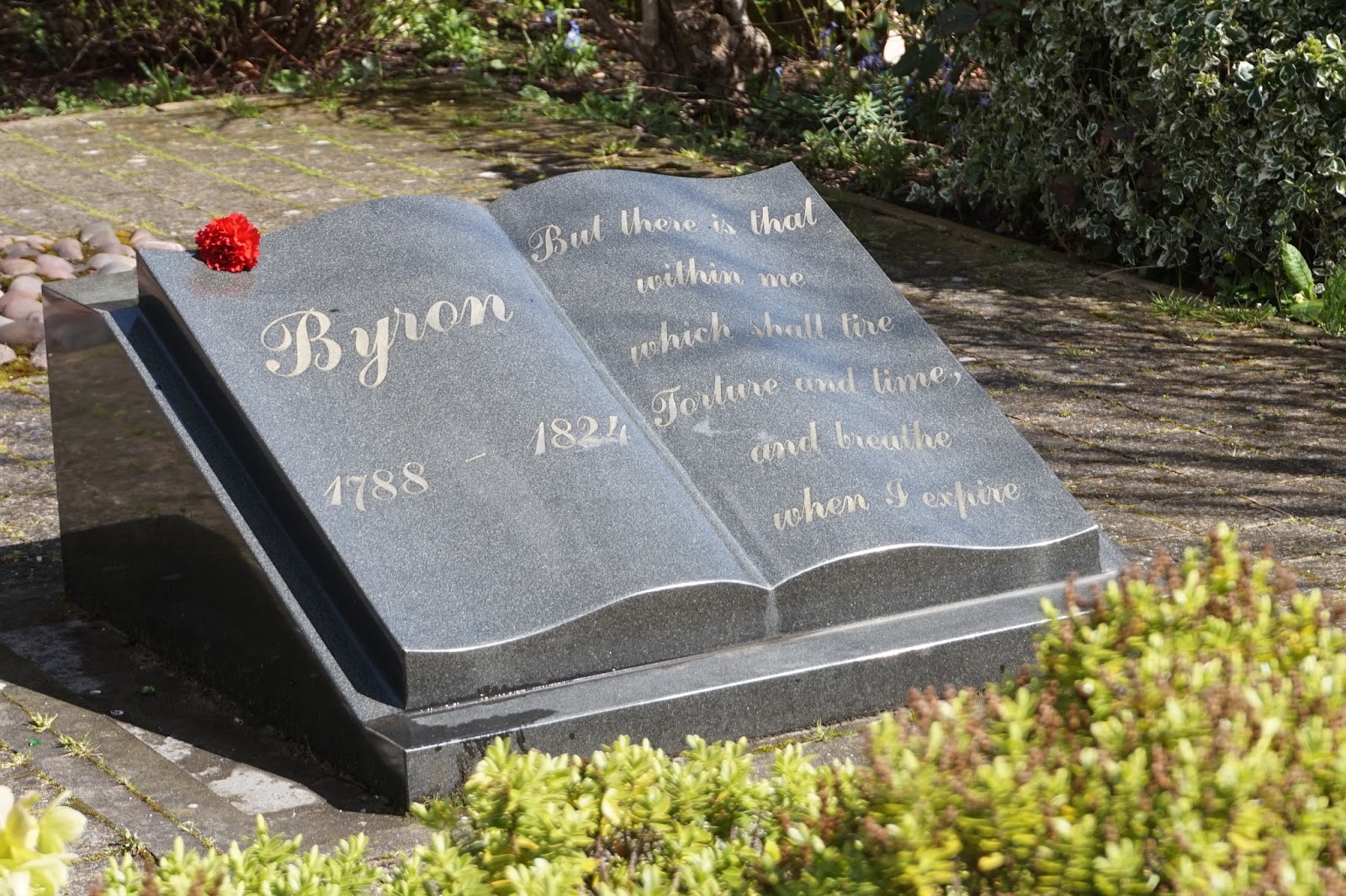
| Lord Byron's memorial outside St. Mary Magdalene Church, Hucknall, England |
Ada died at age 36, the same age at which her father had died - he of fever, she of cancer. Because of the closeness of their families, Mary Somerville's son Woronzow Grieg wrote to Ada's doctor asking him to send on any news. I know this from the reading I did of the correspondence in the Bodleian at Oxford, and when I read the letter from the doctor I was in tears. The doctor let Woronzow know that it was cancer and that there was no hope. He ended his letter by saying that while a doctor is necessary in such circumstances, the best a doctor can ever hope for is to RESTORE health, but in this case the best he could hope for was euthanasia - in other words a "good death."
On her father's memorial outside the Hucknall church is a quote from his work Childe Harold's Pilgrimage, "But there is that within me . . . that shall breathe when I expire." I'd certainly say that is true of Ada!