Showing posts with label Maclaurin. Show all posts

Sunday, June 14, 2026

A Grave Matter


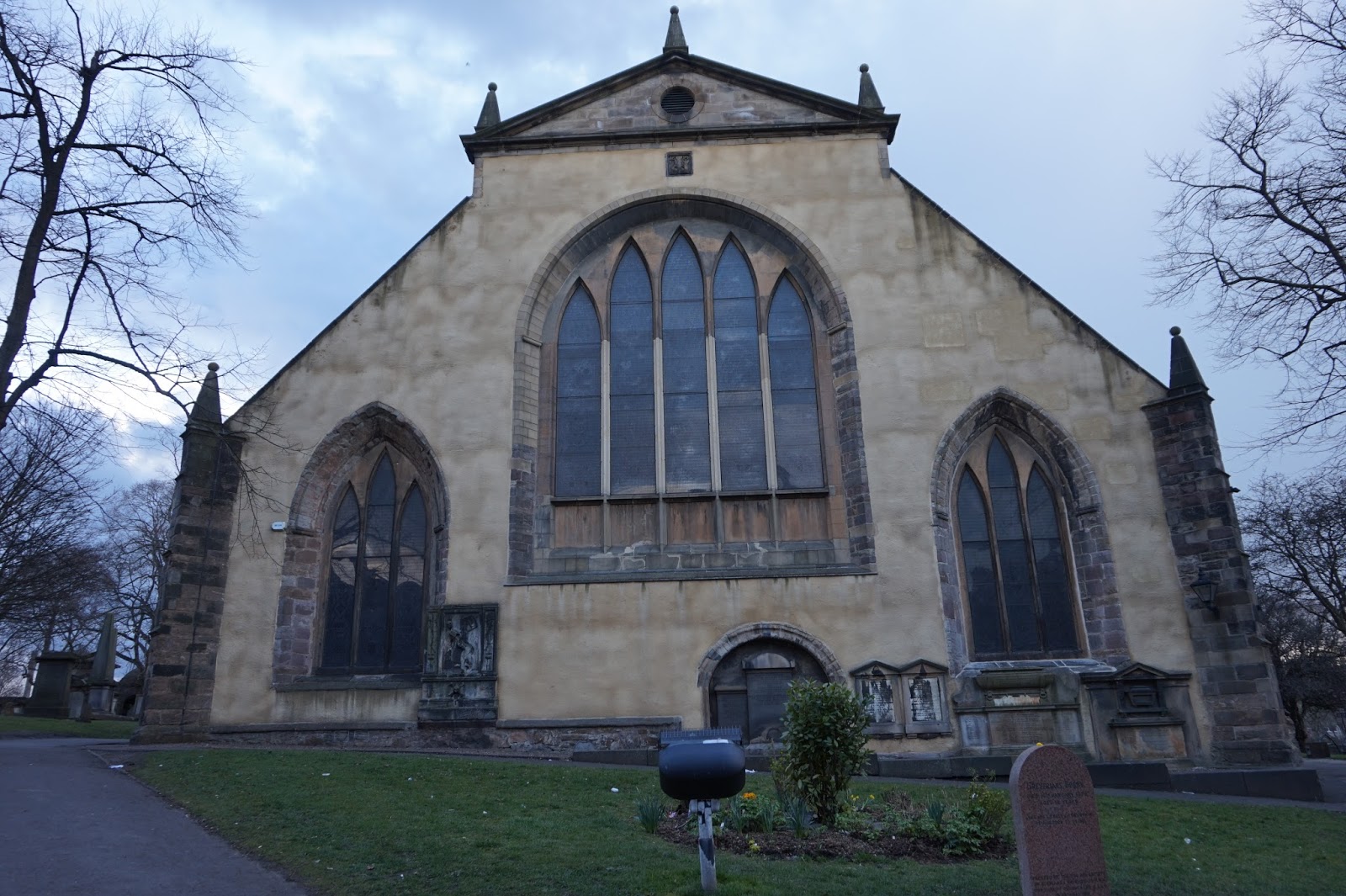
Greyfriars Kirk, Edinburgh, Scotland

This post honors Colin Maclaurin who died 280 years ago today (June 14, 1746) at the age of only 48. I first visited his grave - or tried to - ten years ago, but I only found a memorial tablet. It was only on my most recent trip to the UK that I actually saw his grave. In the post for that first visit, which can be found at this link, I shared quite a bit about his life. In this post I'll be focusing on his tombstone and on the comfort found in the words on his memorial.

Colin Maclaurin Memorial Tablet, Greyfriars Kirkyard
My first visit was rushed. I had about a month's worth of math-history related things to do and only five days in which to do them, so I hurried into Greyfriars Kirkyard as evening fell and temperatures were dropping - not knowing when closing time was, and unsure if I might get locked in overnight. I finally found the memorial tablet, which is the top right plaque on the south-western exterior of the church. 
Greyfriars Kirk, Edinburgh, Scotland
What I didn't notice, as I stood tip-toe to read the plaque, is that Maclaurin's I was standing, unseeing, right next to Maclaurin's actual burial site. I had probably stepped around it to get a better view of the memorial. Directly below his memorial tablet in the picture above, you can see a table stone, which is his gravestone. Below is a closer view.
Colin Maclaurin's Grave, Greyfriars Kirkyard
I feel a little silly at my oversight as I reflect on that first visit, but to be fair, I was rushed and more than a little scared. My focus was up high, not down low, and, even if I had been looking down, the inscription is incredibly faded. It is also quite minimal, having only the initials C. M. and his year of birth and death given in Roman Numerals.
Colin Maclaurin's Tombstone, Greyfriars Kirkyard
Now that we've taken a look at his tombstone, I want to go back to his memorial, but only after sharing a few pictures of the kirkyard, which is often said to be the most haunted graveyard in the world.
Detail of Funerary Art, Greyfriars Kirlyard, Edinburgh

Detail of Funerary Art, Greyfriars Kirlyard, Edinburgh

Detail of Funerary Art, Greyfriars Kirlyard, Edinburgh

Detail of Funerary Art, Greyfriars Kirlyard, Edinburgh

Detail of Funerary Art, Greyfriars Kirlyard, Edinburgh


Detail of Funerary Art, Greyfriars Kirlyard, Edinburgh

Detail of Funerary Art, Greyfriars Kirlyard, Edinburgh
I share the pictures above in order to highlight the words on his memorial.
Colin Maclaurin Memorial Tablet, Greyfriars, Edinburgh

The words of this memorial not only honor Maclaurin but are also intended to bring comfort to those visiting here. I'll give these words first in the Latin and then in English:

***

Infra situs est Colin Maclaurin Mathes olim in Acad. Edin. Prof. Electus ipso Newtono suadente. h.l.p.f. Non ut nomini paterno consulat. Nam tali auxilio nil eget. Sed ut in hoc infelici campo. Ubi Luctus regnant et Pavor. Mortalibus prorsus non absit Solatium. Hujus enim scripta evolve. Mentemque tantarum rerum capacem. Corpori caduco superstitem crede.

***

Here lies Colin Maclaurin, once Professor of Mathematics at the University of Edinburgh, chosen for that post at the urging of Newton himself.

This memorial was erected not to preserve a fame that needs no preservation, but that in this sorrowful place, where grief and fear hold sway, visitors might find some comfort.

Read his works. Reflect upon a mind capable of such achievements, and believe that it survives the frail body that once contained it. Then consolation will not be far away.


Friday, April 1, 2016

Colin Maclaurin and Greyfriar's Kirkyard

Yea!  Technology is cooperating, so I can finally post this!

The day before yesterday I posed a "teaser" in anticipation of this post.  The teaser asked what Lord Voldemort (of the Harry Potter series) has to do with mathematician Colin Maclaurin.

Answer: They are buried in the same graveyard (but more on that later).

Colin Maclaurin (1698-1746) was 11 years old when he entered the University of Glasgow in 1709.  He graduated with an MA degree three years later; his thesis was on gravity.  He became a professor of mathematics at age 19 - the youngest person in the world to have become a professor until his record was broken recently in 2008.  During trips to London he became acquainted with Sir Isaac Newton, who was quite impressed with him and helped pave the way for Maclaurin to take up a professorship at Edinburgh University.  Maclaurin is know for his work in algebra and geometry, the special case of the Taylor Series Polynomial that is named for him, and many other mathematical works.  He was also a founder of the Royal Society of Edinburgh.


One main thing I searched out relating to Colin Maclaurin was his grave, which I knew to be in Greyfriar's Kirkyard.  This was my first experience trying to find a single stone in a large cemetery without help - quite a task!!!  (As we saw in the John Playfair post, cemeteries and kirkyards out here have lists of "celebrities" buried inside.  Colin Maclaurin's name is about halfway down the list here.)


But where is he?


I found a lot of interesting things on the search - though I did hurry through, as it was getting dark and the closing hour wasn't posted on the gate.  It would have been a bitterly cold and tremendously creepy place to be stuck for the night!


And there were memento mori aplenty!


Where is he?


Aha!  There on the kirk wall, top right!

Colin Maclaurin's memorial on the side of Greyfriar's Kirk, Edinburgh
OK, so I've already gone on a tangent, but most of us first hear of Colin Maclaurin in calculus class, so I think I'm allowed a few tangents in this post!


More about Greyfriar's Kirkyard

TANGENT #1

Greyfriar's Kirkyard is famous for Greyfriar's Bobby, a Skye Terrier who reportedly spent 14 years at the grave of his master, John Gray.  Here is a sculpture of him taken "from life" not long before he died on January 14, 1872.  Below this image is a picture of his grave, which is just outside the actual kirkyard - hallowed ground, so people only.  At first when I saw the things that were left at his tombstone it struck me as messy and disrespectful - looked junky at first glance - not flowers and notes, but sticks and and an old boot - until I realized they were fetching sticks, a boot to chew on, etc. - very appropriate for a dog.  As you can see in the picture below, everyone rubs his nose.  I did too!


Here is the church with Greyfriar's Bobby's tombstone in front.


The church is tucked away behind businesses - cafes, shops, etc. - which overlook the kirkyard, as you can see in a picture higher up in this post (the one just after the "celebrities board").


TANGENT #2

One of the restaurants overlooking this kirkyard is The Elephant House, which is where JK Rowling did much of her early writing on the Harry Potter series.  She is known to have wandered through the kirkyard frequently.  Just after I found Maclaurin's stone I overheard a couple of ladies in the distance who seemed to be having an interesting conversation, so I jumped in and asked what they were talking about (don't want to miss out on anything while I'm here - will probably never be back!).  That's how I learned of JK Rowlings wanderings here and that she likely drew on things here and nearby as inspiration.

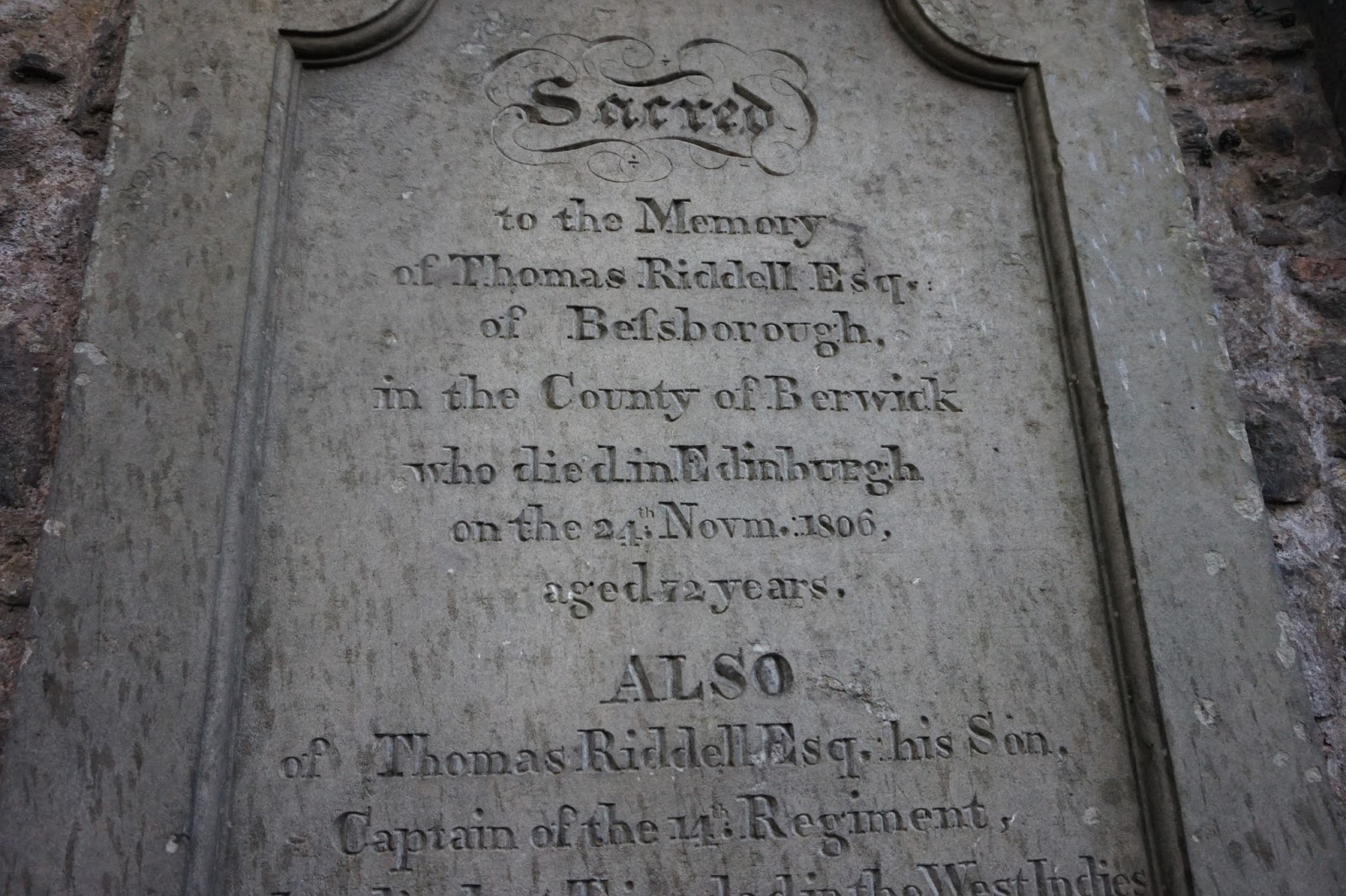
I never would have become aware of the following had I not crashed that conversation.  Below is the tombstone of Tom Riddle, whose namesake now is Lord Voldemort.  I wonder what this gentleman who died in 1806 would make of that!


Thomas Riddle's Stone is certainly much simpler than what is seen in the Harry Potter movies, but if you combine this name with some of the stones posted earlier, the puzzle pieces of inspiration seem to fit.


We also have a McGonagall whose stone is diagonally opposite that of Riddle in the Flodden Wall enclosed area of the cemetery.


Looking over the wall of the cemetery near the McGonagall grave is George Heriot's School, which is rumored to have inspired Hogwarts.


The name Potter also appears on a stone here and as the name of a nearby street and row (Potterrow).


I certainly got more than I bargained for - thinking I was only going to zip in and find Maclaurin's stone and head out - such a wealth of interesting things here!  (I guess that's what happens when you pursue mathematics, you find lots of interesting things on the side!)


Technical Difficulties

For some reason there are issues posting pictures to my blog - so for the moment I'm just going to list today's activities and hope to start getting more images up soon!  I still need to provide an answer about Maclaurin and Voldemort!  It's only day 4, and I'm falling behind!

 - figured out the bus system (a first for me!), and my feet were very, very happy with me after all the walking I did the last few days!

 - went to University of Edinburgh, King's Buildings Campus for a maths (as they say here) colloquium - it was for a "general audience" and was on "The Asymptotics of the Gamma Function via Resurgence" - oh yeah baby!

 - headed to Napier University Edinburgh, Merchiston Campus to see the tower that remains of Napier's castle

 - headed to George Heriot school (which I'm learning by keeping my ears open may have been the inspiration for Hogwarts School of Witchcraft and Wizardry)

 - walked past Greyfriar's again and on to The Elephant House Restaurant (aka the birthplace of Harry Potter, as JK Rowling did her early writing here overlooking Greyfriar's Kirkyard and Edinburgh Castle)

 - decided to have lunch at The Elephant House - sat in the backroom where Rowling did her writing
 - Perused Alexander Nasmyth landscapes in the National Gallery (he taught painting to future mathematician Mary Somerville, and it was from him that she learned of Euclid's Elements and the impact on perspective)

 - headed to St. Cuthbert's Church were mathematician John Napier worshiped and served as an elder (yet another huge kirkyard in which I was trying to find a single stone - need to check, but I'm thinking he was memorialized inside the kirk, which was closed when I got there - actual burial at St. Giles', I believe)

 - sought out and found the birthplace of mathematical physicist James Clerk Maxwell at 14 India Street

 - found the Royal Society of Edinburgh (founded by mathematician Colin Maclaurin) at 22-24 George Street

 - serendipitously found a statue of JCM at the end of George Street as I wound my way back towards my hotel  (and the talk this morning was held in the James Clerk Maxwell Building of the university, so it's been a JCM kind of day :-)

PICTURES SOON, I HOPE!!!

Wednesday, March 30, 2016

Edinburgh

When first planning these mathematical travels I had only planned a couple of days for Edinburgh.  My interest was in John Napier, a very interesting character who also invented logarithms and is responsible for popularizing the use of the decimal point.  After seeing Merchiston Tower, which is all that remains of his castle in Edinburgh and is now part of Edinburgh Napier University, and after touring Lauriston Castle, home of his brother, I was going to be on my way to my myriad of mathematical stops in England.

However, as I began to look into Edinburgh I became aware of more and more mathematicians and mathematical physicists of note who were associated in some way with Edinburgh.  Along with Napier, these are:

Girolamo Cardano
Colin MacLaurin
John Playfair
Mary Somerville
William Thompson, Lord Kelvin
James Clerk Maxwell
Peter Guthrie Tait

and, currently, Sir Michael Atiyah, geometer and Fields Medal winner.

Clearly my Edinburgh sojourn needed to be extended, and I ended up reserving six days in Edinburgh rather than the two I had initially planned.  Even at that I need to focus on two or three and just touch on the others.  In this post I am sharing landmarks that all of these mathematicians would have been familiar with - that's not to say that some changes may not have been made to certain places such as Edinburgh Castle and Holyrood Palace between the time of Napier (b. 1550) and Atiyah (b. 1929).

EDINBURGH CASTLE


HOLYROOD PALACE


HOLYROOD PARK AND ARTHUR'S SEAT


St. Anthony's Chapel ruins in Holyrood Park - partway up to Arthur's Seat
Overlooking the city from near the top of Arthur's Seat
ST. GILES' CATHEDRAL


EDINBURGH UNIVERSITY

Main Campus

"New College" Campus - now a divinity school

"New College" Campus
"New College" Campus (with John Knox)
THE FIRTH OF FORTH

I haven't gotten close yet, but here it is from a bit below Arthur's Seat
CALTON HILL (with or without observatory and various monuments)

Observatory and Playfair Monument

Edinburgh - the Athens of the North

Viewing across Old Calton Burial Ground

Top left - looking over Holyrood Palace