Showing posts with label Klein. Show all posts

Saturday, April 25, 2026

Memory Keeper

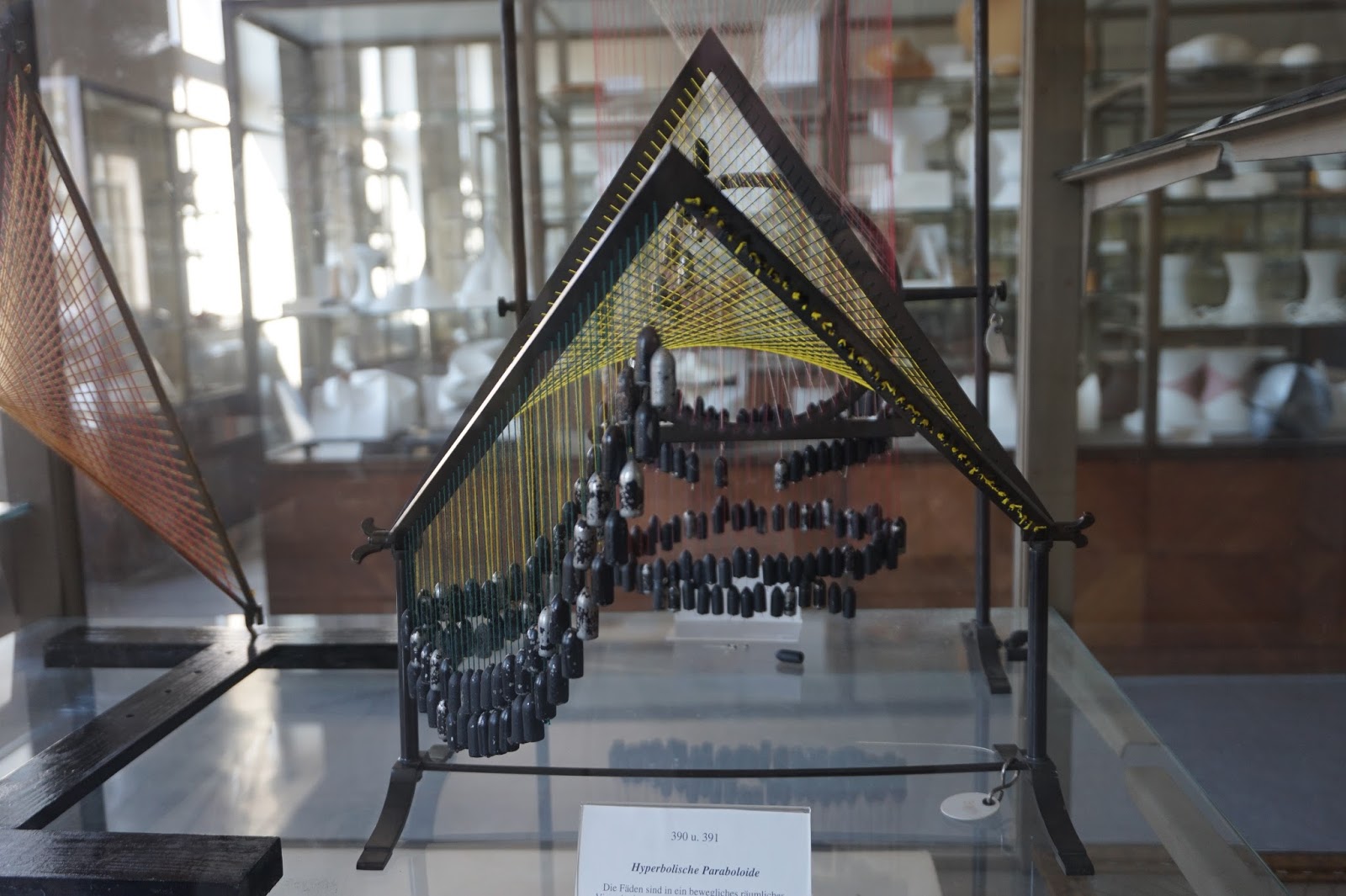
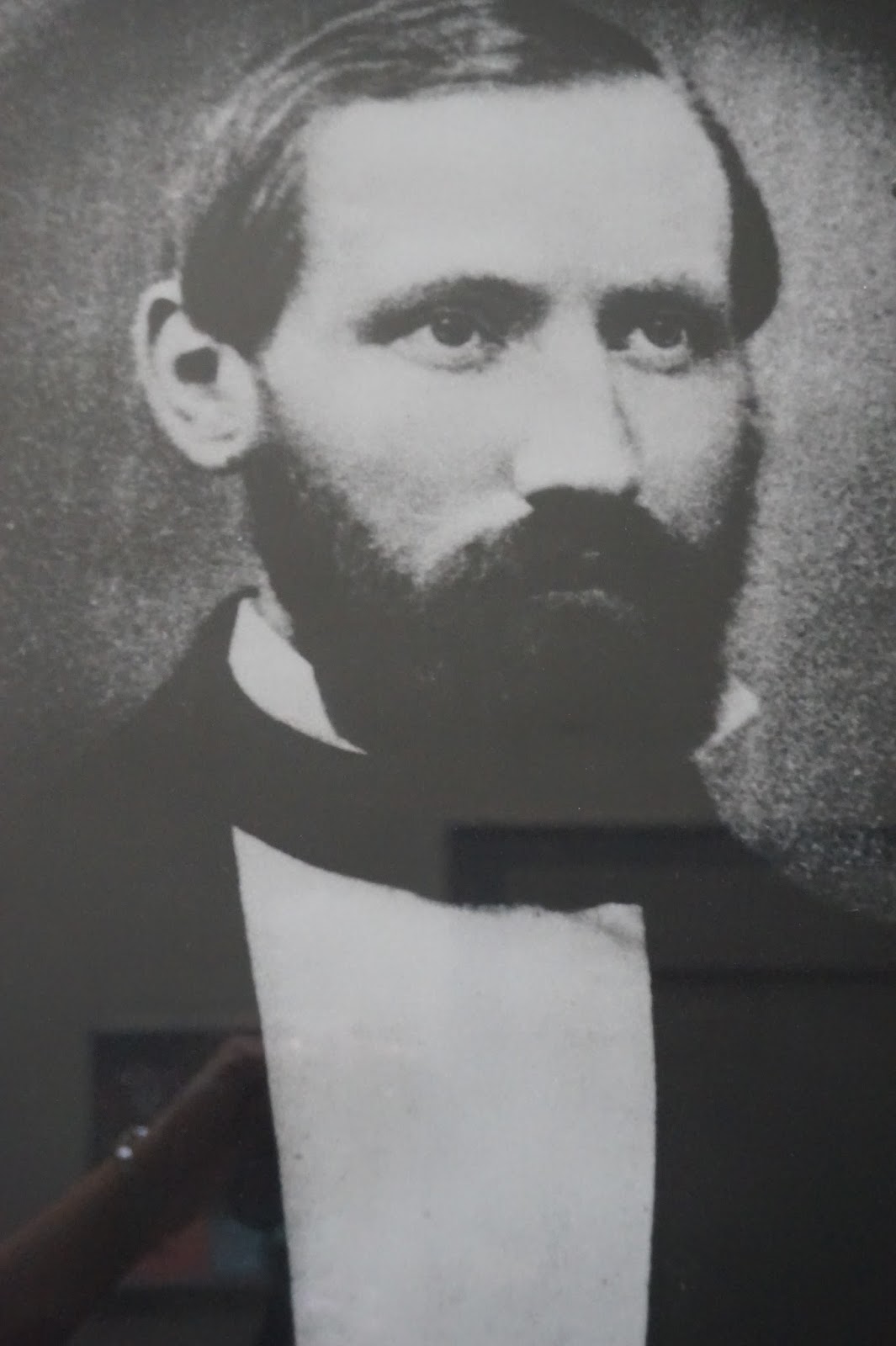
Felix Klein was borh April 25, 1849, and in honor of his birth I am posting about something Constance Reid referred to as "almost his signature" - the Göttingen Collection of Mathematical Models. This is the largest collection of mathematical models in Germany and has items going back as far as the 1780s. It was established and curated by Felix Klein.


In Klein's time, the center for mathematical life at the University of Göttingen was the third floor of the Auditorienhaus (pictured above), and it was in a corridor here that the collection was first housed. Klein had a vision for the math department to have its own institute, and this eventually came to pass. Gottingen's Mathematical Institute, the Mathematisches Institut, (pictured below) opened in 1929. Sadly, this happened four years after Klein's death.

Gottingen's Collection of Mathematical Models, no longer relegated to a corridor, has a spacious area dedicated to it in the Institute. This is the largest collection of historical mathematical models in Germany, comprishing about 540 exhibits in 63 showcases.

The items in the collection date from as far back as 1780 to as recent as video images of fractal objects. The objects from 1780 include a stellated polyhedra that belonged to Abraham Kästner - the doctoral advisor of the doctoral advisor of Carl Freidrich Gauss.


A modern visitor noticed that - ironically - the collection did not contain a Klein bottle (Kleinsche Flasche). They later donated one.
I had already put up a post about the Göttingen Collection of Mathematical Models back in 2016 when I visited, but I felt it deserved a revisit today in honor of its founder Felix Klein. So on this day, April 25, let's raise a bottle - though perhaps one topologically different from his namesake - to this great mathematician and memory keeper.

Tuesday, June 21, 2016

More Mathematicians & Miscellaneous Math Stuff

During my travels I gathered information and took pictures of anything and everything I came across that was related to mathematics, mathematicians and the history of mathematics. Most of these images found their way into full-length posts on the many individual mathematicians I've written about, but in some instances I don't have enough material to support a full post on a specific topic or person.  I don't want these extra images and visits to go unused, however, so in this post I present additional images relating to mathematicians, the history of mathematics and mathematical objects, hoping that my students may find them to be interesting and to be helpful resources - and that others might simply enjoy the images taken of places and objects in the USA, the UK, France and Germany.

Rene Descartes

The great Rene Descartes (1596-1650) - a towering figure in philosophy as well as in mathematics - is one of the mathematicians for whom I was not able to get to a large number of relevant sites.  I did get to visit the church where he is buried, St. Germain de Pres in Paris, and I also happened across a Parisian University named for him.

The picture heading this post, and the next eight pictures are of the Abbey of St. Germain de Pres; the original church at this site was conceived in 512 AD and completed and dedicated in 558 AD, making it the oldest church in Paris.  It's bell tower is one of the oldest in all of France.  Descartes' tomb is located in one of the side chapels near the altar; sadly, I could not view the actual tomb because significant construction is currently taking place at the eastern end of the church.
The following two pictures are of the University of Rene Descartes in Paris.

Henri Poincare

Henri Poincare (1854-1912) was the most prominent French mathematician of his time.  Along with David Hilbert (1862-1943) he was one of the two most prominent mathematicians in Europe of the time.  I was thankful that Montparnasse Cemetery in Paris included Henri Poincare on their map of celebrities buried here.  During my travels it was the case that finding the graves of mathematicians was rather a hit or miss proposition and quite the treasure hunt in most cases - sometimes successful, sometimes not.

W. W. Rouse Ball

Walter William Rouse Ball (1850-1925) entered Trinity College, Cambridge in 1874, earned the spot of Second Wrangler in the Tripos, became a fellow of Trinity in 1875 and remained one the rest of his life.  In 1927 he established chairs at both Cambridge and Oxford.  Among those who have held the Rouse Ball Professorship of Mathematics are J. E. Littlewood and Abram Besicovitch (both at Cambridge) and Sir Roger Penrose (at Oxford).  Plaques commemorating Rouse Ball, Littlewood and Besicovitch can be seen in the chapel of Trinity College Cambridge.  Penrose is currently Emeritus Rouse Ball Professor of Mathematics at Oxford, and his famous tiles can be seen outside Oxford's Mathematical Institute.
When I expressed surprise to the professor hosting me at Cambridge at finding the name of Besicovitch here (I knew he was from eastern Europe), he replied, "Oh, yes, Besi was here!"
Penrose Tiling outside Oxford's Institute of Mathematics

Sir Isaac Barrow

Sir Isaac Barrow (1630-1677) held the Lucasian Chair of Mathematics  just prior to Sir Isaac Newton (1642-1726).  This professorship was founded in 1663 by Henry Lucas and was recently held by famed physicist Stephen Hawking from 1979 to 2009.  

Isaac Barrow resigned the chair in 1669 and was appointed chaplain to King Charles II in 1670.  Three years later, Charles II appointed Barrow to the Mastership of Trinity College, Cambridge, stating that he was the best scholar in England.  He is buried in Westminster Abbey and memorialized with a statue in the chapel at Trinity College, Cambridge.  

I'd always heard that it was Barrow who came up with the Fundamental Theorem of Calculus (before Newton) and that he was Newton's teacher, but during my time in Cambridge I learned in no uncertain terms that this was not the case and that Barrow was nowhere near existing in the same intellectual universe as Newton.  I have that on good authority!  That said, he clearly made contributions and was recognized for those contributions by the king at the time and is worthy of remembrance - as we see in Trinity College and at Westminster Abbey.
Sir Isaac Barrow - Chapel of Trinity College, Cambridge
Westminster Abbey, London - burial place of Sir Isaac Barrow


Mathematical Shapes and Objects

As well as taking pictures of places and things related to specific mathematicians I always had my eyes open for mathematical objects wherever they might be.  The first two pictures are of a sculpture in the grounds of Holyrood Palace, Edinburgh, Scotland.  I think it's pretty cool that the monarch has an icosahedron in her garden.  The pictures following those are of labyrinths whose locations are given in the photo captions.


Location - London Tube Station
Location - Paris - on the bank of the Seine
Location - Paris - on the bank of the Siene
Seattle - near the Space Needle - taken at the JMM Conference before I left for the European part of my sabbatical
In London, after visiting the Royal Society I was walking back toward Westminster Pier along the east side of St. James's Park.  As I was looking across toward Buckingham Palace, a conversation caught my attention.  Someone in a group of people approached another group and asked, "What do you call a seven-sided shape?"  Discussion ensued regarding "heptagon" vs. "septagon."  It caught my attention because this is something I talk about in certain classes I teach, but I'd never heard such a conversation just out and about before.  I thought, "Why on earth are people who are just walking down the street conversing about names of polygons?"  

It struck me later in the day that this must have had to do with British currency, for which, though most coins are circular, two of them are seven-sided polygons.


Friday, May 6, 2016

Mathematical Gottingen

Mobius strip sculpture in front of Gottingen Observatory - once home to Gauss and then Dirichlet and then Riemann

Where to begin?!

Gottingen is absolutely bursting with mathematical history.  As I mentioned in my other post on Gottingen, it included the likes of Gauss, Dirichlet, Riemann, Clebsch, Klein, Hilbert, Minkowski, Noether, and Mobius.  It was THE most important place for mathematics in the world from the time of Hilbert and Klein in the last decades of the 1800s until just before 1933 (Hitler's advent as Chancelor of Germany - at which point he got rid of the Jews and the women from Gottingen University, so there was pretty much no one left to do mathematics).

Today (Friday, May 6, 2016) I had opportunity to meet with a professor from Gottingen,  Dr. Samuel James Patterson, to whom I am profoundly grateful for his having shown me around the Mathematisches Institut and its Collection of Mathematical Models and Instruments, of which he was previously curator.  I'm also grateful for all that he shared with me in conversation regarding the personalities of the famous mathematicians of Gottingen, the history of mathematics and physics in Gottingen, the history of the university and institute there, and for directing me toward points of interest that hadn't shown up in my research before I arrived.
Dr. Samuel James Patterson of the University of Gottingen
Mathematics Institute, Gottingen - from the front - the top of the "T" (Bunsenstrasse 3-5)
Mathematics Institute, Gottingen from the back
Aside - physicists as well as mathematicians were active in this building, and it was in this area out back where, through the conversations of these physicists, that quantum mechanics was born, so I felt it quite a stunning privilege to be here for multiple reasons!
Another view from the back - bottom of the "T"
The Collection of Mathematical Models and Instruments, which is housed on the second floor of the Mathematisches Institut, displays wonderfully the history of mathematical activity in Gottingen.  It stretches back to paper models of polyhedra and other mathematical shapes hand-made by Gauss's teacher in 1780 (paper being made differently then than now!) - continues through models made by Felix Klein (1849-1925) and into the mechanical calculator era - and all the way up to the present with a fractal clock and a screen showing computer-generated models!  A small sampling is given in the pictures below - beginning with the paper models of 1780.


The famous Mobius Strip
The next two images are of models that Klein himself made in order to visualize what he was studying.  These two images are followed by a video of a screen display on the wall here of these types of objects as they can be studied through today's technology.

The next two images are of Klein bottles - objects with interesting topological properties.  These do not date back to Klein but were donated to the collection somewhat recently by someone who noticed they did have a Klein bottle, which seemed to them a travesty!  

And let's just continue with a few more samples that I can't resist posting:
A Riemann Surface
Calculating Devices
This piece of the collection reminds me of my office!
The collection was begun by Felix Klein prior to the construction of the Mathematical Institute Building.  At that time it could be found in a corridor on the third floor of the Auditorienhaus, the center of mathematical activity at Gottingen at the time, where the famous mathematical library, the Lesezimmer, had been founded by Klein as well.  For more information and more pictures, see my post on David Hilbert.
Gottingen University Auditorienhaus
Back to the Mathematics Institute, there are pictures of famous Gottingen mathematicians lining the halls - 
Carl Friedrich Causs
Felix Klein

Bernhard Riemann
David Hilbert
Hermann Minkowski
Emmy Noether
 - as well as interesting posters outside offices of professors.
Do you know the story behind this?  Hint: it's located above a door.
As well as the Auditorienhaus and the Mathematisches Institut, another building in Gottingen associated with mathematics and mathematicians is the observatory.  It was home (successively) to Gauss, Dirichlet and Riemann. Each would have lived in rooms on the left as you face the front (the west side).

Observatory from the back (facing south)
Inside the back courtyard - facing southeast
Wing of the observatory where the living quarters would have been (west)
There were places relating to the history of mathematics wherever I looked in Gottingen.  The two images below are of the Gänseliesel, or "Little Goose Girl" fountain, which stands in front of the Rathaus (medieval town hall). It is a tradition of Gottingen University students to kiss her upon graduating with a Ph.D.
I found in my time in Gottingen that the mathematicians and physicists of the town are both highly honored and also taken a bit for granted.  Many Gottingen streets are named after mathematicians and physicists.  Homes where famous mathematicians lived bear plaques identifying them.  Other buildings also bear plaques in honor of mathematicians.  There are also statues and busts of famous mathematicians and physicists.  (Some of the pictures following, as well as others in the post, are repeated in other posts, but I want this to be complete, so I am including them more than once.  See posts on Hilbert and Gauss for more such pictures.)

Here are some examples of these items:
Home of Hermann Minkowski - colleague and best friend of David Hilbert
On the front of the Mathematics Institute
Yet for all the honor, they are also to some degree an everyday fact of life here.  First we see the bust of David Hilbert in the Mathematics Institute, as adorned by students studying nearby.  Then we see Gauss's grave, which I approached on pilgrimage, as if it were Mecca, and then found myself having to process the fact that people were picnicking in front of it!  I wish I could remember how Dr. Patterson put it exactly when I bemoaned this state of affairs to him - something along the lines of, "We always have Gauss with us."
Dr. Patterson explained to me that where Gauss is buried, which was once the Albani Cemetery is now part of a city park, Cheltenham-Park.  It is no longer used as a cemetery, and only the most prominent stone were left.

As you can imagine the town cemeteries are filled with famous mathematicians of the past.  Alfred Clebsh is buried in a small cemetery just north of the town center, not far from the Auditorienhaus.
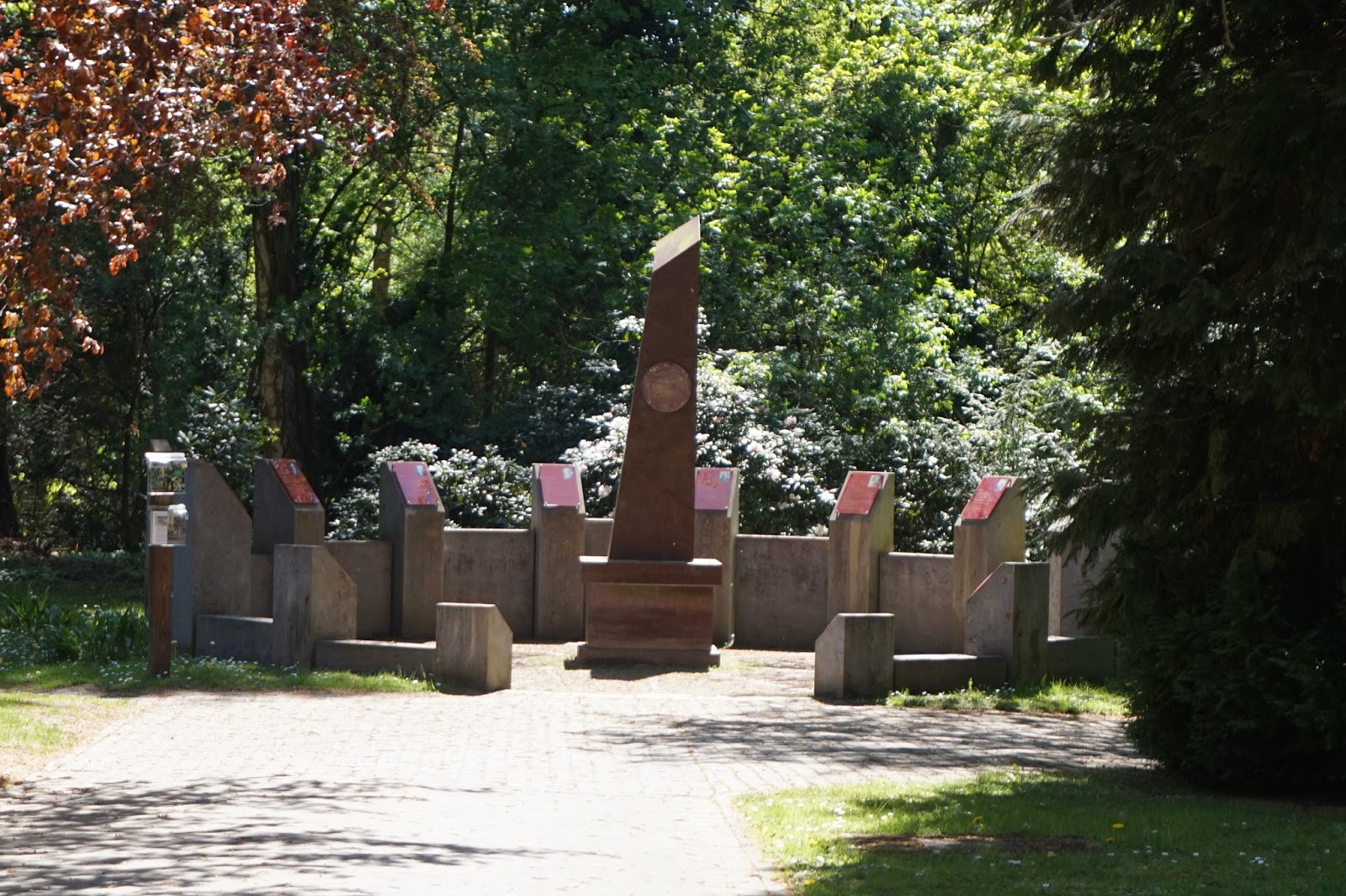
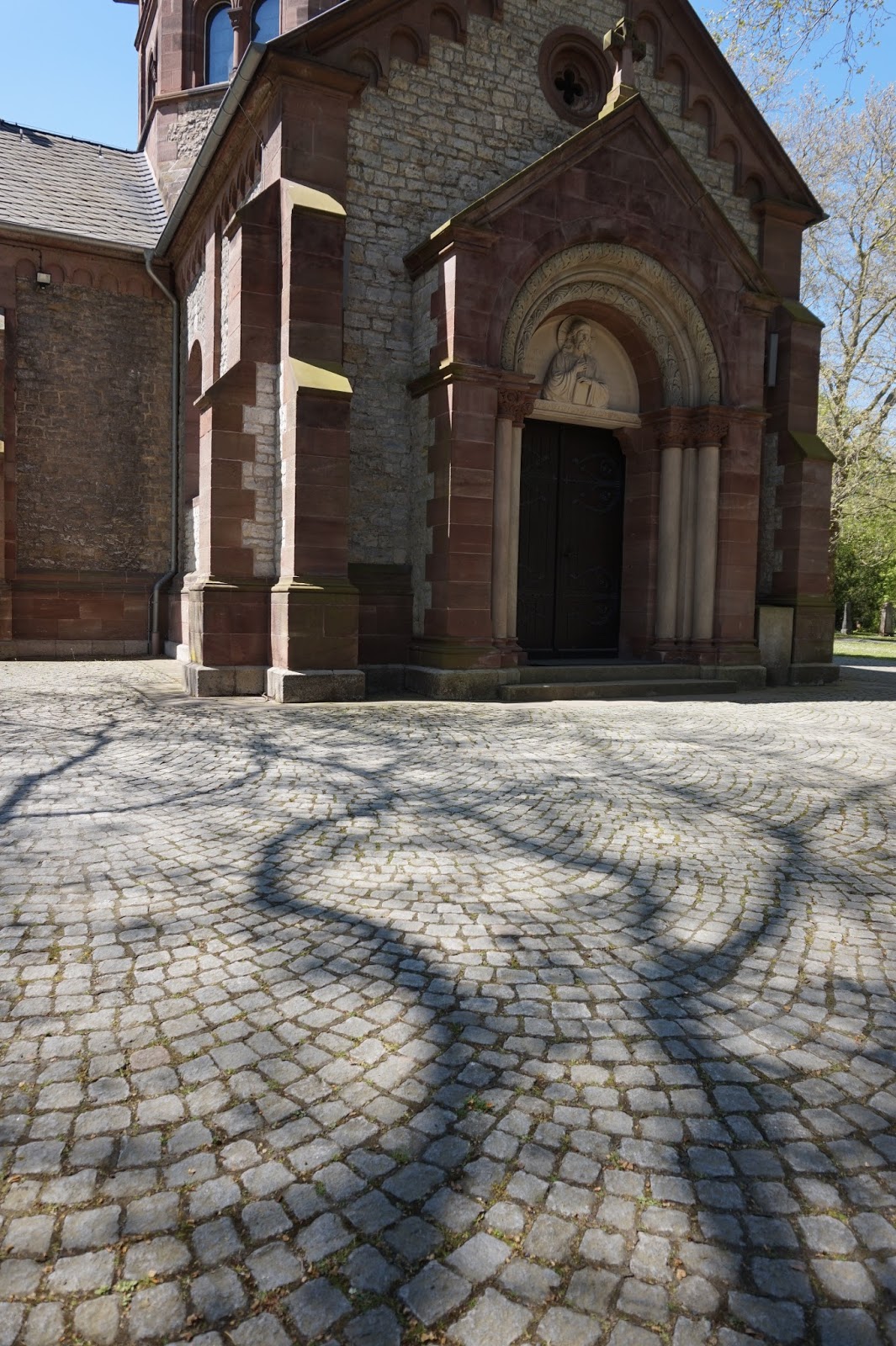
And then there is the Stadtfriedhof or "city cemetery" just west of the town center, which contains the graves of many mathematicians and physicists and also contains a "Nobel Circle," an area honoring all the Nobel Prize winners associated with Gottingen.
If you know of a cemetery with more famous mathematicians, physicists and Nobel Prize winners, please let me know, because I'd love to visit it.  Here is the monument to the nobelists, the "Nobel Rondell":
I spent a lot of time in cemeteries during my travels - Greyfriars Kirkyard in Scotland, Highgate in London, Pere Lachaise in Paris, and many others - all were strikingly beautiful and profoundly interesting, but I found this one to be by far the most calming and peaceful to visit.


The "Nobel Rondell" is near this pond, and many of the nobelists are buried in this area.