Wednesday, March 30, 2016

Belated Penrose Post

Well, I'm "cheating" a little bit on this one. Though the post says I put it up in March of 2016, I'm actually posting this on January 22, 2018. Two months ago, the opportunity came up to revisit the amazing city of Edinburgh.

Even though I was there "just for fun" this time, I couldn't help but look into some of the things related to math that I had missed initially.  One mathematician I'm quite interested in is Roger Penrose whose "impossible shapes" made it into the movie Inception.

Penrose's mathematical work takes inspiration from many places, including the world of art.  He collaborated with artist M. C. Escher, and he had an uncle who was an artist and a collector of surrealist art.  This uncle was Roland Penrose, and his collection is housed at "Modern Two" in Edinburgh.  The rest of this blog consists of photographs I took in the Roland Penrose Gallery of "Modern Two."  They may give a sense of one influence in the life of mathematician Roger Penrose.


Maternity by Miro
Never Again by Tanguy
Magritte
The Black Flag by Magritte
Untitled by Roland Penrose
The Joy of Living by Ernst
Hat in Hand, Hat on Head by Ernst
Roland Penrose

Edinburgh

When first planning these mathematical travels I had only planned a couple of days for Edinburgh.  My interest was in John Napier, a very interesting character who also invented logarithms and is responsible for popularizing the use of the decimal point.  After seeing Merchiston Tower, which is all that remains of his castle in Edinburgh and is now part of Edinburgh Napier University, and after touring Lauriston Castle, home of his brother, I was going to be on my way to my myriad of mathematical stops in England.

However, as I began to look into Edinburgh I became aware of more and more mathematicians and mathematical physicists of note who were associated in some way with Edinburgh.  Along with Napier, these are:

Girolamo Cardano
Colin MacLaurin
John Playfair
Mary Somerville
William Thompson, Lord Kelvin
James Clerk Maxwell
Peter Guthrie Tait

and, currently, Sir Michael Atiyah, geometer and Fields Medal winner.

Clearly my Edinburgh sojourn needed to be extended, and I ended up reserving six days in Edinburgh rather than the two I had initially planned.  Even at that I need to focus on two or three and just touch on the others.  In this post I am sharing landmarks that all of these mathematicians would have been familiar with - that's not to say that some changes may not have been made to certain places such as Edinburgh Castle and Holyrood Palace between the time of Napier (b. 1550) and Atiyah (b. 1929).

EDINBURGH CASTLE


HOLYROOD PALACE


HOLYROOD PARK AND ARTHUR'S SEAT


St. Anthony's Chapel ruins in Holyrood Park - partway up to Arthur's Seat
Overlooking the city from near the top of Arthur's Seat
ST. GILES' CATHEDRAL


EDINBURGH UNIVERSITY

Main Campus

"New College" Campus - now a divinity school

"New College" Campus
"New College" Campus (with John Knox)
THE FIRTH OF FORTH

I haven't gotten close yet, but here it is from a bit below Arthur's Seat
CALTON HILL (with or without observatory and various monuments)

Observatory and Playfair Monument

Edinburgh - the Athens of the North

Viewing across Old Calton Burial Ground

Top left - looking over Holyrood Palace


Friday, March 18, 2016

Getting it in as I Count it Down

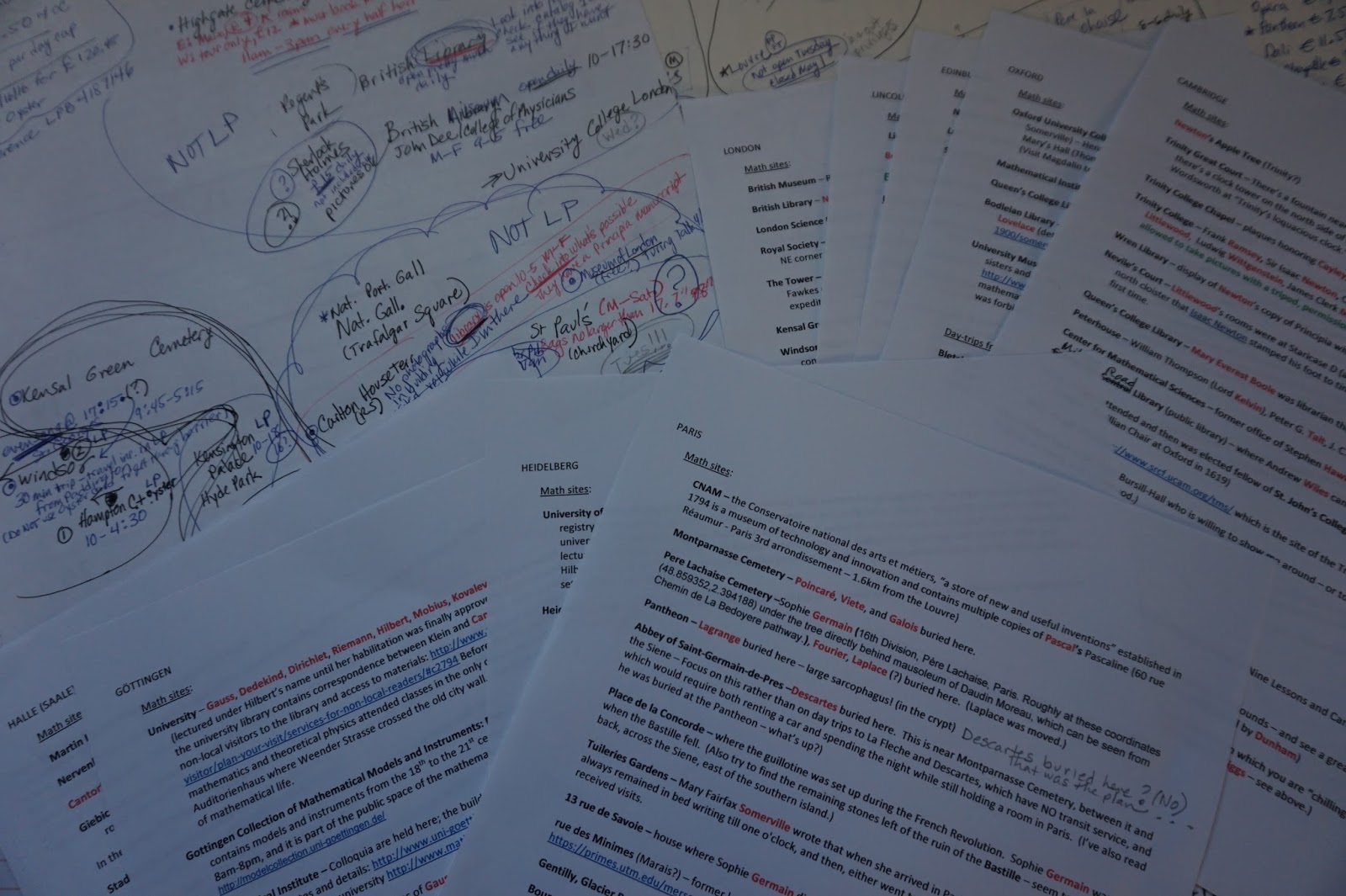
I leave for the European travel part of this math history sabbatical in just over a week, and the phrase most on my mind right now is "GETTING IN."

Can I get all of this:


In this: 
(And will this be enough to keep me going for seven weeks?!)


Can I get all of this:


In this:


Have I gotten all of this -

 - and some of this -

 - and a lot of this -


 In this:


Here are some things I have "gotten in" to for certain:

THE BODLEIAN LIBRARY - One of the things I'm most excited about at this moment is that I have "gotten in" to Oxford's Bodleian Library - one of the oldest libraries in Europe and the second largest in Britain (behind the British Library in London). And that took some doing!! To get a reader's card I needed to send a bank statement proving permanent address, a letter from human resources proving my faculty status, a copy of the picture/signature page of my passport, and an application expressing why there is need for me to access their resources. I got the news about a week ago and am still on cloud nine! I'll be reading correspondence between mathematicians Mary Fairfax Somerville (1780-1870) and Lady Ada Byron Lovelace (1815-1852).  In that era it was exceedingly rare for a woman to pursue mathematics at all (they certainly weren't allowed to attend university!), and this is the only case I know of where one female mathematician served to any degree as a mentor to another.  Ada Byron Lovelace is the daughter of the poet Lord Byron, by the way - but more on that when I visit Hucknall, England on April 6.

TRINITY COLLEGE CAMBRIDGE -  I also "got in" with some experts at Cambridge - very, very gracious - who will show me where at Trinity College the rooms of G. H. Hardy (1877-1947) and J. E. Littlewood (1885-1977) were in the early 1900s.  They've actually already done some research on this for me in advance of my arrival.  I'm particularly happy about "getting in" here for two reasons.  One reason is that Hardy and Littlewood were such prominent and interesting mathematicians and that there are wonderful stories about how they lived so close together but nearly always corresponded by messenger rather than meeting face-to-face. But the other reason I'm so excited is that the chair of the sabbatical committee gently warned me that I probably wouldn't be able to quite pull off all that I had proposed for my travels - seeing Hardy and Littlewood's former rooms being one item he doubted me on. HA! I'm doing it! Hopefully all the rest of the "getting in" goes as well!!

THE KILNS - OK - not math-related, but Lewis is my favorite author, and I'm going to be in Oxford, so how can I not try?  Many weeks after having written them I had given up on hearing back from the C. S. Lewis Society, but just this morning I found a response in my email inbox that there will be a tour on Thursday, April 14 and that I can "get in" on it!  Hurray!  (There are Lewis scholars living and working in his old home, so a tour is not a sure thing for any given visit to Oxford, and only certain areas are open to tourists.  It just happens that my timing for this venue was just right!)

Ready or not, here I come!


Sunday, February 28, 2016

Second Stop: UC Davis

I had opportunity for another pre-travel conference.  The timing couldn't have been better, and the conference couldn't have been better.  This was the Golden Section meeting of the MAA. and it was held at U.C. Davis.  The conference was on Saturday, February 27, and the UCD math department held a math festival the day before, consisting of three seminar talks.


The biggest draw for me was the fact that Persi Diaconis would be speaking at this conference.  He spoke both at the festival and at the conference.  I've known of him and his work for years and was hoping to hear him - and hoping against hope to actually meet him, and I got to! He is a brilliant, world-renowned mathematician, and yet he is so down-to-earth and kind; it was absolutely wonderful talking with him!


I also love his style of presentation - begin and end with CHOCOLATE!  The title of this talk was "Between Combinatorics and Chocolate," but it was more like "Combinatorics between Chocolate and Chocolate!" :-)


This was my first time on the UC Davis campus.  Given how well-known the campus and the whole city is for biking, I found the decor on student housing to be quite clever and appropriate.


Partway through the second day of talks there was time to enjoy mathematical art.


I was drawn to the painting below because it's obviously a Magritte homage - Magritte being my favorite artist.  Once I got near it I overheard the artist, Lidia Luquet, pointing out to another viewer that the apple was partly eaten, and I was immediately brought to the point of tears by the instant connection to the tragic prosecution, persecution and suicide of Alan Turing.


A closer look at the floorboards reveals not wood grain but information about the criminal ammendment (on the books from 1885 to 1967) under which he was prosecuted (Oscar Wilde having been the first person prosecuted under this ammendment).  This was on the right-hand side of the painting, the dark side away from the window.  On the floorboards on the left, in the light, are his mathematical works, including his WWII work on the Enigma Code.


Persi's talk at the conference: Carries, Group Theory, and Additive Combinatorics.


There was a wonderful selection of topics - combinatorics, topology, randomness, analysis, graph theory, group theory, etc.  Here is a sampling:


(Bob, the above two slides are for you, since you want to know about tensors!)


The above is what I'm always telling my students: "Make it Simpler!"  "State and Solve a Simpler Problem!"


There were lovely applications in the talk that the slide above was from - "Randomness and Order in Random Order" by Janko Gravener of UCD.

My sabbatical is focused on the history of mathematics from the Renaissance to the present, and this was definitely the present!  I learned about many open problems in each of these fields.  The freedom this sabbatical is affording me to read, to research, to attend conferences, to plan for travel, and, eventually, to travel is allowing me to learn so much and to be so inspired.  It was eye-opening to be at the conference having done all the reading I've done recently - especially with regard to the rise of modern algebra - and then to attend such interesting talks involving modern algebra (a topic I hadn't had opportunity to engage in for about 30 years!).  It was also striking to hear names, used in theorems, of people whose lives I have been reading about - Dirichlet, Cauchy, Hilbert, etc.  Their names are used as if they are still here - a colleague just down the hall.  "This is Dirichlet."  "This is, of course, Cauchy-Schwarz." "This part is Hilbert."  They absolutely live on in their work.